


Neighborhood food environment and walkability predict obesity in New York City
- PMID: 19337520
- PMCID: PMC2661915
- DOI: 10.1289/ehp.11590
Neighborhood food environment and walkability predict obesity in New York City
Abstract
Background: Differences in the neighborhood food environment may contribute to disparities in obesity.
Objectives: The purpose of this study was to examine the association of neighborhood food environments with body mass index (BMI) and obesity after control for neighborhood walkability.
Methods: This study employed a cross-sectional, multilevel analysis of BMI and obesity among 13,102 adult residents of New York City. We constructed measures of the food environment and walkability for the neighborhood, defined as a half-mile buffer around the study subject's home address.
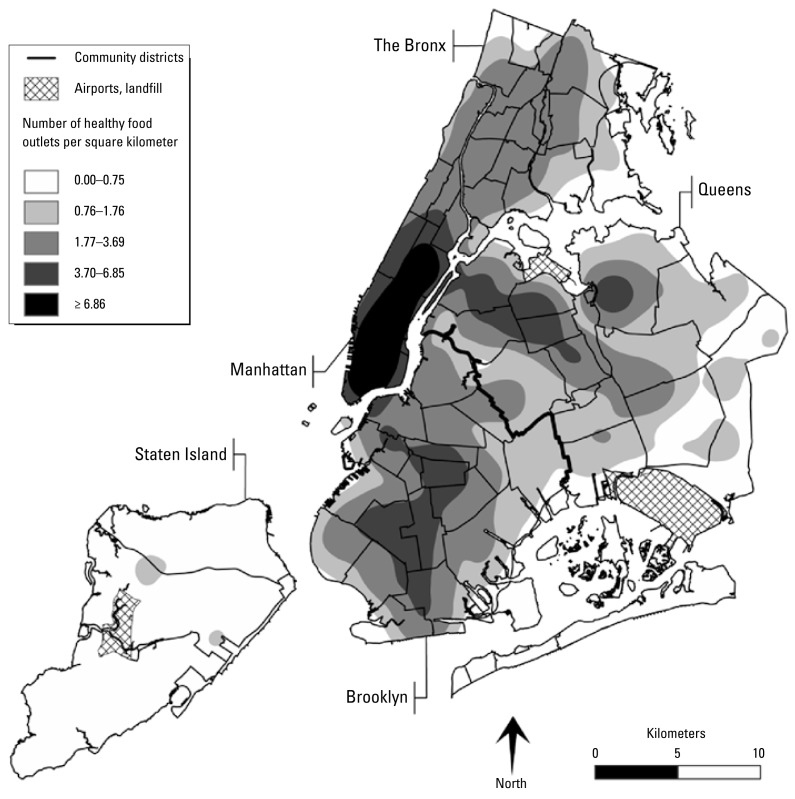
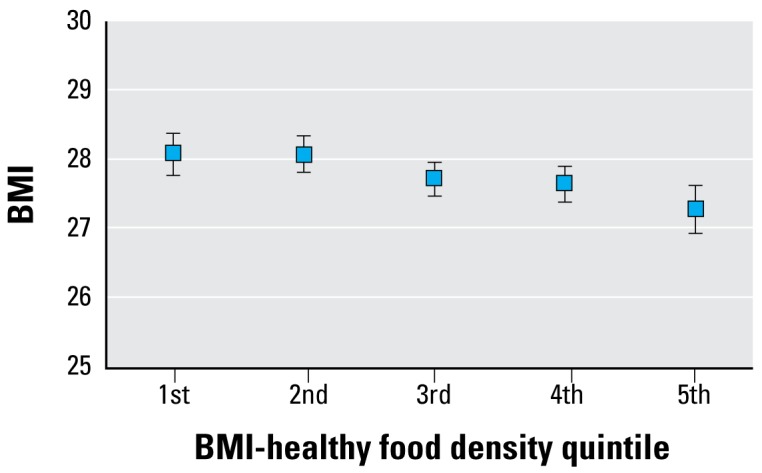
Results: Density of BMI-healthy food outlets (supermarkets, fruit and vegetable markets, and natural food stores) was inversely associated with BMI. Mean adjusted BMI was similar in the first two quintiles of healthy food density (0 and 1.13 stores/km2, respectively), but declined across the three higher quintiles and was 0.80 units lower [95% confidence interval (CI), 0.27-1.32] in the fifth quintile (10.98 stores/km2) than in the first. The prevalence ratio for obesity comparing the fifth quintile of healthy food density with the lowest two quintiles combined was 0.87 (95% CI, 0.78-0.97). These associations remained after control for two neighborhood walkability measures, population density and land-use mix. The prevalence ratio for obesity for the fourth versus first quartile of population density was 0.84 (95% CI, 0.73-0.96) and for land-use mix was 0.91 (95% CI, 0.86-0.97). Increasing density of food outlets categorized as BMI-unhealthy was not significantly associated with BMI or obesity.
Conclusions: Access to BMI-healthy food stores is associated with lower BMI and lower prevalence of obesity.
Keywords: neighborhood studies; obesity; retail food environment; walkability.
Figures
References
-
- Abdollah T. A strict order for fast food. Los Angeles Times (Los Angeles, CA) 2007 Sep 10;:A-1.
-
- Agrawal AW, Schlossberg M, Irvin K. How far, by which route and why? A spatial analysis of pedestrian preference. Environ Behav. 2008;13(1):81–98.
-
- Befort C, Kaur H, Nollen N, Sullivan DK, Nazir N, Choi WS, et al. Fruit, vegetable, and fat intake among non-Hispanic black and non-Hispanic white adolescents: associations with home availability and food consumption settings. J Am Diet Assoc. 2006;106(3):367–373. - PubMed
-
- Bowman SA, Vinyard BT. Fast food consumption of US adults: impact on energy and nutrient intakes and overweight status. J Am Coll Nutr. 2004;23(2):163–168. - PubMed
-
- Burdette HL, Whitaker RC. Neighborhood playgrounds, fast food restaurants, and crime: relationships to overweight in low-income preschool children. Prev Med. 2004;38(1):57–63. - PubMed
Publication types
MeSH terms
Grants and funding
LinkOut - more resources
Full Text Sources
Medical