


Development of Visual Selection in 3- to 9-Month-Olds: Evidence From Saccades to Previously Ignored Locations
- PMID: 19337575
- PMCID: PMC2662615
- DOI: 10.1080/15250000802459060
Development of Visual Selection in 3- to 9-Month-Olds: Evidence From Saccades to Previously Ignored Locations
Abstract
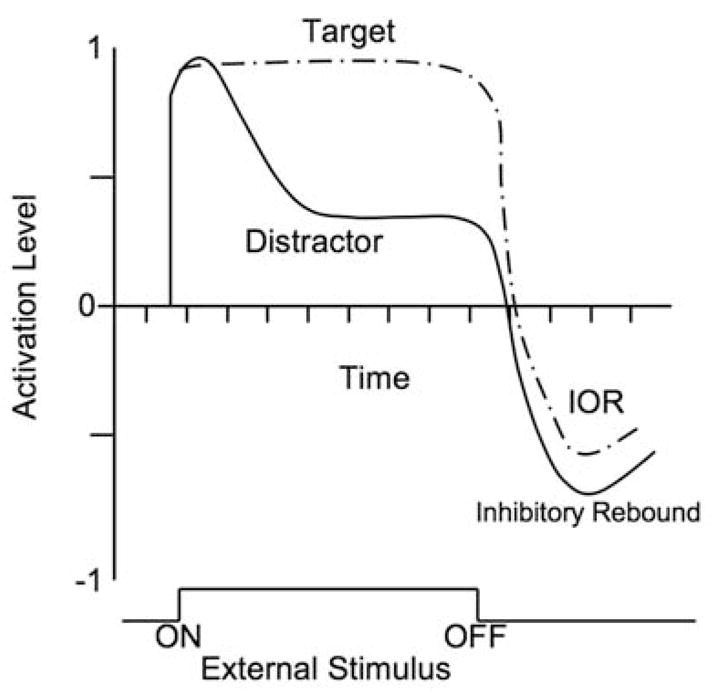
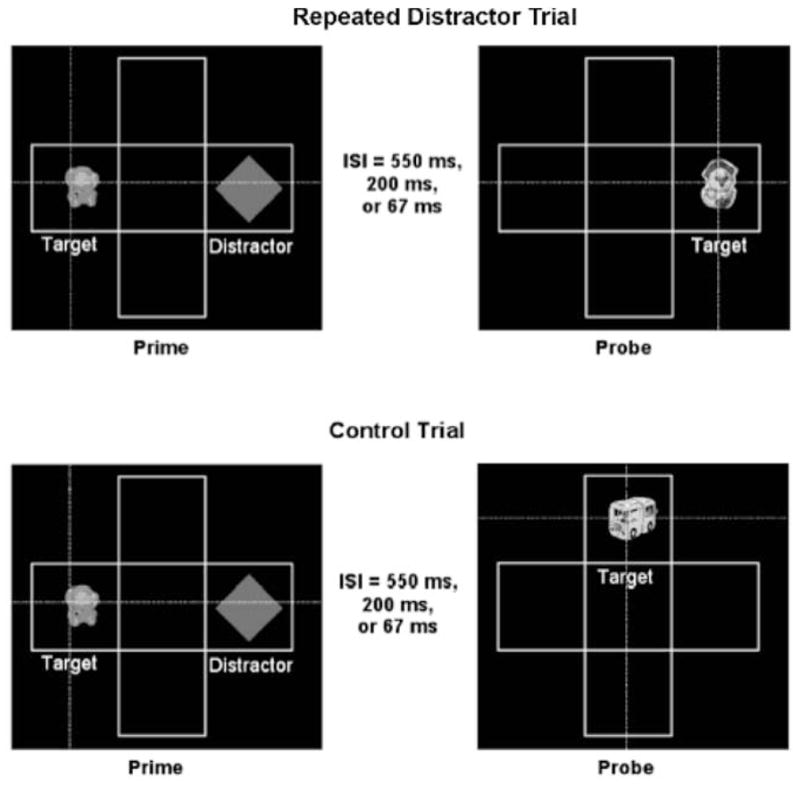
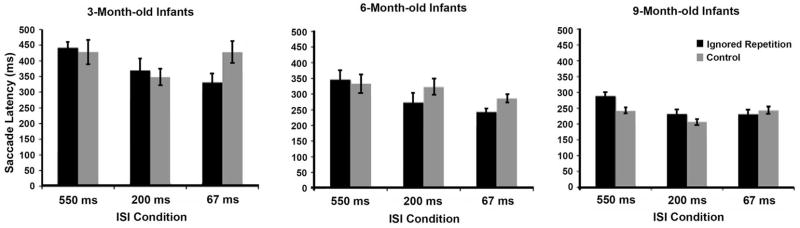
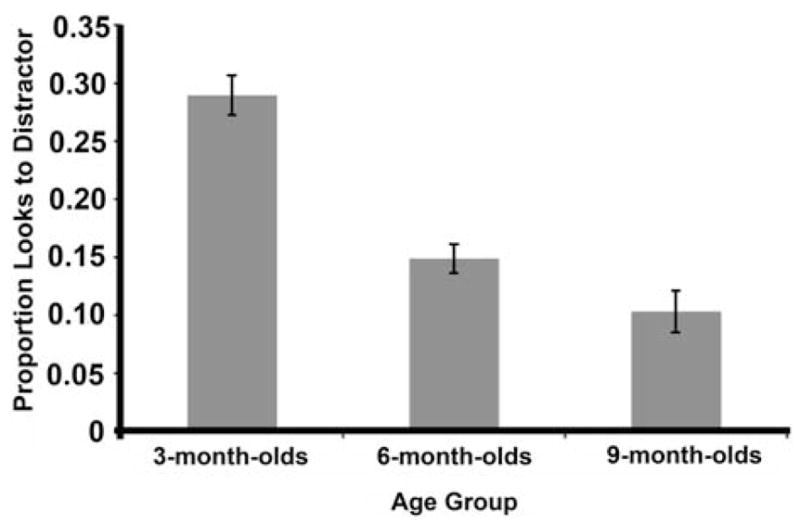
We examined changes in the efficiency of visual selection over the first postnatal year with an adapted version of a spatial negative priming paradigm. In this task, when a previously ignored location becomes the target to be selected, responses to it are impaired, providing a measure of visual selection. Oculomotor latencies to target selection were the dependent measure. Each trial consisted of a prime and a probe presentation, separated by a 67-, 200-, or 550-msec interstimulus interval (ISI), to test the efficiency of selection as a function of processing time. In the prime, the target was accompanied by a distractor item. In the probe, the target appeared either in the location formerly occupied by the distractor (repeated distractor trials) or in one of the other two locations (control trials). We tested 41 infants in each of 3 age groups (3, 6, and 9 months) on the three different ISIs. Nine-month-old infants' saccade latencies were slowed on repeated distractors relative to control trials, given sufficiently long ISIs. Saccade latencies in the youngest two age groups showed only facilitation on repeated distractor trials at short ISIs. These results suggest that visual selection efficiency is a function of the interaction of the processing limitations of a system with environmental conditions, in this case the time allotted for the selection process.
Figures
References
-
- Amso D, Johnson SP. Selection and inhibition in infancy: Evidence from the spatial negative priming paradigm. Cognition. 2005;95:B27–B36. - PubMed
-
- Amso D, Johnson SP. Learning by selection: Visual search and object perception in young infants. Developmental Psychology. 2006;42:1236–1245. - PubMed
-
- Buckholz E, Van Damme J, O’Donnell C. Positive priming: Locations containing relevant information are labeled accordingly. Human Movement Science. 1998;17:781–799.
-
- Canfield RL, Smith EG, Brezsnyak MP, Snow KL. Information processing through the first year of life: A longitudinal study using the visual expectation paradigm. Monographs of the Society for Research in Child Development. 1997;62 (2, Serial No. 250) - PubMed
-
- Crawford TJ, Hill S, Higham S. The inhibitory effect of a recent distractor. Vision Research. 2005;45:3365–3378. - PubMed
Grants and funding
LinkOut - more resources
Full Text Sources
