


The effects of sildenafil and acetazolamide on breathing efficiency and ventilatory control during hypoxic exercise
- PMID: 19337745
- PMCID: PMC2732568
- DOI: 10.1007/s00421-009-1042-5
The effects of sildenafil and acetazolamide on breathing efficiency and ventilatory control during hypoxic exercise
Abstract
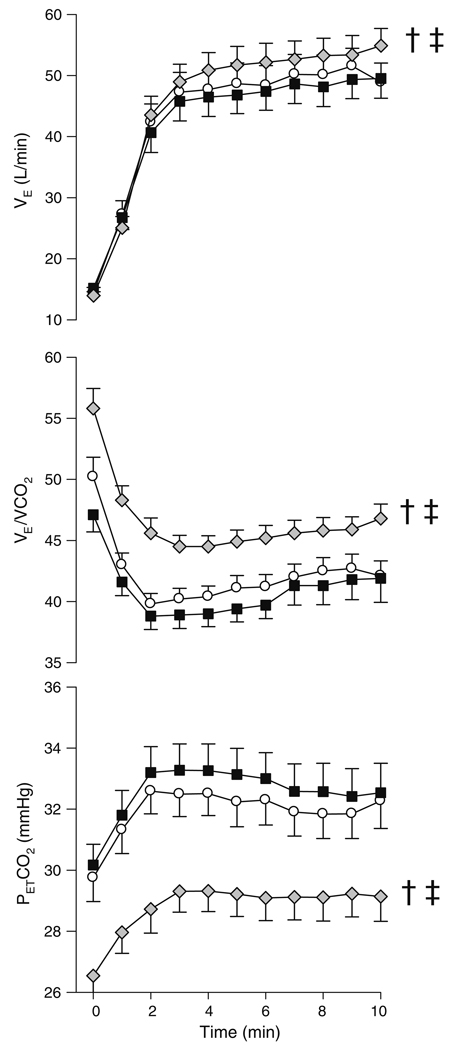
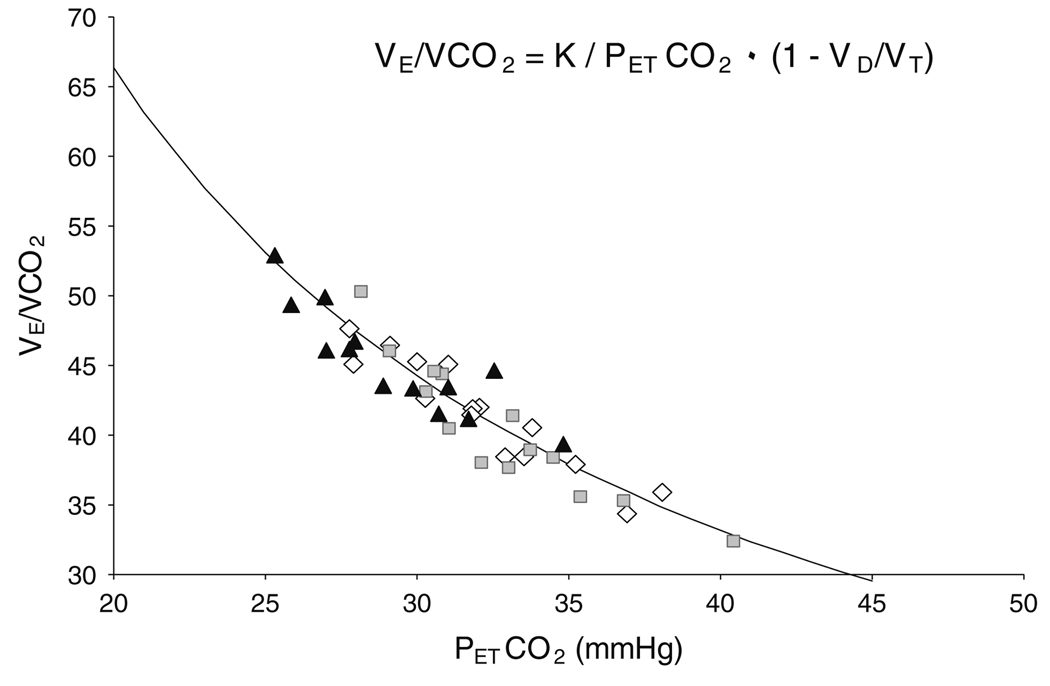
The reduced arterial oxygen tension at high altitude impairs the ability to work. Acetazolamide improves arterial oxygen saturation (SaO(2)) by increasing ventilation but is associated with an increased work and cost of breathing. Depending on the settings, sildenafil can also increases SaO(2) possibly through a reduction in pulmonary hypertension and interstitial edema, which could improve ventilation-perfusion matching. The objective of this study is to determine the effects of acetazolamide and sildenafil on ventilatory control and breathing efficiency (V(E)/VCO(2)) during submaximal steady-state hypoxic exercise in healthy individuals. Following 18 h of hypoxic exposure in an altitude tent at an oxygen concentration of 12.5% (simulated altitude of 4,300 m), 15 participants performed 10 min of hypoxic exercise on a stationary bicycle at 40% of their sea level peak oxygen uptake (VO(2)) while randomly receiving sildenafil 40 mg (SIL), acetazolamide 125 mg (ACZ) or a placebo (PLA). There was no difference in VO(2) during exercise between conditions while SaO(2) was greater with acetazolamide compared to both placebo and sildenafil. Acetazolamide increased ventilation (PLA 49.0 +/- 3.2, SIL 47.7 +/- 3.1, ACZ 52.1 +/- 3.0 l/min) and reduced end-tidal CO(2) (P(ET)CO(2)) (PLA 32.1 +/- 0.8, SIL 32.8 +/- 0.9, ACZ 29.2 +/- 0.7 mmHg) compared to placebo and sildenafil. Breathing was less efficient with acetazolamide (increased V(E)/VCO(2)) in comparison to placebo and sildenafil (PLA 41.5 +/- 1.0, SIL 40.4 +/- 1.3, ACZ 45.4 +/- 1.0) while sildenafil did not change V(E)/VCO(2) during hypoxic exercise. In conclusion, acetazolamide increased ventilation and reduced breathing efficiency while sildenafil did not affect breathing efficiency despite a trend toward a blunted ventilatory response, possibly due to a reduction in pulmonary hypertension and/or ventilatory drive, during submaximal hypoxic exercise in healthy individuals.
Conflict of interest statement
Figures

References
-
- Bocchi EA, Guimaraes G, Mocelin A, et al. Sildenafil effects on exercise, neurohormonal activation, and erectile dysfunction in congestive heart failure: a double-blind, placebo-controlled, randomized study followed by a prospective treatment for erectile dysfunction. Circulation. 2002;106:1097–1103. doi: 10.1161/01.CIR.0000027149.83473.B6. - DOI - PubMed
-
- Capen RL, Wagner WW., Jr Intrapulmonary blood flow redistribution during hypoxia increases gas exchange surface area. J Appl Physiol. 1982;52:1575–1580. - PubMed
-
- Dempsey JA, Gledhill N, Reddan WG, et al. Pulmonary adaptation to exercise: effects of exercise type and duration, chronic hypoxia and physical training. Ann NY Acad Sci. 1977;301:243–261. doi: 10.1111/j.1749-6632.1977.tb38203.x. - DOI - PubMed
-
- Faoro V, Huez S, Giltaire S, et al. Effects of acetazolamide on aerobic exercise capacity and pulmonary hemodynamics at high altitudes. J Appl Physiol. 2007a;103:1161–1165. doi: 10.1152/japplphysiol.00180.2007. - DOI - PubMed
-
- Faoro V, Lamotte M, Deboeck G, et al. Effects of sildenafil on exercise capacity in hypoxic normal subjects. High Alt Med Biol. 2007b;8:155–163. doi: 10.1089/ham.2007.1058. - DOI - PubMed
Publication types
MeSH terms
Substances
Grants and funding
LinkOut - more resources
Full Text Sources
