


Neurobiological mechanisms of placebo responses
- PMID: 19338509
- PMCID: PMC3073412
- DOI: 10.1111/j.1749-6632.2009.04424.x
Neurobiological mechanisms of placebo responses
Abstract
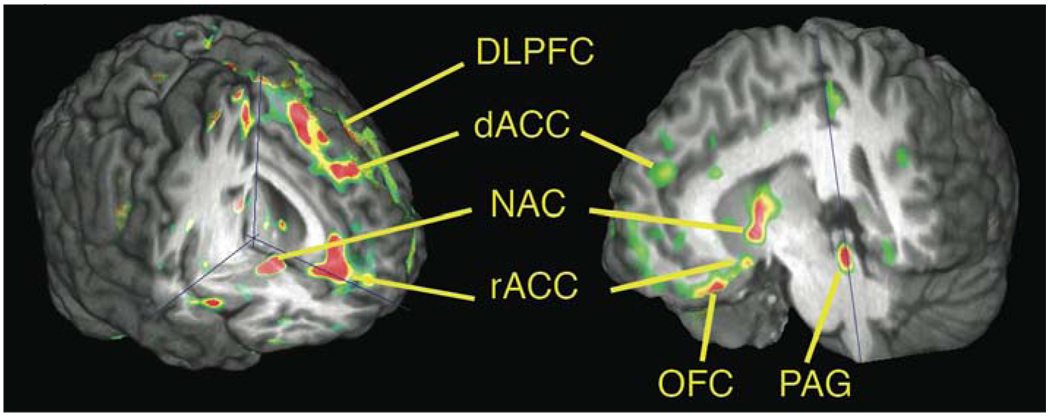
Expectations, positive or negative, are modulating factors influencing behavior. They are also thought to underlie placebo effects, potentially impacting perceptions and biological processes. We used sustained pain as a model to determine the neural mechanisms underlying placebo-induced analgesia and affective changes in healthy humans. Subjects were informed that they could receive either an active agent or an inactive compound, similar to routine clinical trials. Using PET and the mu-opioid selective radiotracer [(11)C]carfentanil we demonstrate placebo-induced activation of opioid neurotransmission in a number of brain regions. These include the rostral anterior cingulate, orbitofrontal and dorsolateral prefrontal cortex, anterior and posterior insula, nucleus accumbens, amygdala, thalamus, hypothalamus, and periaqueductal grey. Some of these regions overlap with those involved in pain and affective regulation but also motivated behavior. The activation of endogenous opioid neurotransmission was further associated with reductions in pain report and negative affective state. Additional studies with the radiotracer [(11)C]raclopride, studies labeling dopamine D2/3 receptors, also demonstrate the activation of nucleus accumbens dopamine during placebo administration under expectation of analgesia. Both dopamine and opioid neurotransmission were related to expectations of analgesia and deviations from those initial expectations. When the activity of the nucleus accumbens was probed with fMRI using a monetary reward expectation paradigm, its activation was correlated with both dopamine, opioid responses to placebo in this region and the formation of placebo analgesia. These data confirm that specific neural circuits and neurotransmitter systems respond to the expectation of benefit during placebo administration, inducing measurable physiological changes.
Figures
References
-
- Ader R. The role of conditioining in pharmacotherapy. In: Harrington A, editor. The placebo effect: an interdisciplinary exploration. Cambridge, MA: Harvard UP; 1997. pp. 138–165.
-
- Amanzio M, Pollo A, Maggi G, Benedetti F. Response variability to analgesics: a role for non-specific activation of endogenous opioids. Pain. 2001;90:205–215. - PubMed
-
- Badiani A, Oates MM, Day HE, Watson SJ, Akil H, Robinson TE. Environmental modulation of amphetamine-induced c-fos expression in D1 versus D2 striatal neurons. Behav Brain Res. 1999;103:203–209. - PubMed
Publication types
MeSH terms
Substances
Grants and funding
LinkOut - more resources
Full Text Sources
Medical
Research Materials
