


Decorrelating source and sink determinism of nitrogen remobilization during grain filling in wheat
- PMID: 19339296
- PMCID: PMC2685305
- DOI: 10.1093/aob/mcp077
Decorrelating source and sink determinism of nitrogen remobilization during grain filling in wheat
Abstract
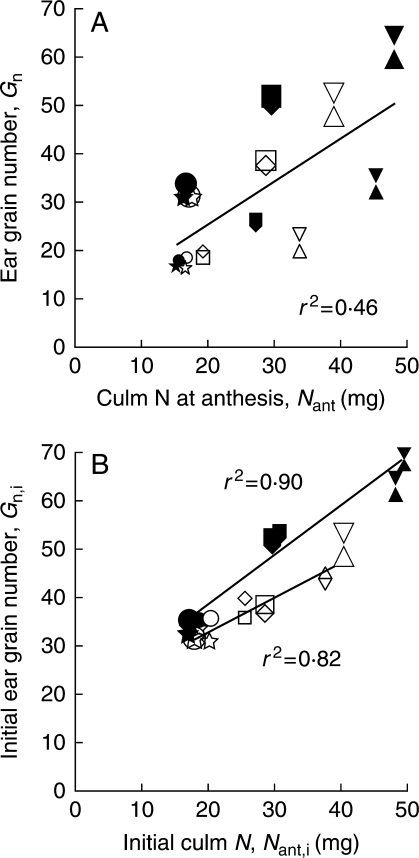
Background and aims: Nitrogen (N) remobilization is the major source of N for grain filling in wheat, the other being N uptake after anthesis (N(up)); however, variations in remobilization efficiency are not fully understood. It is hard to tell whether the source or the sink effects predominate, because N in the culm at anthesis (N(ant)) correlates strongly with both N remobilization (N(rem)) and grain number (G(n)), respectively the main source and the main sink.
Methods: A pot experiment was thus designed to assess the relative contributions of the source and sink to N(rem) regulation. Using two cultivars of winter wheat (Triticum aestivum, 'Apache' and 'Autan'), three pre-anthesis and two post-anthesis N fertilization levels were applied in order to vary the N sources, while ear trimming at anthesis reduced sink size.
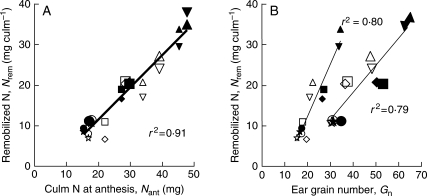
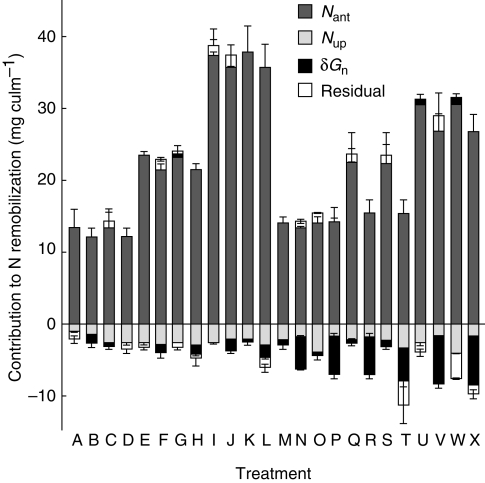
Key results: Unlike results observed at a scale of m(2), the equation binding N(ant) to N(rem) exhibited a negative intercept, challenging the concept of nitrogen remobilization efficiency. Before ear trimming, G(n) fitted well to N(ant), with a slope dependent on genotype. To obtain a sink variable that was less correlated with N(ant), the difference deltaG(n) was calculated between actual grain number and that which could be predicted from culm N before trimming. A multiple regression then predicted N(rem) (r(2) = 0.95) from N(ant), N(up) and deltaG(n), with fitting unbiased by fertilization treatment, trimming or genotype.
Conclusions: In untrimmed culms, deltaG(n) had a negligible effect, so that N(rem) could be fitted to N(ant) and N(up) only: grain N filling appeared to be determined by sources only (N(ant) and N(up)), not by sink, and the reduction of N(rem) by N(up) was quantified. In these 'normal' cases, the regulation of N(rem) should thus be located within the N sources themselves. In contrast, ear-trimming needs to be considered with caution as it introduced a sink limitation on N(rem); moreover one with an important genotype effect.
Figures
References
-
- Abbate PE, Andrade FH, Culot JP. The effects of radiation and nitrogen on number of grains in wheat. Journal of Agricultural Science. 1995;124:351–360.
-
- Andersson A, Johanson E, Oscarson P. Nitrogen redistribution from the roots in post-anthesis plants of spring wheat. Plant and Soil. 2004;264:321–332.
-
- Bancal P, Soltani F. Source–sink partitioning. Do we need Münch? Journal of Experimental Botany. 2002;53:1919–1928. - PubMed
-
- Barbottin A, Lecompte C, Bouchard C, Jeuffroy MH. Nitrogen remobilization during grain filling in wheat: genotypic and environmental effects. Crop Science. 2005;45:1141–1150.
-
- Barneix AJ. Physiology and biochemistry of source-regulated protein accumulation in the wheat grain. Journal of Plant Physiology. 2007;164:581–590. - PubMed
