. 2009 Jun;83(12):6098-105.
doi: 10.1128/JVI.00123-09. Epub 2009 Apr 1.

Human-specific modulation of transcriptional activity provided by endogenous retroviral insertions

Affiliations

Human-specific modulation of transcriptional activity provided by endogenous retroviral insertions

Elena Gogvadze et al. J Virol. 2009 Jun.

Abstract

Many phenotypic differences exist between Homo sapiens and its closest relatives, chimpanzees, and these differences can arise as a result of variations in the regulation of certain genes common to these closely related species. Human-specific endogenous retroviruses (HERVs) and their solitary long terminal repeats (LTRs) are probable candidates for such a role due to the presence of regulatory elements, such as enhancers, promoters, splice sites, and polyadenylation signals. In this study we show for the first time that HERVs can participate in the specific antisense regulation of human gene expression owing to their LTR promoter activity. We found that two HERV LTRs situated in the introns of genes SLC4A8 (for sodium bicarbonate cotransporter) and IFT172 (for intraflagellar transport protein 172) in the antisense orientation serve in vivo as promoters for generating RNAs complementary to the exons of enclosing genes. The antisense transcripts formed from LTR promoter were shown to decrease the mRNA level of the corresponding genes. The human-specific regulation of these genes suggests their involvement in the evolutionary process.


Figures
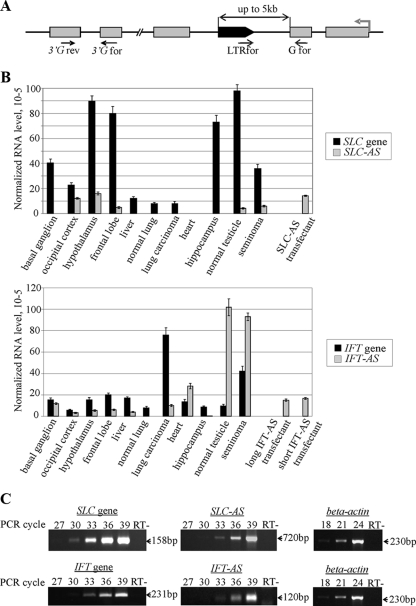
FIG. 1.
FIG. 1.
(A) Schematic representation of the genomic loci selected for the analysis and positions of the primers used. Gray rectangles represent exons of a gene harboring LTR, the gray arrow indicates the gene transcriptional direction, and the black arrow indicates the human-specific LTR. (B) Comparison of the SLC-AS/IFT-AS RNA level with the mRNA level of the corresponding genes determined by qRT-PCR and normalized to the level of β-actin gene transcripts. For the IFT gene, the observed AS transcript level was a combination of both “short” and “long” transcript concentrations. (C) Representative figure of the RT-PCR results obtained for the frontal lobe sample. The primer pairs 3′SLC4A8for/3′SLC4A8rev, SLC4A8for1/LTRfor, 3′IFT172for/3′IFT172rev, and IFT172for1-LTRfor were used to determine the transcriptional levels of the SLC gene, the SLC-AS gene, the IFT gene, and the IFT-AS gene, respectively. The level of β-actin mRNA was determined using the βact-for and β-act-rev primers. An RT- control was performed in all RT-PCR experiments.
FIG. 2.
FIG. 2.
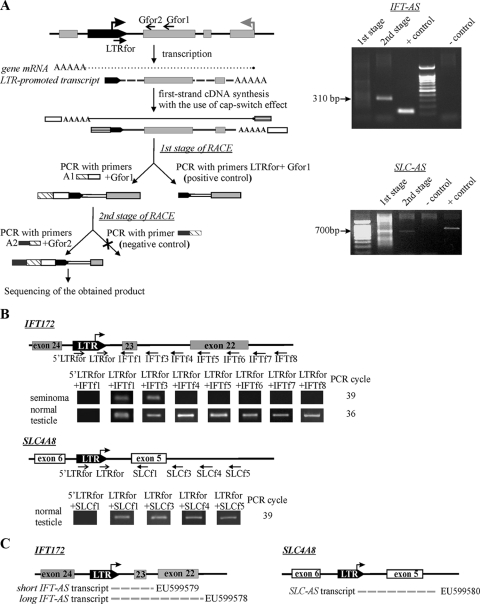
(A) Scheme of the 5′RACE technique and its results for the IFT-AS and SLC-AS transcripts. 5′RACE was performed according as described previously (61). The gray arrow indicates the gene transcriptional start site, and the black arrow indicates the transcriptional start site within LTR. White and striped rectangles represent adapter sequences used for cDNA synthesis. cDNA synthesized using the “cap-switch” effect was used as a template for RACE. To achieve the required specificity, the reaction was performed in two stages. In the first PCR, we used a gene-specific primer (Gfor1), complementary to SLC exon 5 or IFT172 exon 23, and the suppression adapter A1, whose 3′-half was complementary to the sequence of the oligonucleotide used for cDNA synthesis. The second PCR was performed with the nested gene-specific primer Gfor2 and the “step-out” suppression adapter A2. Suppression adapters were used to prohibit the amplification of molecules that do not contain annealing site for a gene-specific primer. (B) The extent of the antisense transcripts was determined in a series of qRT-PCRs with pairs of primers, one of which was complementary to the 3′ sequence of the LTR (LTRfor) and the others of which were complementary to different positions within the gene. RT-PCR product size for the primers LTRfor+IFT172for1/IFT172for3-for8 corresponded to theoretically expected lengths of 123, 292, 326, 428, 527, 626, and 712 bp, respectively. The lengths of the RT-PCR products with the primers LTRfor+SLC4A8for1/SLC4A8for3-for5 were 820, 926, 1,050, and 1,155 bp, respectively. To validate 5′RACE data and measure the level of the potential readthrough transcripts initiated somewhere upstream of the LTRs, qRT-PCRs with the primers 5′LTRfor+IFT172for1 or SLC4A8for1 were performed. (C) Types of antisense transcripts found and their corresponding accession numbers.
FIG. 3.
FIG. 3.
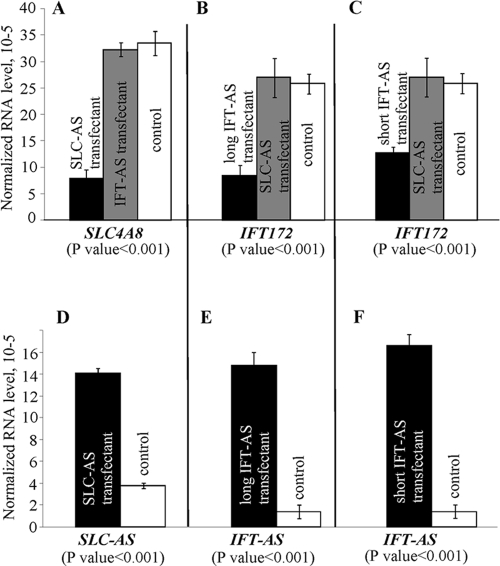
Effect of SLC-AS and IFT-AS overexpression on the mRNA levels of the corresponding genes. Relative levels of SLC4A8 (A), IFT172 (B and C), SLC-AS (D), and IFT-AS (E and F) transcripts were determined by using qRT-PCR. All measurements were carried out in quadruplicate, and expression levels were normalized to the β-actin gene transcript. P values were calculated by using a pairwise t test with α = 0.05.
FIG. 4.
FIG. 4.
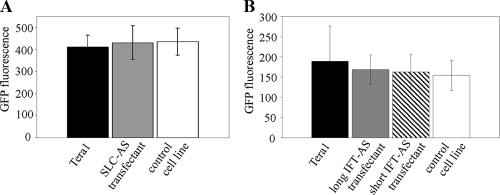
Synthesis of the fused proteins GFP-SLC (A) and GFP-IFT (B) in cell lines overexpressing antisense transcripts and in control cell lines. Protein levels were determined by measuring the GFP activity in untransfected Tera1 cells, SLC/IFT-AS transfectants, and vector-transfectant. pCMVβ plasmid was used as an internal control. The results were normalized to the β-galactosidase activity in each cell line. Transient-transfection experiments were repeated three times.
FIG. 5.
FIG. 5.
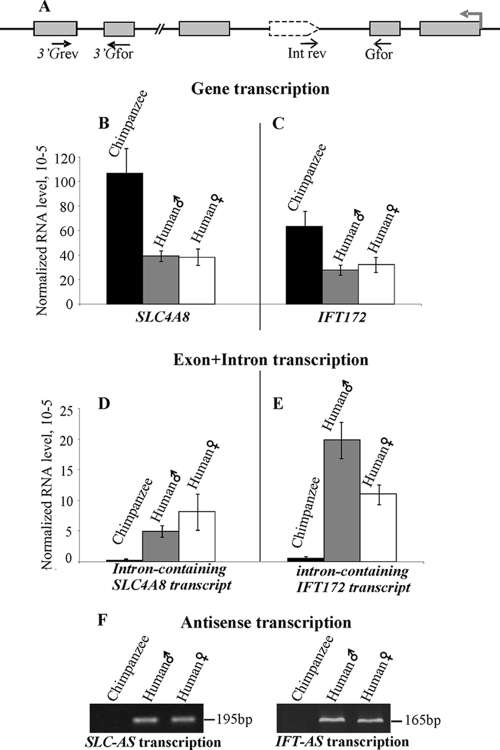
Comparison of the SLC4A8 and IFT172 expression levels in human and chimpanzee brains. (A) Schematic representation of the genomic loci and positions of the primers used. Gray rectangles represent exons of a gene harboring LTR, the gray arrow indicates the gene transcriptional direction, and the dotted arrow indicates the human-specific LTR. (B to E) Relative levels of SLC4A8 (B) and IFT172 (C), as well as intron-containing SLC4A8 (D) and IFT172 (E), transcripts analogous to the SLC-AS and IFT-AS transcripts in humans were measured by using qRT-PCR. All measurements were carried out in quadruplicate, and RNA levels were normalized to the β-actin gene transcript. (C) Results of orientation-specific RT-PCR analyses for human and chimpanzee samples after 39 cycles of amplification (see Fig. S1 in the supplemental material for the scheme of the method).

References

    1. Aalkjaer, C., S. Frische, J. Leipziger, S. Nielsen, and J. Praetorius. 2004. Sodium coupled bicarbonate transporters in the kidney, an update. Acta Physiol. Scand. 181505-512. - PubMed
    1. Altschul, S. F., W. Gish, W. Miller, E. W. Myers, and D. J. Lipman. 1990. Basic local alignment search tool. J. Mol. Biol. 215403-410. - PubMed
    1. Amlal, H., C. E. Burnham, and M. Soleimani. 1999. Characterization of Na+/HCO-3 cotransporter isoform NBC-3. Am. J. Physiol. 276F903-F913. - PubMed
    1. Bannert, N., and R. Kurth. 2004. Retroelements and the human genome: new perspectives on an old relation. Proc. Natl. Acad. Sci. USA 101(Suppl. 2)14572-14579. - PMC - PubMed
    1. Belshaw, R., A. L. Dawson, J. Woolven-Allen, J. Redding, A. Burt, and M. Tristem. 2005. Genomewide screening reveals high levels of insertional polymorphism in the human endogenous retrovirus family HERV-K(HML2): implications for present-day activity. J. Virol. 7912507-12514. - PMC - PubMed

Publication types

LinkOut - more resources