


doi: 10.1152/jn.91060.2008.
Epub 2009 Apr 1.
Neurochemical effects of theta burst stimulation as assessed by magnetic resonance spectroscopy
Affiliations
- PMID: 19339458
- PMCID: PMC2694115
- DOI: 10.1152/jn.91060.2008
Item in Clipboard
Neurochemical effects of theta burst stimulation as assessed by magnetic resonance spectroscopy
J Neurophysiol.
2009 Jun.
Erratum in
- J Neurophysiol. 2011 Jun;105(6):3114
Abstract
Continuous theta burst stimulation (cTBS) is a novel transcranial stimulation technique that causes significant inhibition of synaptic transmission for <or=1 h when applied over the primary motor cortex (M1) in humans. Here we use magnetic resonance spectroscopy to define mechanisms mediating this inhibition by noninvasively measuring local changes in the cortical concentrations of gamma-aminobutyric acid (GABA) and glutamate/glutamine (Glx). cTBS to the left M1 led to an increase in GABA compared with stimulation at a control site without significant change in Glx. This direct evidence for increased GABAergic interneuronal activity is framed in terms of a new hypothesis regarding mechanisms underlying cTBS.
Figures
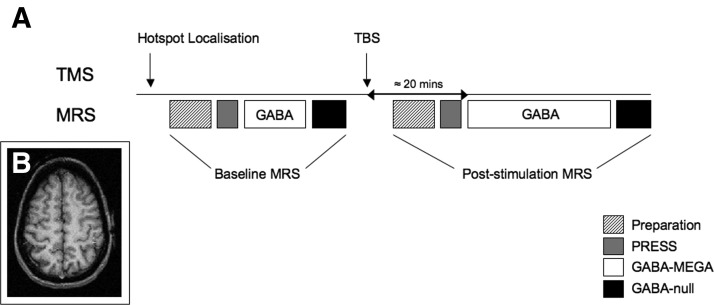
A: experimental protocol. A baseline magnetic resonance spectroscopy (MRS) acquisition was performed after the motor hotspot had been identified in each subject. After this was complete, the subjects were removed from the scanner and a 40-s train of theta burst stimulation (TBS) pulses were applied, either to the motor hotspot (M1; verum stimulation) or to the vertex (Cz; control stimulation). The subjects were then repositioned in the scanner and a poststimulation MRS spectrum was acquired. This commenced after a period of about 20 min of scanner setup. B: typical 2 × 2 × 2-cm voxel placed within the hand region of the left primary motor cortex.
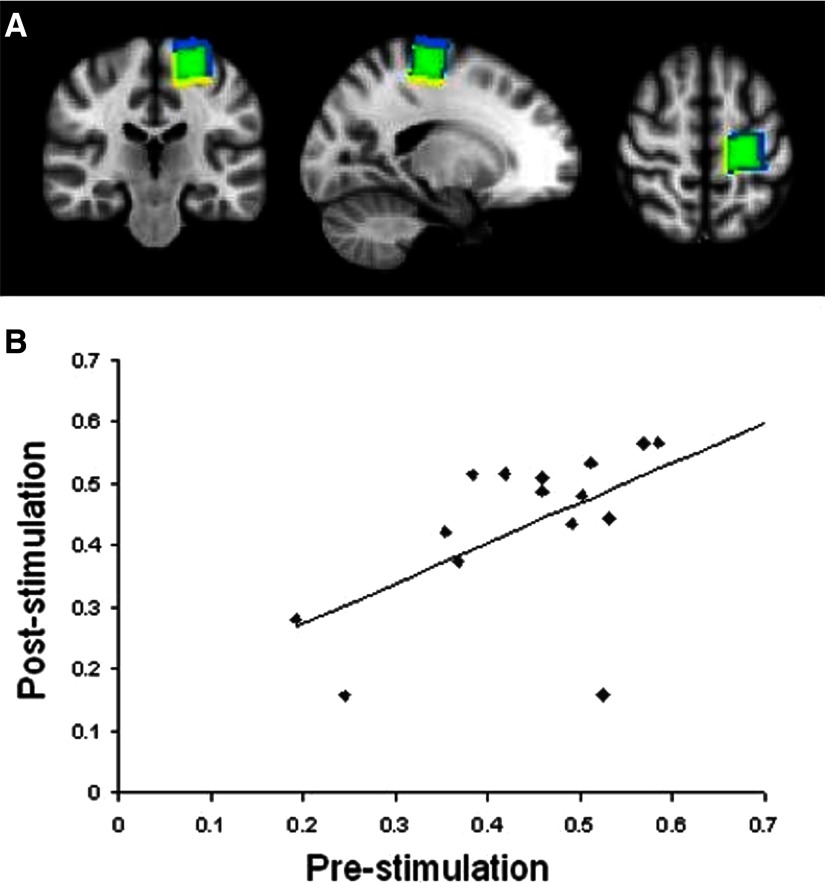
A: typical locations for the prestimulation voxel (yellow) and the poststimulation voxel (blue). The substantial overlap between the 2 is shown in green. B: plot showing the high correlation between the amount of gray matter within the voxel of interest before and after stimulation (r2 = 0.88, P < 0.01).
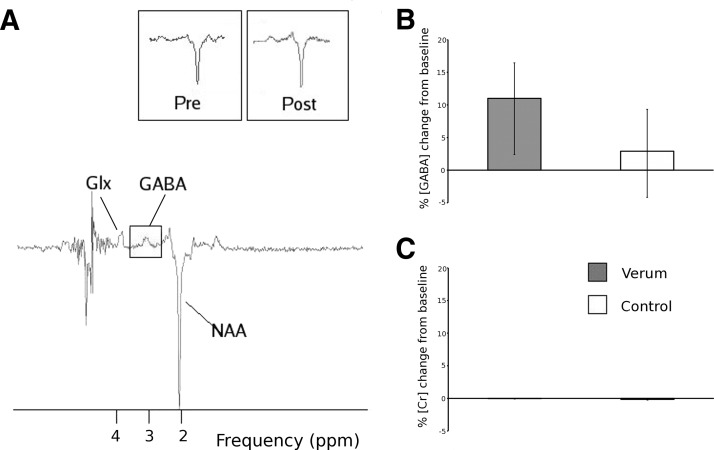
A: typical γ-aminobutyric acid (GABA)–optimized spectrum acquired. Insets show representative GABA and N-acetylaspartate (NAA) peaks before and after stimulation in the same subject. Glx, composite measure of glutamate and glutamine. B: percentage change in GABA:NAA ratio from baseline. Verum stimulation leads to a significant increase in GABA:NAA ratio, compared with control. C: percentage change in creatine signal for baseline. There is no significant change with either stimulation condition.
References
-
- Chen R, Classen J, Gerloff C, Celnik P, Wassermann EM, Hallett M, Cohen LG. Depression of motor cortex excitability by low-frequency transcranial magnetic stimulation. Neurology 48: 1398–1403, 1997. - PubMed
-
- Cooke SF, Bliss TVP. Plasticity in the human central nervous system. Brain 129: 1659–1673, 2006. - PubMed
-
- de Graaf R, Mason G, Patel A, Behar KL, Rothman DL. In vivo 1H-[13C]-NMR spectroscopy of cerebral metabolism. NMR Biomed 16: 339–357, 2003. - PubMed
-
- Di Lazzaro V, Dileone M, Profice P, Pilato F, Cioni B, Meglio M, Capone F, Tonali PA, Rothwell JC. Direct demonstration that repetitive transcranial magnetic stimulation can enhance corticospinal excitability in stroke. Stroke 37: 2850–2853, 2006. - PubMed
-
- Di Lazzaro V, Oliviero A, Meglio M, Cioni B, Tamburrini G, Tonali P, Rothwell JC. Direct demonstration of the effect of lorazepam on the excitability of the human motor cortex. Clin Neurophysiol 111: 794–799, 2000. - PubMed
Publication types
MeSH terms
Substances
Grants and funding
LinkOut - more resources
Full Text Sources
Miscellaneous
