


Childhood craniopharyngioma: greater hypothalamic involvement before surgery is associated with higher homeostasis model insulin resistance index
- PMID: 19341477
- PMCID: PMC2675525
- DOI: 10.1186/1471-2431-9-24
Childhood craniopharyngioma: greater hypothalamic involvement before surgery is associated with higher homeostasis model insulin resistance index
Abstract
Background: Obesity seems to be linked to the hypothalamic involvement in craniopharyngioma. We evaluated the pre-surgery relationship between the degree of this involvement on magnetic resonance imaging and insulin resistance, as evaluated by the homeostasis model insulin resistance index (HOMA). As insulin-like growth factor 1, leptin, soluble leptin receptor (sOB-R) and ghrelin may also be involved, we compared their plasma concentrations and their link to weight change.
Methods: 27 children with craniopharyngioma were classified as either grade 0 (n = 7, no hypothalamic involvement), grade 1 (n = 8, compression without involvement), or grade 2 (n = 12, severe involvement).
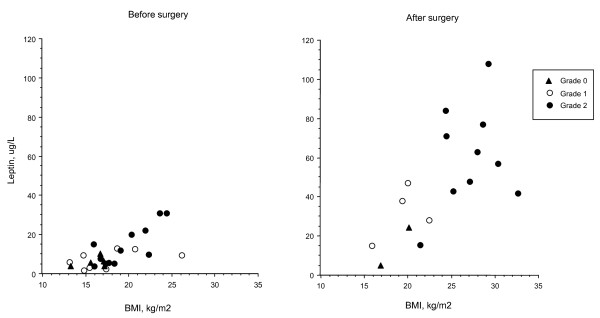
Results: Despite having similar body mass indexes (BMI), the grade 2 patients had higher glucose, insulin and HOMA before surgery than the grade 0 (P = 0.02, <0.05 and 0.02 respectively) and 1 patients (P < 0.02 and <0.03 for both insulin and HOMA). The grade 0 (5.8 +/- 4.9) and 1 (7.2 +/- 5.3) patients gained significantly less weight (kg) during the year after surgery than did the grade 2 (16.3 +/- 7.4) patients. The pre-surgery HOMA was positively correlated with these weight changes (P < 0.03). The data for the whole population before and 6-18 months after surgery showed increases in BMI (P < 0.0001), insulin (P < 0.005), and leptin (P = 0.0005), and decreases in sOB-R (P < 0.04) and ghrelin (P < 0.03).
Conclusion: The hypothalamic involvement by the craniopharyngioma before surgery seems to determine the degree of insulin resistance, regardless of the BMI. The pre-surgery HOMA values were correlated with the post-surgery weight gain. This suggests that obesity should be prevented by reducing inn secretion in those cases with hypothalamic involvement.
Figures
References
-
- Lustig RH, Rose SR, Burghen GA, Velasquez-Mieyer P, Broome DC, Smith K, Li H, Hudson MM, Heideman RL, Kun LE. Hypothalamic obesity caused by cranial insult in children: Altered glucose and insulin dynamics and reversal by a somatostatin agonist. J Pediatr. 1999;135:162–168. doi: 10.1016/S0022-3476(99)70017-X. - DOI - PubMed
MeSH terms
Substances
LinkOut - more resources
Full Text Sources
Medical
Research Materials
