


Characterization of the effects of methylmercury on Caenorhabditis elegans
- PMID: 19341752
- PMCID: PMC2753706
- DOI: 10.1016/j.taap.2009.03.013
Characterization of the effects of methylmercury on Caenorhabditis elegans
Abstract
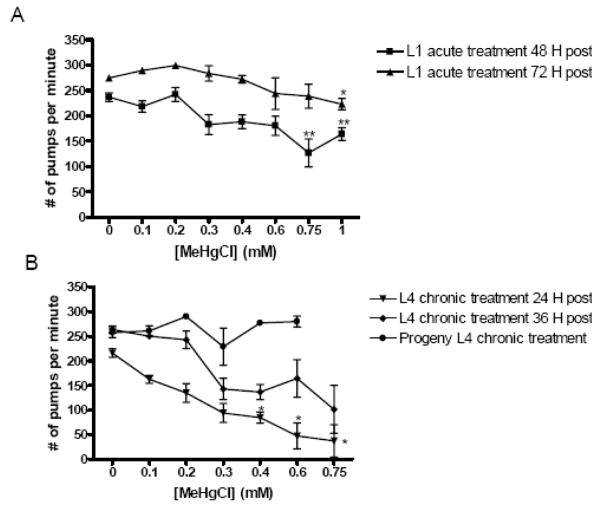
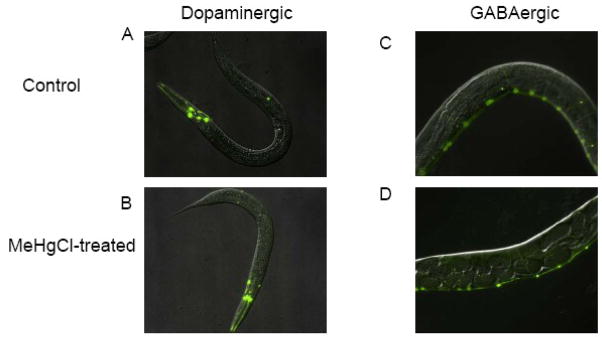
The rising prevalence of methylmercury (MeHg) in seafood and in the global environment provides an impetus for delineating the mechanism of the toxicity of MeHg. Deleterious effects of MeHg have been widely observed in humans and in other mammals, the most striking of which occur in the nervous system. Here we test the model organism, Caenorhabditis elegans (C. elegans), for MeHg toxicity. The simple, well-defined anatomy of the C. elegans nervous system and its ready visualization with green fluorescent protein (GFP) markers facilitated our study of the effects of methylmercuric chloride (MeHgCl) on neural development. Although MeHgCl was lethal to C. elegans, induced a developmental delay, and decreased pharyngeal pumping, other traits including lifespan, brood size, swimming rate, and nervous system morphology were not obviously perturbed in animals that survived MeHgCl exposure. Despite the limited effects of MeHgCl on C. elegans development and behavior, intracellular mercury (Hg) concentrations (<or=3 ng Hg/mg protein) in MeHgCl-treated nematodes approached levels that are highly toxic to mammals. If MeHgCl reaches these concentrations throughout the animal, this finding indicates that C. elegans cells, particularly neurons, may be less sensitive to MeHgCl toxicity than mammalian cells. We propose, therefore, that C. elegans should be a useful model for discovering intrinsic mechanisms that confer resistance to MeHgCl exposure.
Conflict of interest statement
Conflict of Interest Statement
None of the authors has a conflict of interest.
Figures
References
-
- Altun-Gultekin Z, Andachi Y, Tsalik EL, Pilgrim D, Kohara Y, Hobert O. A regulatory cascade of three homeobox genes, ceh-10, ttx-3 and ceh-23, controls cell fate specification of a defined interneuron class in C. elegans. Development. 2001;128:1951–1969. - PubMed
-
- Aschner M, Yao CP, Allen JW, Tan KH. Methylmercury alters glutamate transport in astrocytes. Neurochem Int. 2000;37:199–206. - PubMed
-
- Asikainen S, Vartiainen S, Lakso M, Nass R, Wong G. Selective sensitivity of Caenorhabditis elegans neurons to RNA interference. Neuroreport. 2005;16:1995–1999. - PubMed
-
- Bischof LJ, Huffman DL, Aroian RV. Assays for toxicity studies in C. elegans with Bt crystal proteins. Methods Mol Biol. 2006;351:139–154. - PubMed
Publication types
MeSH terms
Substances
Grants and funding
LinkOut - more resources
Full Text Sources
