


Review
doi: 10.1016/j.coi.2009.03.004.
Epub 2009 Apr 1.
Antigen presentation in celiac disease
Affiliations
- PMID: 19342211
- PMCID: PMC3901576
- DOI: 10.1016/j.coi.2009.03.004
Item in Clipboard
Review
Antigen presentation in celiac disease
Curr Opin Immunol.
2009 Feb.
Abstract
Celiac disease is caused by an inappropriate immune response to ingested gluten proteins. As a dietary antigen, gluten undergoes extensive but incomplete proteolytic digestion in the intestinal lumen. The resultant peptide fragments of gluten require deamidation, but not necessarily further intracellular processing for presentation. Recent studies reveal why the disease associated HLA-DQ2 molecule is particularly suited for binding proline-rich gluten peptides. In comparison, DQ8 exhibits different binding characteristics, which may explain the lesser risk for disease in association with this molecule.
Figures
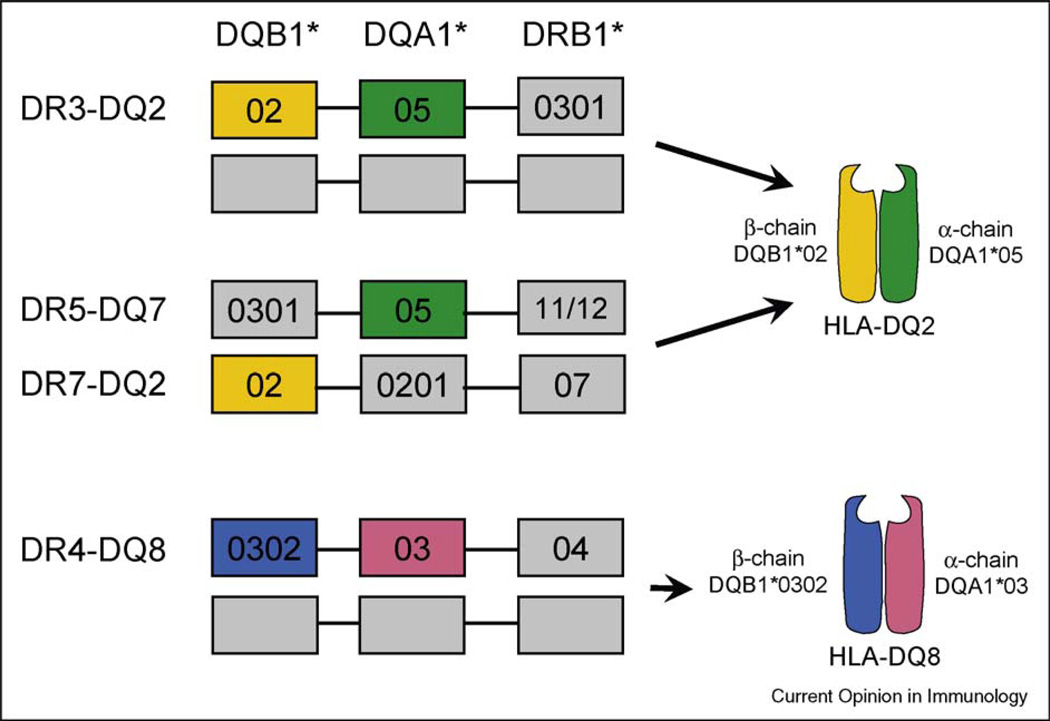
HLA association in celiac disease. A vast majority of celiac patients express the HLA-DQ2 heterodimer encoded by the DQA1*05 and DQB1*02 genes. These two genes are carried either in cis on the DR3-DQ2 haplotype, or in trans in individuals who are DR5-DQ7 and DR7-DQ2 heterozygous. Most DQ2-negative patients express DQ8 encoded on the DR4-DQ8 haplotype.
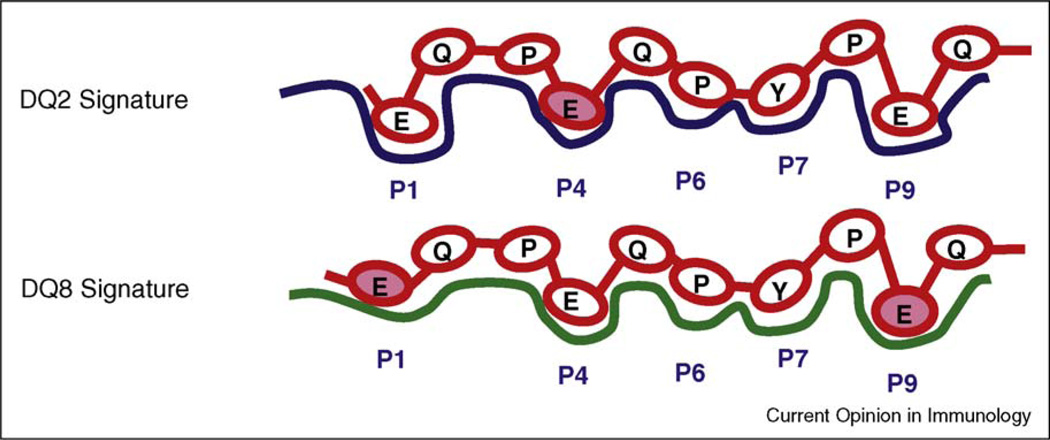
Peptide binding signatures of DQ2 and DQ8 molecules. The DQ2-restricted γ-III epitope and the DQ8-restricted γ-I epitope recognized by lesion derived T cells of CeD patients share the same 9 amino acid core sequence. This sequence contains three glutamate residues formed by TG2-mediated deamidation in positions P1, P4 and P9. DQ2 prefers negatively charged glutamate residue in P4 (shaded) whereas DQ8 prefers glutamate in P1 and P9 (shaded).
Comment in
-
Editorial overview.Curr Opin Immunol. 2009 Feb;21(1):68-9. doi: 10.1016/j.coi.2009.03.005. Epub 2009 Apr 1. Curr Opin Immunol. 2009. PMID: 19342209 No abstract available.
References
-
- Maki M, Mustalahti K, Kokkonen J, Kulmala P, Haapalahti M, Karttunen T, Ilonen J, Laurila K, Dahlbom I, Hansson T, et al. Prevalence of celiac disease among children in Finland. N Engl J Med. 2003;348:2517–2524. - PubMed
-
- Thorsby E, Lie BA. HLA associated genetic predisposition to autoimmune diseases: genes involved and possible mechanisms. Transpl Immunol. 2005;14:175–182. - PubMed
-
- Scott H, Sollid LM, Fausa O, Brandtzaeg P, Thorsby E. Expression of major histocompatibility complex class-II subregion products by jejunal epithelium in patients with celiac disease. Scand J Immunol. 1987;26:563–571. - PubMed
-
- Kelly J, Weir DG, Feighery C. Differential expression of HLA-D gene products in the normal and coeliac small bowel. Tissue Antigens. 1988;31:151–160. - PubMed
Publication types
MeSH terms
Substances
Grants and funding
LinkOut - more resources
Full Text Sources
Other Literature Sources
Medical
Research Materials
