. 2009 Apr 28;106(17):7173-8.
doi: 10.1073/pnas.0900693106. Epub 2009 Apr 2.

The assembled structure of a complete tripartite bacterial multidrug efflux pump

Affiliations

The assembled structure of a complete tripartite bacterial multidrug efflux pump

Martyn F Symmons et al. Proc Natl Acad Sci U S A. .

Abstract

Bacteria like Escherichia coli and Pseudomonas aeruginosa expel drugs via tripartite multidrug efflux pumps spanning both inner and outer membranes and the intervening periplasm. In these pumps a periplasmic adaptor protein connects a substrate-binding inner membrane transporter to an outer membrane-anchored TolC-type exit duct. High-resolution structures of all 3 components are available, but a pump model has been precluded by the incomplete adaptor structure, because of the apparent disorder of its N and C termini. We reveal that the adaptor termini assemble a beta-roll structure forming the final domain adjacent to the inner membrane. The completed structure enabled in vivo cross-linking to map intermolecular contacts between the adaptor AcrA and the transporter AcrB, defining a periplasmic interface between several transporter subdomains and the contiguous beta-roll, beta-barrel, and lipoyl domains of the adaptor. With short and long cross-links expressed as distance restraints, the flexible linear topology of the adaptor allowed a multidomain docking approach to model the transporter-adaptor complex, revealing that the adaptor docks to a transporter region of comparative stability distinct from those key to the proposed rotatory pump mechanism, putative drug-binding pockets, and the binding site of inhibitory DARPins. Finally, we combined this docking with our previous resolution of the AcrA hairpin-TolC interaction to develop a model of the assembled tripartite complex, satisfying all of the experimentally-derived distance constraints. This AcrA(3)-AcrB(3)-TolC(3) model presents a 610,000-Da, 270-A-long efflux pump crossing the entire bacterial cell envelope.


Conflict of interest statement

The authors declare no conflict of interest.

Figures
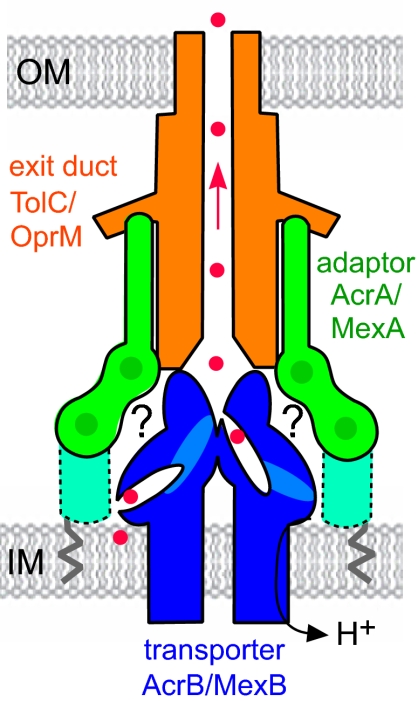
Fig. 1.
Fig. 1.
Schematic of the tripartite multidrug efflux pump. The pumps comprise an exit duct (shown in orange; TolC in E. coli, OprM in P. aeruginosa) anchored in the outer membrane (OM), an integral inner membrane (IM) transporter (in blue; AcrB and MexB) and a periplasmic adaptor protein (in green; AcrA and MexA) linked to the inner membrane by a fatty acid (zigzag line). The adaptor binds the exit duct α-helical domain via its α-hairpin (23) and the transporter via unknown interactions (indicated by ?). The adaptor linear multidomain structure is characterized by interdomain flexibility, but it is incomplete, missing the MP domain indicated by the dotted outline. Red dots indicate antibacterial drugs bound to putative pockets in the transporter, passing through TolC (arrowed), and out of the cell.
Fig. 2.
Fig. 2.
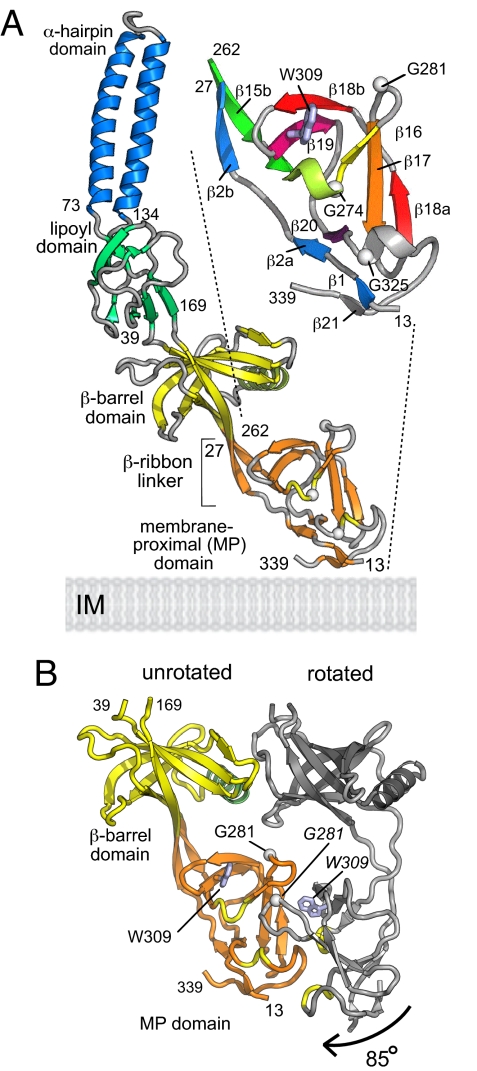
The completed structure of the periplasmic adaptor. (A) Structure of MexA including the MP domain. The 4 adaptor domains are: α-hairpin (blue), lipoyl (green), β-barrel (yellow), and MP β-roll (orange). Turns are gray except for 2 MP domain helical turns (yellow) that include Gly residues (white Cα atoms) on the concave surface effecting crystal contacts. The enlarged inset gives a smoothed representation of the MP domain topology, with elements numbered according to the adaptor family sequence alignment (Fig. S1) and colored from blue to red. Trp-309 is shown in gray. (B) The MP domain: conformational variation, rotation, and crystal contacts. The MexA adaptor barrel (yellow) and MP (orange) domain, shown in the unrotated MP domain conformation, establish crystal contacts with a neighboring copy (gray), with the MP domain in its rotated conformation. Helical turns on the MP domain concave face are in yellow, and Gly-281 and Trp-309 are shown as white Cα atoms and gray side-chains, respectively (labeled in italics on the rotated domain).
Fig. 3.
Fig. 3.
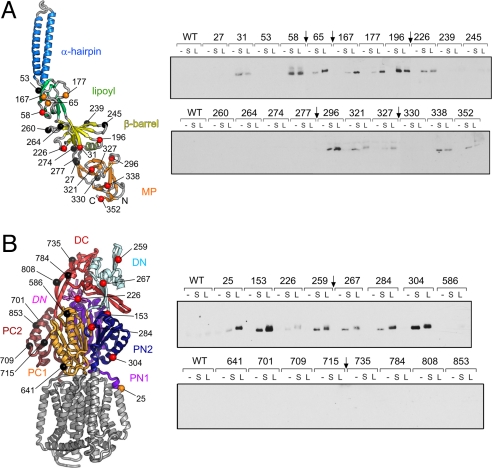
In vivo cross-linking of AcrA adaptor and AcrB transporter. (Left) Cysteine substitutions in AcrA (A) and AcrB (B) are shown on backbone ribbons. (Right) The cross-linking results from the AcrA (A) and AcrB (B) variants are presented showing immunoblots of AcrA protein. The AcrA adaptor (A) has 21 Cys substitutions on the lipoyl (green), β-barrel (yellow), and MP β-barrel (orange) domains. On the AcrB transporter periplasmic surface (B), 16 Cys substitutions span the PN1, DN, PN2, PC1, DC, and PC2 subdomains; the integral membrane part of the transporter is shown in gray for reference. In vivo cross-linking was performed by using either the short reagent SPDP (S) or longer LC-SPDP (L). Negative controls without cross-linker (−) or with protein (WT) having no Cys substitution were included in every assay series (duplicate WT controls were removed, indicated by arrows). The residues on the protein structures (Left) are colored red if cross-linked by both S and L linkers, orange if linked only by L linker, or black if negative, i.e., giving no cross-link.
Fig. 4.
Fig. 4.
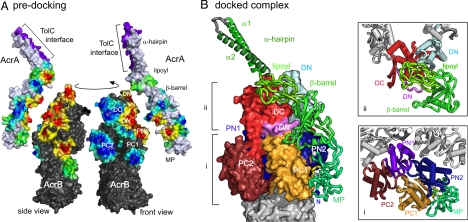
Docking of AcrA and AcrB directed by the cross-linking data. (A) AcrA and AcrB interaction hotspots predocking. Cross-linking hotspots on the AcrA and AcrB surfaces predocking, colored on a gradient reflecting all cross-linking data: from dark blue near negative Cys-substituted residues (no cross-link), through green near residues with a bias to the L linker, to yellow/orange/red with increasing proximity to positives linked by both S and L linker. The TolC interface of the adaptor hairpin (23) is in magenta. The arrow indicates rotation from side to front view. (B) Docked complex of AcrA on an AcrB subunit. The 4 AcrA adaptor domains are shown in green shades, with 2 helical turns of the MP concave surface in yellow, β-turn Gly residues in white and the N-terminal residue in blue. The transporter periplasmic subdomain colors are as in Fig. 3B. Cross-sections at 2 levels of the complex (indicated by the brackets) are boxed on the right and illustrate the domain–domain contacts of the adaptor MP domain (i) and β-barrel and lipoyl domains (ii).
Fig. 5.
Fig. 5.
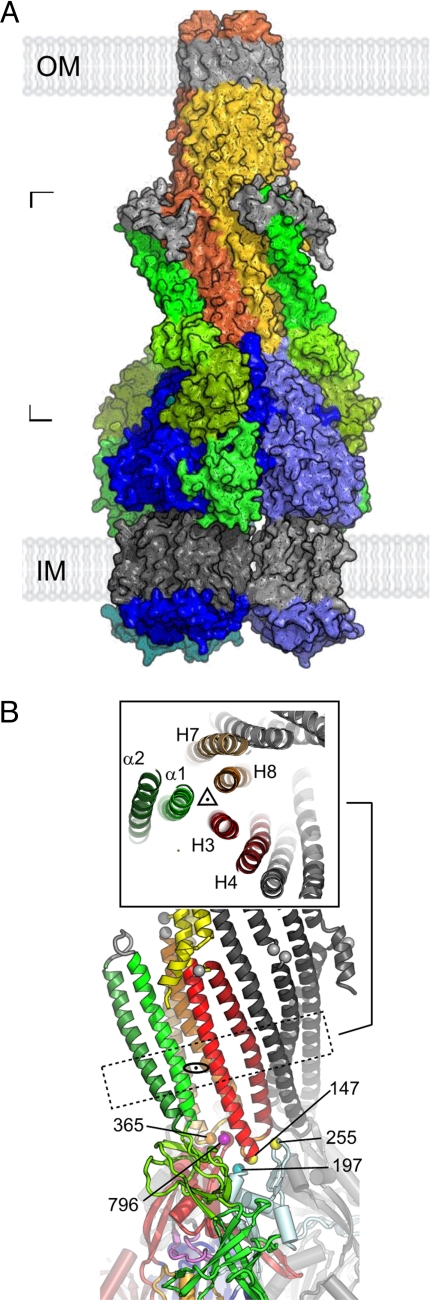
Assembly of the tripartite efflux pump. (A) Completed pump model. The surface rendering of the TolC3–AcrA3–AcrB3 complex is colored by its components. The TolC trimer (orange, red, and yellow subunits with gray equatorial domains and membrane regions) is docked onto the AcrA (green)-docked AcrB trimer (blue/light blue subunits with gray membrane regions) that was generated in Fig. 4. The location of the inner and outer membrane is indicated. (B) Detail of the TolC–AcrA–AcrB docking region. For clarity the TolC equatorial domains have been omitted between the gray Cα atoms. The boxed cross-section (corresponding to the dotted rectangle at the level of the adaptor lipoyl and α-hairpin domains) shows the TolC helical coils (8) H3 (light red) and H4 (dark red), H7 (light orange) and H8 (dark orange), and the AcrA α-hairpin with α1 (bright green) and α2 (dark green). Pseudodimeric arrangement is indicated by the dyad symbol while a pseudotrimeric arrangement is indicated by the 3-fold symbol in the cross-section. Colored loops and marked Cα positions show TolC–AcrB subunit register (with AcrB colored as for Fig. 4B).

Comment in

References

    1. Koronakis V, Eswaran J, Hughes C. Structure and function of TolC: The bacterial exit duct for proteins and drugs. Annu Rev Biochem. 2004;73:467–489. - PubMed
    1. Eswaran J, Koronakis E, Higgins MK, Hughes C, Koronakis V. Three's company: Component structures bring a closer view of tripartite drug efflux pumps. Curr Opin Struct Biol. 2004;14:741–747. - PubMed
    1. Nikaido H, Zgurskaya HI. AcrAB and related multidrug efflux pumps of Escherichia coli. J Mol Microbiol Biotechnol. 2001;3:215–218. - PubMed
    1. Thanabalu T, Koronakis E, Hughes C, Koronakis V. Substrate-induced assembly of a contiguous channel for protein export from Escherichia coli: Reversible bridging of an inner-membrane translocase to an outer membrane exit pore. EMBO J. 1998;17:6487–6496. - PMC - PubMed
    1. Poole K. Multidrug resistance in Gram-negative bacteria. Curr Opin Microbiol. 2001;4:500–508. - PubMed

Publication types

MeSH terms

Substances

Associated data

LinkOut - more resources