. 2009 Apr 3;324(5923):105-8.
doi: 10.1126/science.1166657.

Use-dependent plasticity in clock neurons regulates sleep need in Drosophila

Affiliations

Use-dependent plasticity in clock neurons regulates sleep need in Drosophila

Jeffrey M Donlea et al. Science. .

Abstract

Sleep is important for memory consolidation and is responsive to waking experience. Clock circuitry is uniquely positioned to coordinate interactions between processes underlying memory and sleep need. Flies increase sleep both after exposure to an enriched social environment and after protocols that induce long-term memory. We found that flies mutant for rutabaga, period, and blistered were deficient for experience-dependent increases in sleep. Rescue of each of these genes within the ventral lateral neurons (LNVs) restores increased sleep after social enrichment. Social experiences that induce increased sleep were associated with an increase in the number of synaptic terminals in the LNV projections into the medulla. The number of synaptic terminals was reduced during sleep and this decline was prevented by sleep deprivation.


Figures

Fig. 1
Fig. 1
Clock cells regulate experience-dependent increases in sleep. (A) Data for each GAL4 line (GAL4>/+:rut2080/+;;UAS-rut/+) is compared to its parental line (GAL4/+:rut2080/+). No increase in Δ daytime sleep is observed in the absence of GAL4 [(rut2080/+;;UAS-rut/+)-(rut2080/+); white bar]. The mean Δ daytime sleep for Gs-elav-GAL4 (RU+ versus RU−) is shown to facilitate comparisons (black). One-way analysis of variance (ANOVA) for genotype, F(33,903) =9.09.(*, P < .05 with correction for 34 comparisons; n ≥ 16 for all groups). (B and C) Sleep after social enrichment in mutant rut2080/+;pdf-GAL4/+ flies and rut2080/+;pdf-GAL4/+;UAS-rut/+ flies (n = 16 in each group). (D and E) Average daytime sleep and sleep-bout duration in rut2080/+;pdf-GAL4/+ mutant and rut2080/+;pdf-GAL4/+;UAS-rut/+ rescue flies. Two-way ANOVA reveals a genotype by condition interaction for sleep [F(1,57) = 4.44, P = 0.03]andbouts[F(1,57) = 6.59, P = 0.013](*, P < .05, planned pairwise comparisons with a Tukey correction; n = 14 to 16 for all groups).(F and G) PER immunohistochemistry of per01;per+7.2-2 and per01mutants. (H) Δ daytime sleep in per01 mutants and per01;per+7.2-2 flies (P = 0.0002; n = 30 to 32 in each group). (I) Male per01 mutants do not exhibit a reduction in courtship 48 hours after a spaced courtship conditioning (N, Naïve; T, Trained; n = 13 to 14).(J) per01 flies only exhibit a transient increase in sleep immediately after training. (K) per01;per+7.2-2 flies exhibit suppression of courtship 48 hours after training (P = 0.001; n = 13 in each group). (L) per01;per+7.2-2 males also show sustained increases in sleep for 2 days. (M) Δ daytime sleep is quantified for per01 and per01;per+7.2-2 males Two-way ANOVA reveals a genotype by day interaction F(1,39) = 7.48, P = 0.009(*, P < .05 planned pairwise comparisons with a Tukey correction; n = 13 to 14 each group).
Fig. 2
Fig. 2
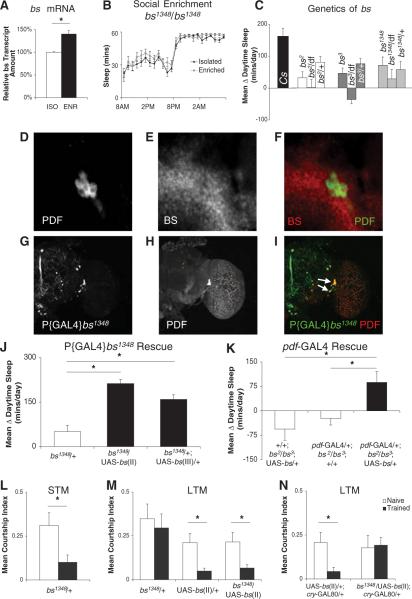
blistered regulates experience-dependent increases in sleep. (A) bs transcripts are significantly elevated in socially enriched Cs flies compared with their isolated siblings (P = 0.03). (B) Flies homozygous for the P{GAL4}bs1348 insertion do not respond to social enrichment with an increase in sleep (n = 16 in each group). (C) Mean Δ daytime sleep is absent in bs2 and bs3 mutants and persists when each allele (bs2, bs3, or P{GAL4}bs1348) is outcrossed to Cs or with the Deficiency In(2LR)Px4. One-way ANOVA for genotype [F(9,124) = 2.73; P = 0.04; n = 32 in each group]. (D) Expression of UAS-egfp using pdf-GAL4 labels the cell bodies of LNVs. (E) Immunohistochemistry using mouse antibody to BS (diluted 1:1000). (F) Colocalization of BS and pdf-GAL4 indicates that BS is expressed in pdf-expressing LNVs. (G) P{GAL4}bs1348 was used to drive UAS-egfp, and the expression pattern was evaluated using confocal microscopy. (H) Brains of P{GAL4}bs1348/+;UAS-egfp flies were colabeled with guinea pig antibody to PDF (diluted 1:10,000) (I) Colocalization of GFP with PDF indicates that P{GAL4}bs1348 drives GAL4 expression in PDF-expressing LNVs (arrows). (J) The failure to respond to social enrichment with an increase in sleep can be rescued by combining P{GAL4}bs1348 with either of two separate UAS-bs alleles. One-way ANOVA for genotype [F(2,45) = 22.86; P = 1.4×10;*, P < .05 Bonferroni post-hoc test; n = 16 in each group)].(K) Expressing wild-type bs using pdf-GAL4 in an otherwise bs mutant background (pdf-GAL4/+;bs2/bs3;UAS-bs) rescues increases in Δ daytime sleep); parental lines are shown in white. The lower Δsleep versus 2J may indicate a partial rescue. One-way ANOVA for genotype [F(2,45) = 6.30; P = 0.003; *, P < .05, Bonferroni post-hoc test; n = 16 in each group)]. (L) Courtship suppression in P{GAL4}bs1348 mutants tested 5 min after Courtship Conditioning White bars represent naïve males; dark bars represent trained males (P = 0.02; n =13 in each group). (M) LTM is disrupted in P{GAL4}bs1348/+ mutants tested 48 hours after training and rescued by expression of UAS-bs. Two-way ANOVA reveals a genotype by condition interaction [F(2,72) = 16.73; P = 0.0001] (*, P <.05, planned pairwise comparisons with a Tukey correction; n = 13 in each group).(N) Blocking GAL4 expression in clock cells using cry-GAL80 prevents rescue of LTM. Genotype by condition interaction [F(1,48) = 2.32; P = 0.14] (*, P <.05, planned pairwise comparisons with a Tukey correction; n = 13 in each group).
Fig. 3
Fig. 3
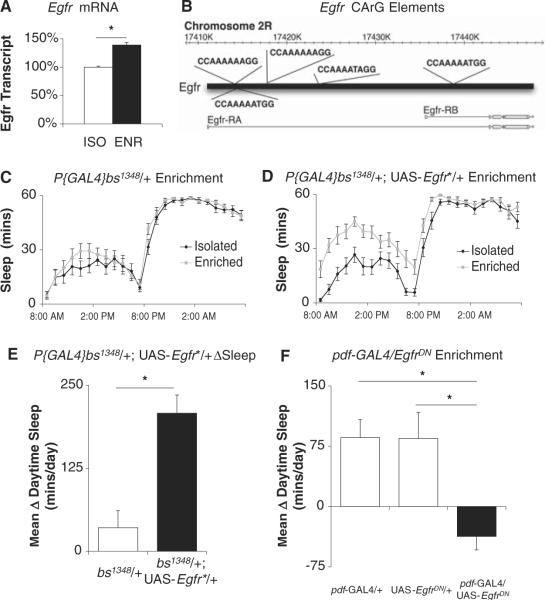
Egfr mediates experience-dependent sleep. (A) Transcription of Egfr is significantly elevated in socially enriched Cs flies compared with their isolated siblings, as measured by quantitative polymerase chain reaction. (B) Genomic Egfr sequence contains several SRF-binding CArG elements. (C and D) Driving the expression of UAS-Egfr* with P{GAL4}bs1348 restores ΔSleep after social enrichment. (E) Summary of the response for data shown in (C) and (D) (*, P = 7×10⁻⁵; n = 16 in each group). (F) No change in Δ sleep is observed in pdf-GAL4/UAS-EgfrDN. One-way ANOVA for genotype F(2,44) = 7.75, P =0.001 (*, P < .05, Bonferroni correction; n = 15 to 16 in each group).
Fig. 4
Fig. 4
LNV synapse number in medulla. (A and B) LNV projections in socially enriched pdf-GAL4/+;;UAS-dlgWT-gfp/+ flies contain more GFP-positive terminals than their socially isolated siblings when evaluated using confocal microscopy. (C) Relative quantification of dlg-GFP-immunopositive terminals in socially isolated pdf-GAL4/+;;UAS-dlgWT-gfp/+ flies versus socially enriched siblings (P = 1.5×10; n =33 to 34 in each group). (D) dlg-GFP positive terminals 48 hours after social enrichment in sleep-deprived flies and their normally sleeping siblings. (P = 0.003; n = 15 to 18 in each group). (E and F) Social enrichment of pdf-GAL4/+;UAS-VAMP-GFP/+ flies induces a modest increase of LNV terminals relative to isolated siblings. (G) Relative quantification of VAMP-GFP-positive terminals in socially isolated pdf-GAL4/+;UAS-VAMP-gfp/+ flies and their socially enriched siblings (P = 0.03; n =16 to 18 in each group).(H) UAS-VAMP-gfp-positive terminals 48 hours after social enrichment in sleep-deprived flies and their normally sleeping siblings (P = 0.01; n = 18 in each group).

Comment in

References

    1. Rechtschaffen A, Gilliland MA, Bergmann BM, Winter JB. Science. 1983;221:182. - PubMed
    1. Shaw PJ, Tononi G, Greenspan RJ, Robinson DF. Nature. 2002;417:287. - PubMed
    1. Walker MP, Brakefield T, Morgan A, Hobson JA, Stickgold R. Neuron. 2002;35:205. - PubMed
    1. Graves LA, Heller EA, Pack AI, Abel T. Learn. Mem. 2003;10:168. - PMC - PubMed
    1. Ganguly-Fitzgerald I, Donlea J, Shaw PJ. Science. 2006;313:1775. - PubMed

Publication types

MeSH terms