


doi: 10.1016/j.optcom.2007.10.040.
Phase Matching considerations in Second Harmonic Generation from tissues: Effects on emission directionality, conversion efficiency and observed morphology
Affiliations
- PMID: 19343083
- PMCID: PMC2390911
- DOI: 10.1016/j.optcom.2007.10.040
Item in Clipboard
Phase Matching considerations in Second Harmonic Generation from tissues: Effects on emission directionality, conversion efficiency and observed morphology
Opt Commun.
.
No abstract available
Figures
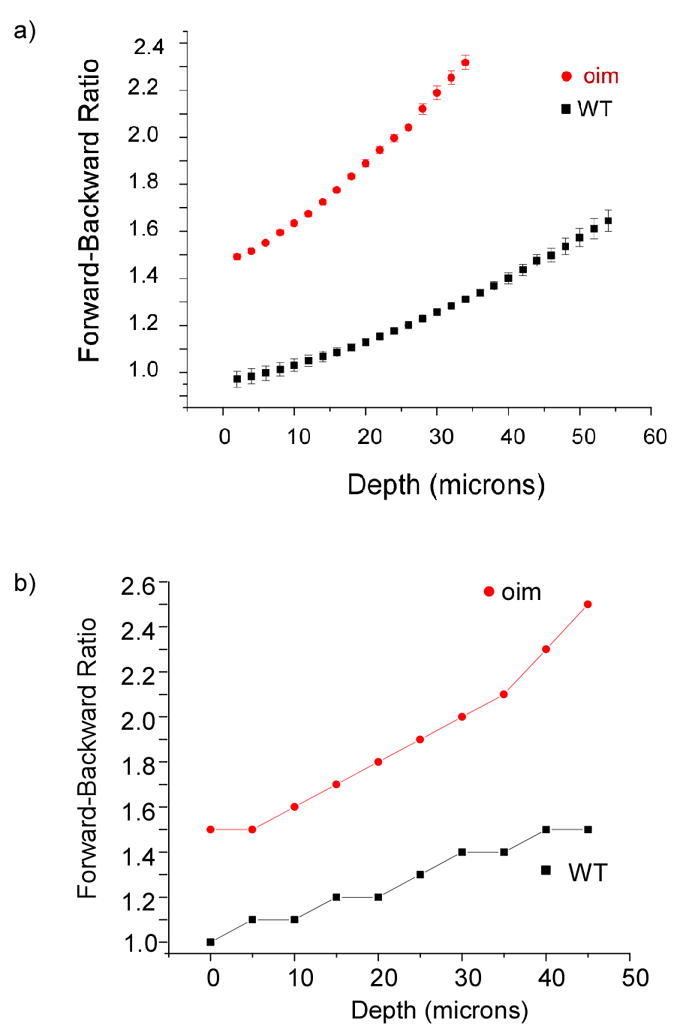
Experiment (a) and simulated (b) forward/backward intensities plotted as a function of excitation depth in WT and oim skin. The simulation used scattering parameters determined through diffuse reflectance and transmittance measurements and assumed an initial 75% and 25% distribution of (quasi)coherent forward and backward components.
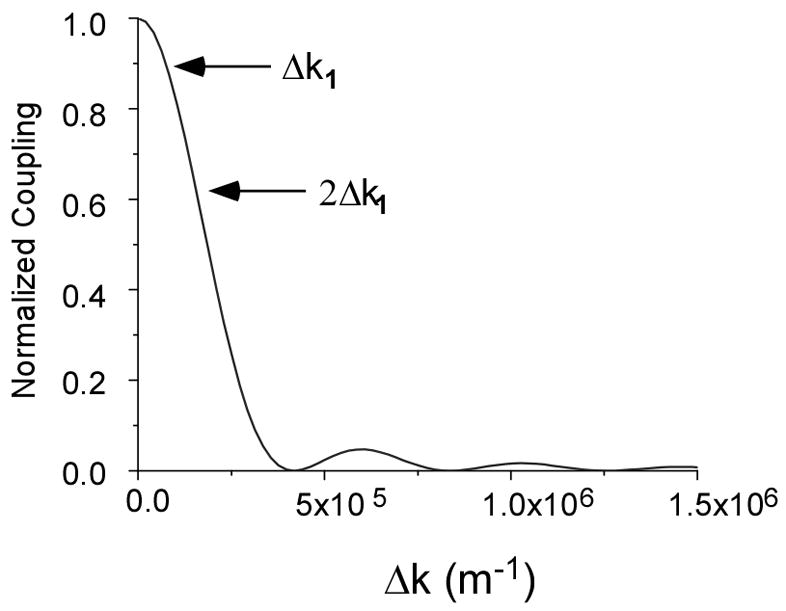
Normalized SHG coupling as function of Δk for values of Δk1 and 2Δk1. The increased phase mismatch of the wave vector results in relative decreased SHG conversion efficiency.
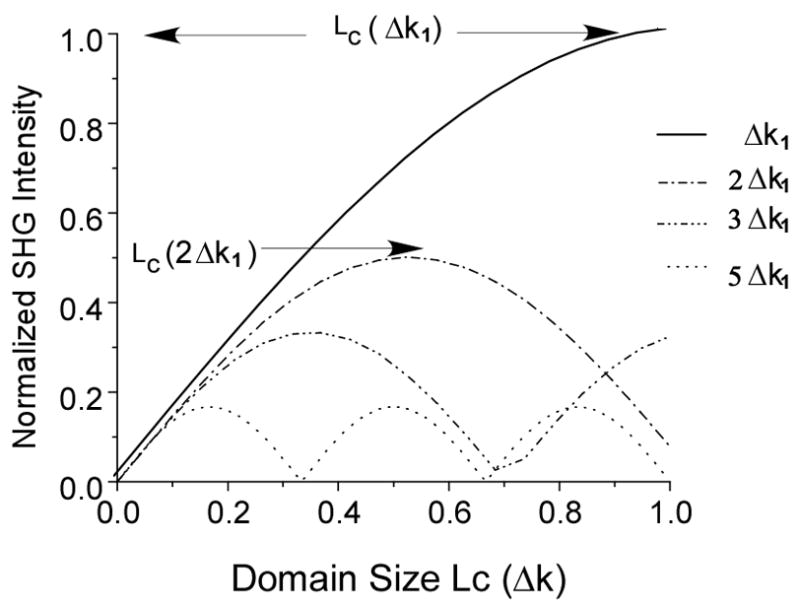
Normalized SHG buildup as functions of Δk1 and domain size. The conversion oscillates as sin(Δk L/2) and domain length, L, reaching its first maximum at the respective coherence length. The respective coherence lengths for the two largest (m=1&2) are denoted by arrows.
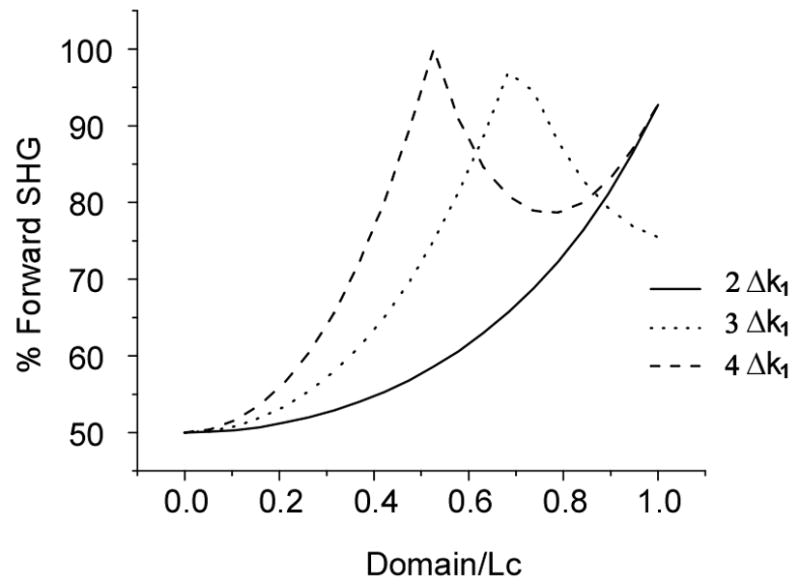
Calculated % FSHG as a function of normalized domain size for several phase matching conditions. This calculation shows that domains with values close to Lc1 will support predominantly forward emission, while smaller domains will produce essentially 50%-50% forward and backward distributions.
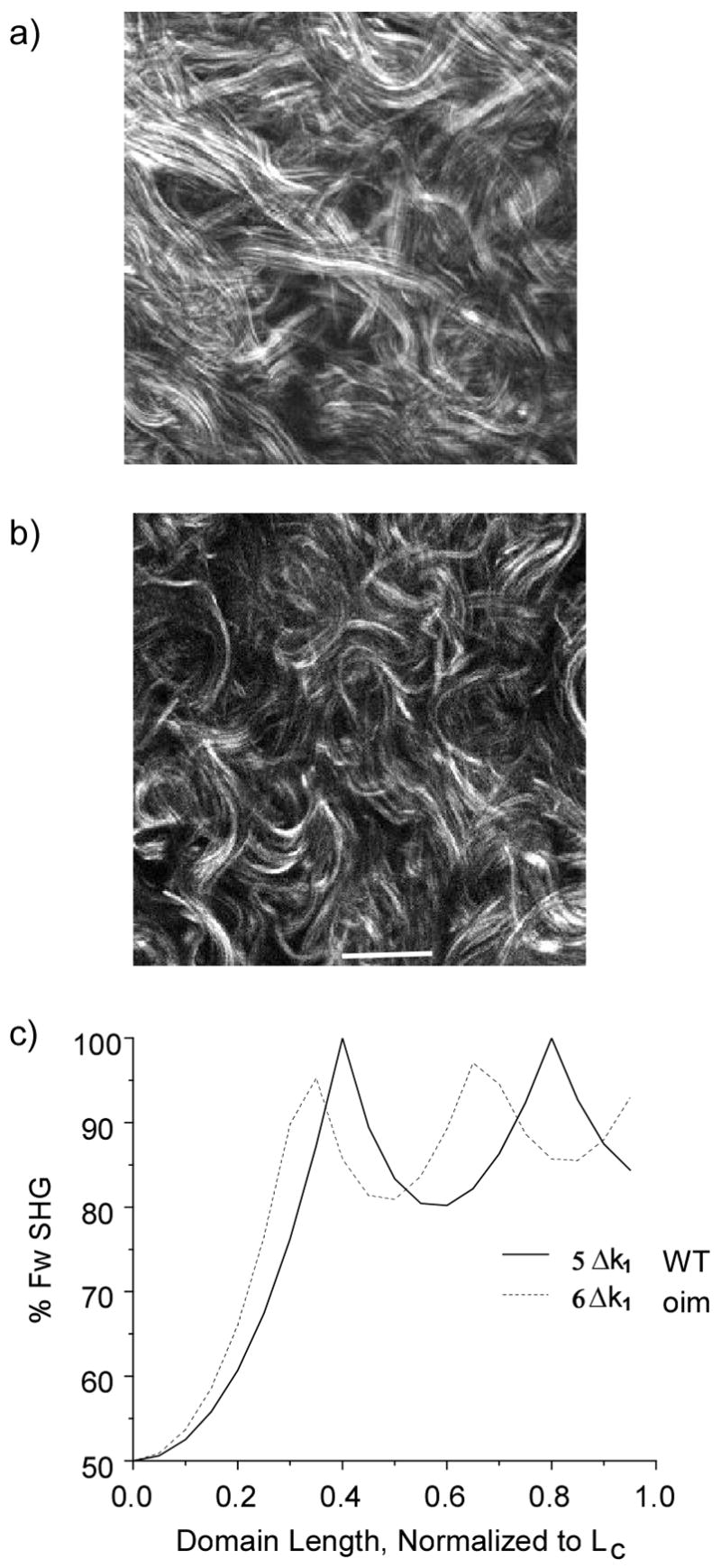
SHG images of WT and oim skin are shown in (a) and (b), respectively (Scale bar =20 microns). The oim has more random assembly. 5(c) shows the calculated %FSHG for the corresponding relative Δk values for the WT and oim skin.
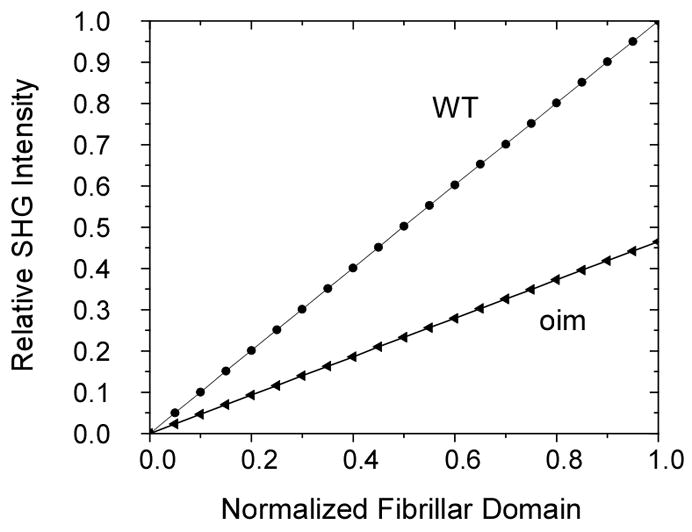
The relative SHG intensities (normalized to the maximum amplitude for WT) for both oim and WT over their respective normalized domains are calculated using the Δk values from Fig. 5. The plot appears linear as it corresponds to the beginning region on Fig. 3, where sinθ≈θ. This calculation shows that the WT will result in SHG intensities which are approximately 2.2 times larger than the oim. The experimentally ratio is approximately 2.5.
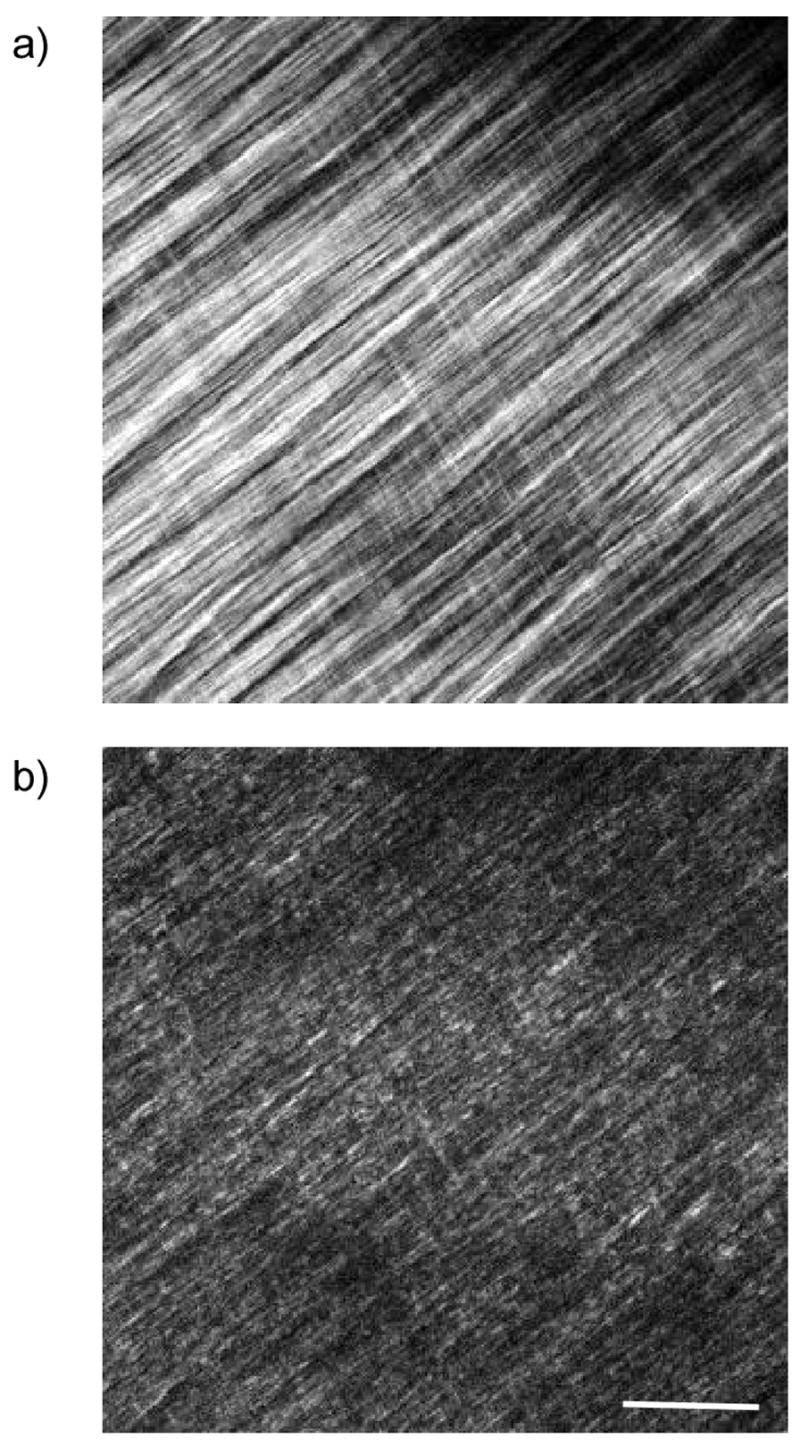
Forward (a) and Backward (b) SHG images of Valonia cellulose. Segmented features appear in the backward channel due to destructive interference. Scale bar=20 microns.
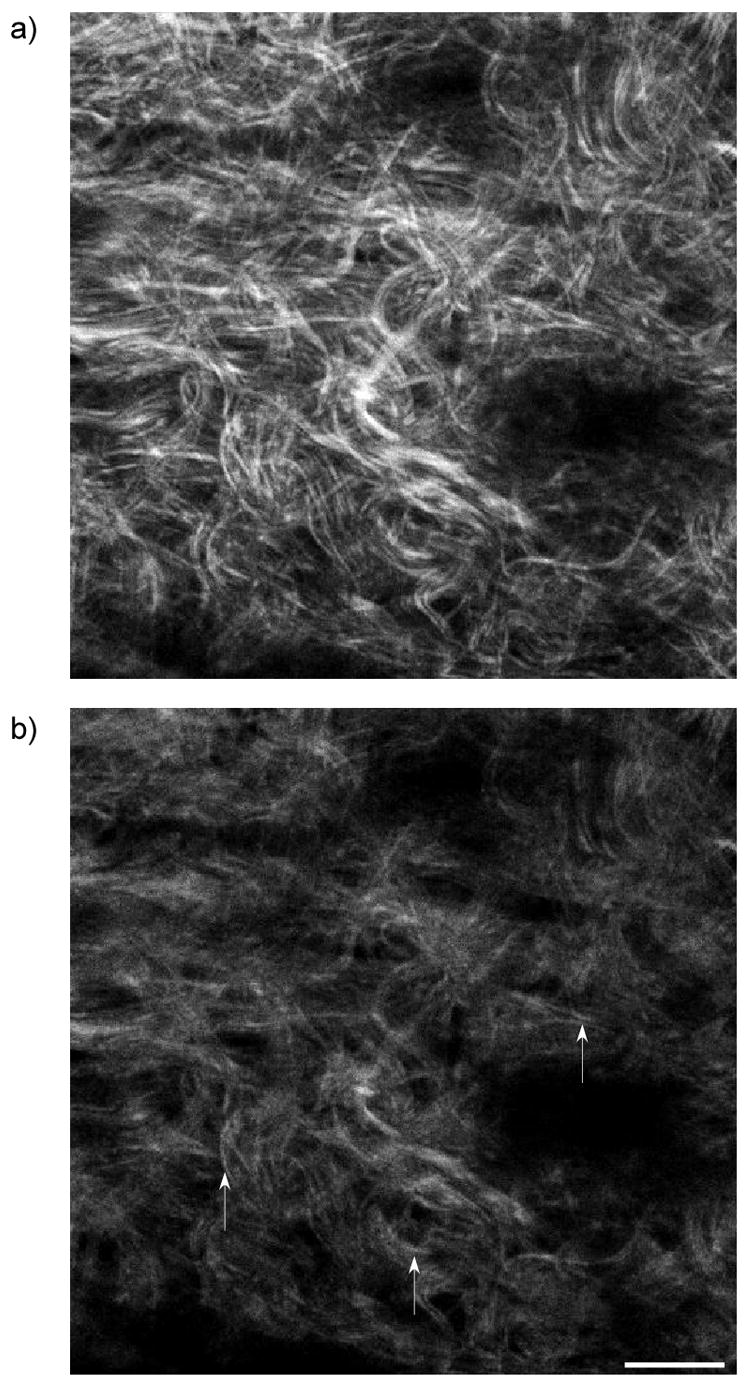
Forward (a) and backward images (b) for oim skin, where the arrows denote local areas where segmented fibrils exists in the backward channel. Scale bar=20 microns.
References
-
- Tai SP, Tsai TH, Lee WJ, Shieh DB, Liao YH, Huang HY, Zhang K, Liu HL, Sun CK. Optical biopsy of fixed human skin with backward-collected optical harmonics signals. Opt Express. 2005;13:8231–8242. - PubMed
-
- Yeh AT, Nassif N, Zoumi A, Tromberg BJ. Selective corneal imaging using combined second-harmonic generation and two-photon excited fluorescence. Opt Lett. 2002;27:2082–2084. - PubMed
Grants and funding
LinkOut - more resources
Full Text Sources
Other Literature Sources