


Stability of local brain levels of insulin-like growth factor-I in two well-characterized models of decreased plasma IGF-I
- PMID: 19343576
- PMCID: PMC3085503
- DOI: 10.1080/08977190902863639
Stability of local brain levels of insulin-like growth factor-I in two well-characterized models of decreased plasma IGF-I
Abstract
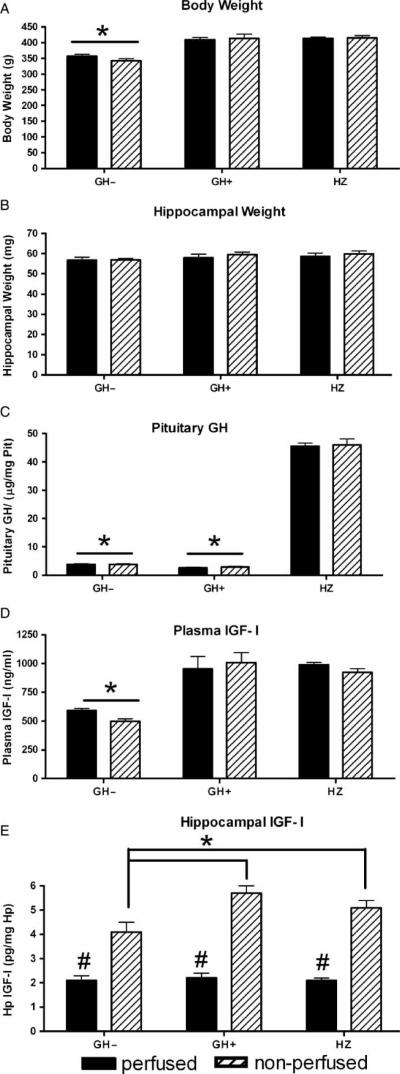
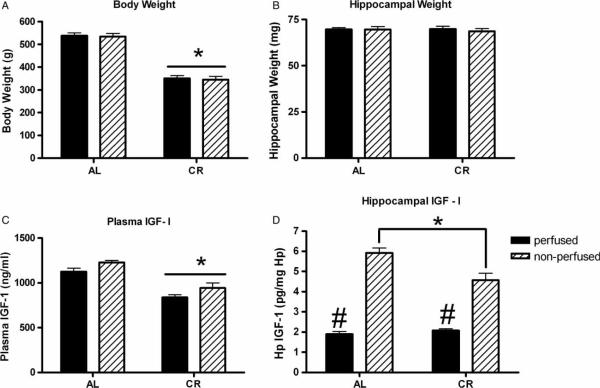
Insulin-like growth factor-I (IGF-I), a functionally important neurotrophic factor, impacts tissues throughout the body including the central nervous system. In addition to the significant proportion of IGF-I that is synthesized in the liver and released into the plasma, IGF-I is expressed locally in tissues. The present study investigated the relationship between plasma and local brain levels of IGF-I in two well-characterized models of decreased IGF-I. The first is an adult-onset growth hormone deficiency (AOGHD) model, and the second is a caloric restriction (CR) model. In the first cohort of animals from both models, the hippocampus was removed from the brain immediately following decapitation, and in the second cohort, the animals were perfused transcardially with phosphate buffered saline to remove cerebral blood prior to harvesting the hippocampus. Our results demonstrated that although the plasma IGF-I levels were decreased in the CR and AOGHD rats compared to controls, the hippocampal IGF-I levels did not differ among the groups. These data suggest that local brain IGF-I levels are regulated in a different manner than plasma IGF-I levels.
Figures
References
-
- Bondy CA, Werner H, Roberts CT, Jr, LeRoith D. Cellular pattern of insulin-like growth factor-I (IGF-I) and type I IGF receptor gene expression in early organogenesis: Comparison with IGF-II gene expression. Mol Endocrinol. 1990;4:1386–1398. - PubMed
-
- Breese CR, D'Costa A, Rollins YD, Adams C, Booze RM, Sonntag WE, Leonard S. Expression of insulin-like growth factor-1 (IGF-1) and IGF-binding protein 2 (IGF-BP2) in the hippocampus following cytotoxic lesion of the dentate gyrus. J Comp Neurol. 1996;369:388–404. - PubMed
-
- Carter CS, Ramsey MM, Ingram RL, Cashion AB, Cefalu WT, Wang ZQ, Sonntag WE. Models of growth hormone and IGF-1 deficiency: Applications to studies of aging processes and life-span determination. J Gerontol A Biol Sci Med Sci. 2002a;57:B177–B188. - PubMed
-
- Carter CS, Ramsey MM, Sonntag WE. A critical analysis of the role of growth hormone and IGF-1 in aging and lifespan. Trends Genet. 2002b;18:295–301. - PubMed
Publication types
MeSH terms
Substances
Grants and funding
LinkOut - more resources
Full Text Sources
Medical
