


Opioid receptors in the gastrointestinal tract
- PMID: 19345246
- PMCID: PMC3163293
- DOI: 10.1016/j.regpep.2009.03.012
Opioid receptors in the gastrointestinal tract
Abstract
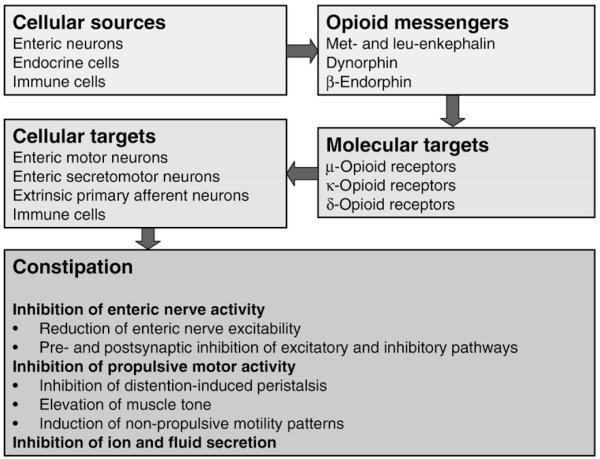
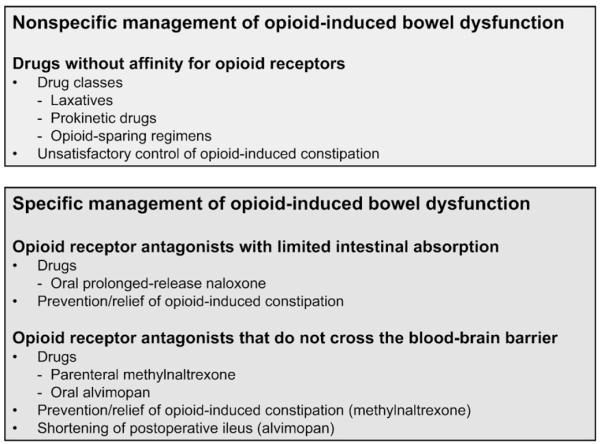
Opium is arguably one of the oldest herbal medicines, being used as analgesic, sedative and antidiarrheal drug for thousands of years. These effects mirror the actions of the endogenous opioid system and are mediated by the principal mu-, kappa- and delta-opioid receptors. In the gut, met-enkephalin, leu-enkephalin, beta-endorphin and dynorphin occur in both neurons and endocrine cells. When released, opioid peptides activate opioid receptors on the enteric circuitry controlling motility and secretion. As a result, inhibition of gastric emptying, increase in sphincter tone, induction of stationary motor patterns and blockade of peristalsis ensue. Together with inhibition of ion and fluid secretion, these effects cause constipation, one of the most frequent and troublesome adverse reactions of opioid analgesic therapy. Although laxatives are most frequently used to ameliorate opioid-induced bowel dysfunction, their efficacy is unsatisfactory. Specific antagonism of peripheral opioid receptors is a more rational approach. This goal is addressed by the use of opioid receptor antagonists with limited absorption such as oral prolonged-release naloxone and opioid receptor antagonists that do not penetrate the blood-brain barrier such as methylnaltrexone and alvimopan. Preliminary evidence indicates that peripherally restricted opioid receptor antagonists may act as prokinetic drugs in their own right.
Figures
References
-
- Holzer P, Lembeck F. Analgesia up to the twentieth century. In: Parnham MJ, Bruinvels, editors. Discoveries in Pharmacology. Psycho- and Neuro-pharmacology. Elsevier; Amsterdam: 1983. pp. 357–77.
-
- Hamilton GR, Baskett TF. In the arms of Morpheus: the development of morphine for postoperative pain relief. Can J Anaesth. 2000;47:367–74. - PubMed
-
- Lammers WJ, Lammers-van den Berg AM, Morrison JF, Petroianu GA. Translating Trendelenburg; back to the future. Naunyn Schmiedebergs Arch Pharmacol. 2006;373:134–8. - PubMed
-
- Trendelenburg P. Physiological and pharmacological investigations of small intestinal peristalsis. Arch Exp Pathol Pharmakol. 1917;81:55–129. [Translation of the article “Physiologische und pharmakologische Versuche über die Dünndarmperistaltik”] - PubMed
- Naunyn-Schmiedeberg’s Arch Pharmacol. 1917;373:101–33. - PubMed
-
- Schaumann O. Pain, the protective system and combinations with morphine-like effect. Wien Med Wschr. 1959;109:78–81. - PubMed
Publication types
MeSH terms
Substances
Grants and funding
LinkOut - more resources
Full Text Sources
Other Literature Sources
Research Materials
Miscellaneous
