


Globular tetramers of beta(2)-microglobulin assemble into elaborate amyloid fibrils
- PMID: 19345691
- PMCID: PMC2726924
- DOI: 10.1016/j.jmb.2009.03.066
Globular tetramers of beta(2)-microglobulin assemble into elaborate amyloid fibrils
Abstract
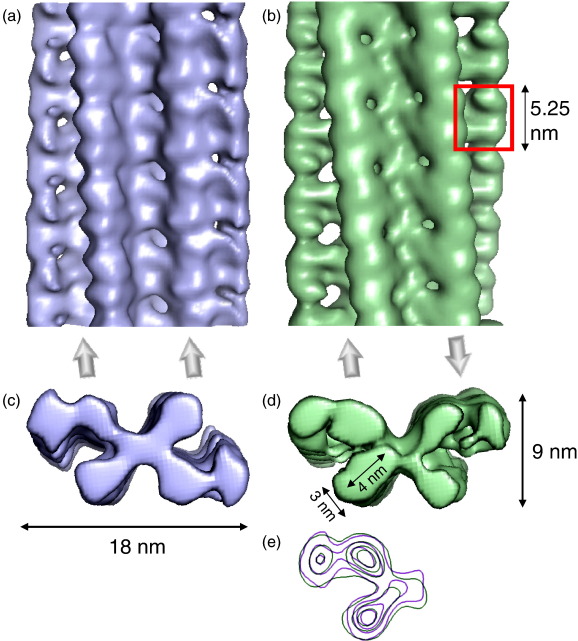
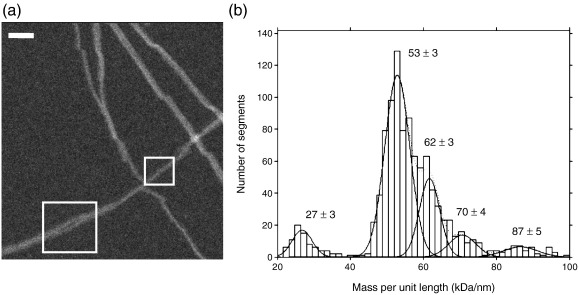
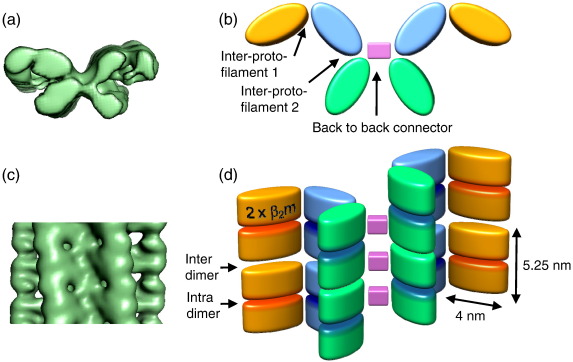
Amyloid fibrils are ordered polymers in which constituent polypeptides adopt a non-native fold. Despite their importance in degenerative human diseases, the overall structure of amyloid fibrils remains unknown. High-resolution studies of model peptide assemblies have identified residues forming cross-beta-strands and have revealed some details of local beta-strand packing. However, little is known about the assembly contacts that define the fibril architecture. Here we present a set of three-dimensional structures of amyloid fibrils formed from full-length beta(2)-microglobulin, a 99-residue protein involved in clinical amyloidosis. Our cryo-electron microscopy maps reveal a hierarchical fibril structure built from tetrameric units of globular density, with at least three different subunit interfaces in this homopolymeric assembly. These findings suggest a more complex superstructure for amyloid than hitherto suspected and prompt a re-evaluation of the defining features of the amyloid fold.
Figures
References
-
- Cohen A.S., Calkins E. Electron microscopic observations on a fibrous component in amyloid of diverse origins. Nature. 1959;183:1202–1203. - PubMed
-
- Pepys M.B. Amyloidosis. Annu. Rev. Med. 2006;57:223–241. - PubMed
-
- Fowler D.M., Koulov A.V., Balch W.E., Kelly J.W. Functional amyloid — from bacteria to humans. Trends Biochem. Sci. 2007;32:217–224. - PubMed
-
- Chiti F., Dobson C.M. Protein misfolding, functional amyloid, and human disease. Annu. Rev. Biochem. 2006;75:333–366. - PubMed
Publication types
MeSH terms
Substances
Grants and funding
LinkOut - more resources
Full Text Sources
Research Materials
