


APOBEC3G cytidine deaminase association with coronavirus nucleocapsid protein
- PMID: 19345973
- PMCID: PMC7103413
- DOI: 10.1016/j.virol.2009.03.010
APOBEC3G cytidine deaminase association with coronavirus nucleocapsid protein
Abstract
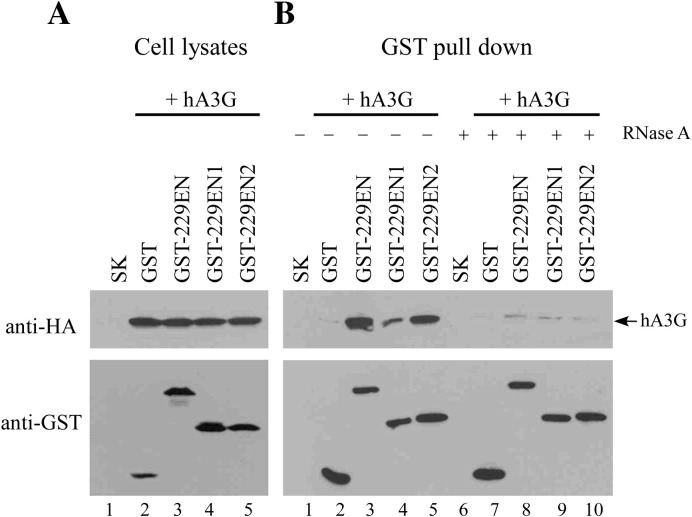
We previously reported that replacing HIV-1 nucleocapsid (NC) domain with SARS-CoV nucleocapsid (N) residues 2-213, 215-421, or 234-421 results in efficient virus-like particle (VLP) production at a level comparable to that of wild-type HIV-1. In this study we demonstrate that these chimeras are capable of packaging large amounts of human APOBEC3G (hA3G), and that an HIV-1 Gag chimera containing the carboxyl-terminal half of human coronavirus 229E (HCoV-229E) N as a substitute for NC is capable of directing VLP assembly and efficiently packaging hA3G. When co-expressed with SARS-CoV N and M (membrane) proteins, hA3G was efficiently incorporated into SARS-CoV VLPs. Data from GST pull-down assays suggest that the N sequence involved in N-hA3G interactions is located between residues 86 and 302. Like HIV-1 NC, the SARS-CoV or HCoV-229E N-associated with hA3G depends on the presence of RNA, with the first linker region essential for hA3G packaging into both HIV-1 and SARS-CoV VLPs. The results raise the possibility that hA3G is capable of associating with different species of viral structural proteins through a potentially common, RNA-mediated mechanism.
Figures


References
-
- Alce T.M., Popik W. APOBEC3G is incorporated into virus-like particles by a direct interaction with HIV-1 Gag nucleocapsid protein. J. Biol. Chem. 2004;279(33):34083–34086. - PubMed
-
- Bennett R.P., Presnyak V., Wedekind J.E., Smith H.C. Nuclear exclusion of the HIV-1 host defense factor APOBEC3G requires a novel cytoplasmic retention signal and is not dependent on RNA binding. J. Biol. Chem. 2008;283(12):7320–7327. - PubMed
Publication types
MeSH terms
Substances
LinkOut - more resources
Full Text Sources
Molecular Biology Databases
Research Materials
Miscellaneous
