


Impact of diabetes mellitus on treatment outcomes of patients with active tuberculosis
- PMID: 19346391
- PMCID: PMC2750857
Impact of diabetes mellitus on treatment outcomes of patients with active tuberculosis
Abstract
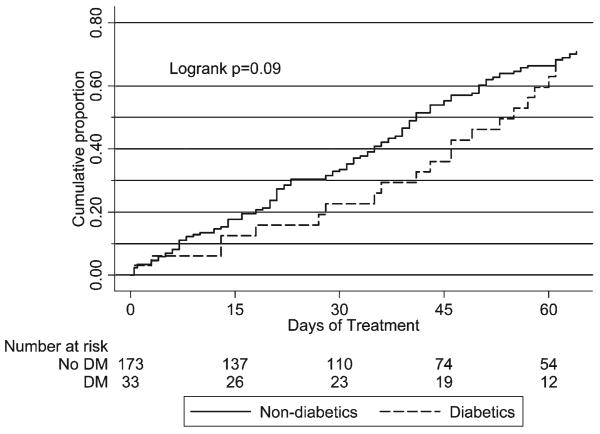
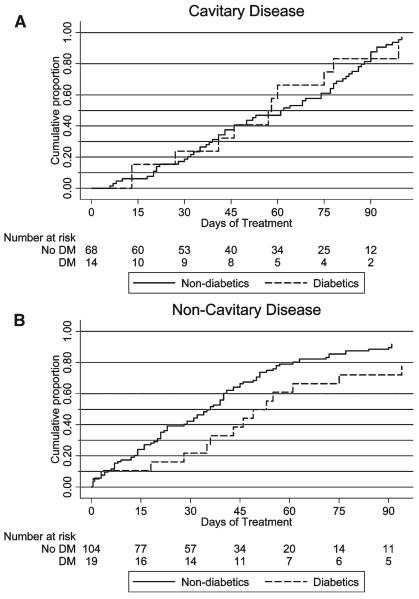
Diabetes mellitus (DM) is an emerging chronic health condition of developed and developing countries. We conducted a retrospective cohort study of patients with active, culture-confirmed tuberculosis (TB) in Maryland to determine the impact of DM on TB treatment outcomes. Of 297 TB patients, 42 (14%) had DM. Patients with diabetes had 2.0 times higher odds of death than patients without diabetes (95% confidence interval [CI] 0.74-5.2, P = 0.18). Adjusting for human immunodeficiency virus (HIV), age, weight, and foreign birth, the odds of death were 6.5 times higher in patients with diabetes than patients without diabetes (95% CI 1.1-38.0, P = 0.039). In pulmonary TB patients, time to sputum culture conversion was longer in patients with diabetes than patients without diabetes (median 49 versus 39 days, P = 0.09). Two-month culture conversion proportions were similar (70% and 69%). Treatment failure occurred in 4.1% of patients without diabetes and 6.7% of patients with diabetes (P = 0.51). In conclusion, DM was a risk factor for death in Maryland TB patients. There was a trend toward increased time to culture conversion; two-month culture conversion proportions, however, were similar.
Figures
References
-
- World Health Organization . Global Tuberculosis Control: Surveillance, Planning, Financing. WHO; Geneva: 2008.
-
- Wild S, Roglic G, Green A, Sicree R, King H. Global prevalence of diabetes: estimates for the year 2000 and projections for 2030. Diabetes Care. 2004;27:1047–1053. - PubMed
-
- National Diabetes Statistics 2007. Available at: http://diabetes.niddk.nih.gov/dm/pubs/statistics/. Accessed February 4, 2009.
-
- King H, Aubert RE, Herman WH. Global burden of diabetes, 1995–2025: prevalence, numerical estimates, and projections. Diabetes Care. 1998;21:1414–1431. - PubMed
-
- Wang JY, Lee LN, Hsueh PR. Factors changing the manifestation of pulmonary tuberculosis. Int J Tuberc Lung Dis. 2005;9:777–783. - PubMed
Publication types
MeSH terms
Substances
Grants and funding
LinkOut - more resources
Full Text Sources
Medical