. 2009 Apr 28;106(17):7167-72.
doi: 10.1073/pnas.0811313106. Epub 2009 Apr 3.

Single amino acid substitution in Plasmodium yoelii erythrocyte ligand determines its localization and controls parasite virulence

Affiliations

Single amino acid substitution in Plasmodium yoelii erythrocyte ligand determines its localization and controls parasite virulence

Hitoshi Otsuki et al. Proc Natl Acad Sci U S A. .

Abstract

The major virulence determinant of the rodent malaria parasite, Plasmodium yoelii, has remained unresolved since the discovery of the lethal line in the 1970s. Because virulence in this parasite correlates with the ability to invade different types of erythrocytes, we evaluated the potential role of the parasite erythrocyte binding ligand, PyEBL. We found 1 amino acid substitution in a domain responsible for intracellular trafficking between the lethal and nonlethal parasite lines and, furthermore, that the intracellular localization of PyEBL was distinct between these lines. Genetic modification showed that this substitution was responsible not only for PyEBL localization but also the erythrocyte-type invasion preference of the parasite and subsequently its virulence in mice. This previously unrecognized mechanism for altering an invasion phenotype indicates that subtle alterations of a malaria parasite ligand can dramatically affect host-pathogen interactions and malaria virulence.


Conflict of interest statement

The authors declare no conflict of interest.

Figures

Fig. 1.
Fig. 1.
Schematic structure of P. yoelii EBL (PyEBL). SIG, TM, R2, and R6 indicate the putative endoplasmic reticulum transporting signal, the transmembrane region, region 2, and region 6, respectively. Amino acid alignment of PyEBL from 17X, 17XL, and YM lines are shown below. Eight conserved Cys residues that form disulfide bridges (Predicted SH-bond) and the substitution from Cys to Arg (*) are indicated.
Fig. 2.
Fig. 2.
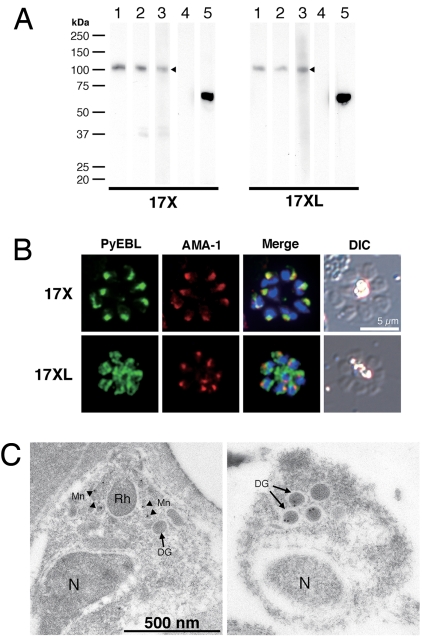
Western blot analysis and PyEBL localization in P. yoelii schizont by immunostaining. (A) Western blot analysis with mAb 5B10 (lane 1), mAb 1G10 (lanes 2), and mouse serum (lane 3) specific for PyEBL against purified P. yoelii schizont extracts. A 110-kDa band was detected in both 17X and 17XL lines, with no significant difference in the protein expression level (arrowheads). This band was not detected by normal mouse serum (lane 4). Anti-AMA1 serum detected a 66-kDa band at similar levels (lane 5). (B) P. yoelii schizonts were incubated with mAb 5B10 (PyEBL), rabbit anti-AMA1 serum (AMA1), and DAPI (blue) for nuclear staining. Schizonts labeled with anti-PyEBL (5B10) were stained with FITC secondary antibody (green). Anti-AMA1 were stained with Alexa-546 secondary antibody (red). DIC images are shown in the right-hand column. The 17X line shows apical PyEBL signal colocalized with AMA1, but the region 6–substituted 17XL line shows diffused staining that does not colocalize with AMA1. (C) Immunoelectron microcopy was carried out for resin-embedded P. yoelii 17X and 17XL lines with anti-PyEBL mouse serum and secondary antibody conjugated with gold particles. PyEBL was detected in the micronemes (arrowheads) of the 17X line, but in the 17XL line it was located in the dense granules (arrows). N, nucleus; Mn, microneme; DG, dense granule; Rh, rhoptry.
Fig. 3.
Fig. 3.
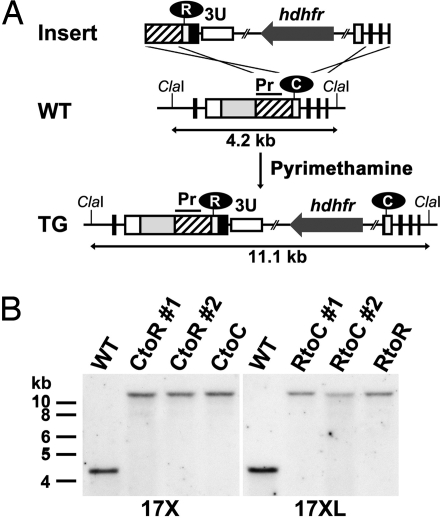
Amino acid replacement of PyEBL region 6 second cysteine location by targeted recombination. (A) Schematic representation of the WT and modified (TG) pyebl gene loci. The replacement cassette (Insert) was inserted into the pyebl gene locus by double-crossover recombination. In this schematic, the second Cys in region 6 was replaced with Arg in the 17X line to generate 17X-CtoR. Other transgenic lines were generated in a similar fashion. ClaI restriction sites and the expected size of the DNA fragment after ClaI digestion are shown. Pr, probe region used in Southern blot analysis. (B) Southern blot analysis of the pyebl gene locus in WT and transgenic parasite lines derived from P. yoelii 17X and 17XL. The absence of the 4.2-kb WT band and the presence of an 11.1-kb band indicate that the PyEBL locus was modified in all transgenic clones.
Fig. 4.
Fig. 4.
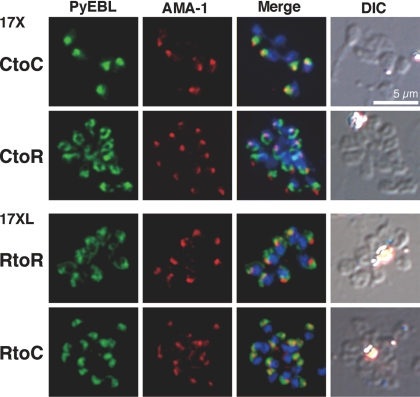
Replacement of Cys to Arg in region 6 altered subcellular localization of PyEBL. Schizonts of transgenic parasite lines were incubated with mAb 5B10 (PyEBL), rabbit anti-AMA1 serum (AMA1), and DAPI (blue) for nuclear staining. DIC images are shown in the right-hand column. In the 17X background, control (CtoC) shows an apical PyEBL signal colocalized with AMA1, but replaced (CtoR) shows a 17XL pattern. Inversely, 17XL background control (RtoR) shows a diffused nonapical pattern, but replaced to cysteine (RtoC) shows an apical signal colocalized with AMA1.
Fig. 5.
Fig. 5.
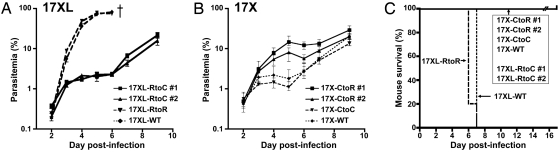
Effect of the alteration of pyebl gene loci on the course of infection and parasite virulence in mice. Mice were i.v. inoculated with 1 × 10⁶ parasitized erythrocytes from WT or transgenic parasite lines. (A) Parasitemia of 17XL-RtoC was dramatically reduced to the same level as that of the nonlethal 17X line. (B) Parasitemia of 17X-CtoR was significantly higher than parental 17X and control 17X-CtoC on days 4 and 5 (P < 0.001), the acute phase of infection; however, the pattern observed is intermediate between the lethal 17XL and nonlethal 17X lines. Parasitemias are plotted using the geometric mean and SD of log-transformed data from groups of 5 mice. (C) All mice infected with 17XL-RtoC survived, whereas all mice infected with parental 17XL and control 17XL-RtoR lines died by day 7. All mice infected with 17X, 17X-CtoC, and 17X-CtoR survived.

References

    1. Landau I, Gautret P. In: Malaria: Parasite Biology, Pathogenesis, and Protection. Sherman IW, editor. Washington, DC: American Society for Microbiology; 1998. pp. 401–417.
    1. Yoeli M, Hargreaves B, Carter R, Walliker D. Sudden increase in virulence in a strain of Plasmodium berghei yoelii. Ann Trop Med Parasitol. 1975;69:173–178. - PubMed
    1. Playfair JH, De Souza JB, Cottrell BJ. Protection of mice against malaria by a killed vaccine: Differences in effectiveness against P. yoelii and P. berghei. Immunology. 1977;33:507–515. - PMC - PubMed
    1. Miller LH, Mason SJ, Clyde DF, McGinniss MH. The resistance factor to Plasmodium vivax in blacks. The Duffy-blood-group genotype, FyFy. N Engl J Med. 1976;295:302–304. - PubMed
    1. Wertheimer SP, Barnwell JW. Plasmodium vivax interaction with the human Duffy blood group glycoprotein: Identification of a parasite receptor-like protein. Exp Parasitol. 1989;69:340–350. - PubMed

Publication types