


A shortcut to identifying small molecule signals that regulate behavior and development in Caenorhabditis elegans
- PMID: 19346493
- PMCID: PMC2683085
- DOI: 10.1073/pnas.0811918106
A shortcut to identifying small molecule signals that regulate behavior and development in Caenorhabditis elegans
Abstract
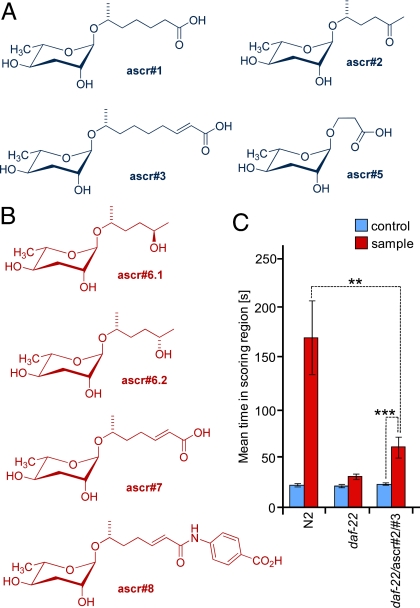
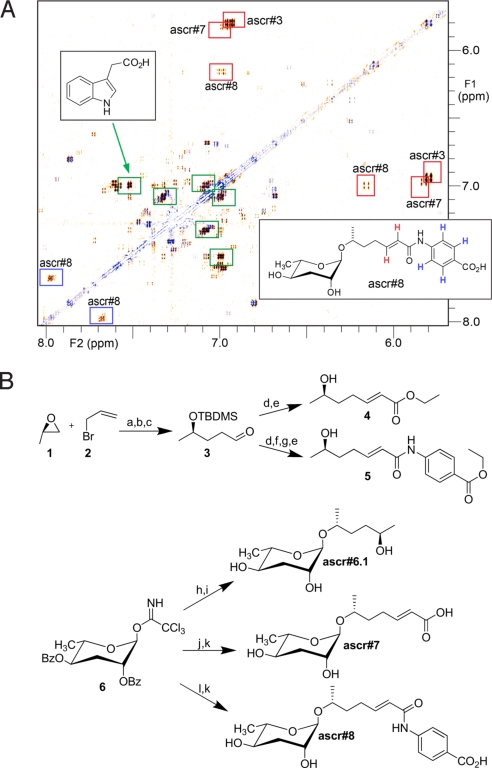
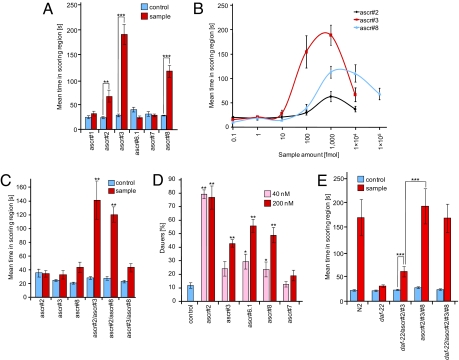
Small molecule metabolites play important roles in Caenorhabditis elegans biology, but effective approaches for identifying their chemical structures are lacking. Recent studies revealed that a family of glycosides, the ascarosides, differentially regulate C. elegans development and behavior. Low concentrations of ascarosides attract males and thus appear to be part of the C. elegans sex pheromone, whereas higher concentrations induce developmental arrest at the dauer stage, an alternative, nonaging larval stage. The ascarosides act synergistically, which presented challenges for their identification via traditional activity-guided fractionation. As a result the chemical characterization of the dauer and male attracting pheromones remained incomplete. Here, we describe the identification of several additional pheromone components by using a recently developed NMR-spectroscopic approach, differential analysis by 2D NMR spectroscopy (DANS), which simplifies linking small molecule metabolites with their biological function. DANS-based comparison of wild-type C. elegans and a signaling-deficient mutant, daf-22, enabled identification of 3 known and 4 previously undescribed ascarosides, including a compound that features a p-aminobenzoic acid subunit. Biological testing of synthetic samples of these compounds revealed additional evidence for synergy and provided insights into structure-activity relationships. Using a combination of the three most active ascarosides allowed full reconstitution of the male-attracting activity of wild-type pheromone extract. Our results highlight the efficacy of DANS as a method for identifying small-molecule metabolites and placing them within a specific genetic context. This study further supports the hypothesis that ascarosides represent a structurally diverse set of nematode signaling molecules regulating major life history traits.
Conflict of interest statement
The authors declare no conflict of interest.
Figures

Comment in
-
DANSing with Caenorhabditis elegans.Proc Natl Acad Sci U S A. 2009 May 12;106(19):7685-6. doi: 10.1073/pnas.0903021106. Epub 2009 May 5. Proc Natl Acad Sci U S A. 2009. PMID: 19416852 Free PMC article. No abstract available.
References
-
- Kaletta T, Hengartner MO. Finding function in novel targets: C. elegans as a model organism. Nat Rev Drug Discov. 2006;5:387–399. - PubMed
-
- Schroeder FC. Small molecule signaling in Caenorhabditis elegans. ACS Chem Biol. 2006;1:198–200. - PubMed
-
- Motola DL, et al. Identification of Ligands for DAF-12 that govern dauer formation and reproduction in C. elegans. Cell. 2006;124:1209–1223. - PubMed
-
- Jeong PY, et al. Chemical structure and biological activity of the Caenorhabditis elegans dauer-inducing pheromone. Nature. 2005;433:541–545. - PubMed
Publication types
MeSH terms
Substances
Grants and funding
LinkOut - more resources
Full Text Sources
Other Literature Sources
Molecular Biology Databases
Research Materials
Miscellaneous
