


Students' perception of community disapproval, perceived enforcement of school antismoking policies, personal beliefs, and their cigarette smoking behaviors: results from a structural equation modeling analysis
- PMID: 19346507
- PMCID: PMC2671461
- DOI: 10.1093/ntr/ntp033
Students' perception of community disapproval, perceived enforcement of school antismoking policies, personal beliefs, and their cigarette smoking behaviors: results from a structural equation modeling analysis
Abstract
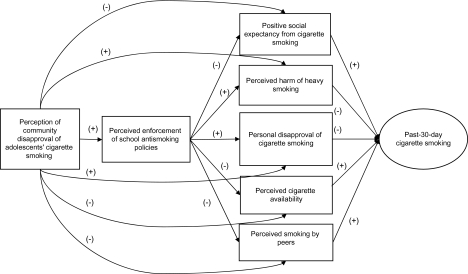
Introduction: School tobacco use policies are often considered to be part of a comprehensive approach to preventing or reducing adolescent cigarette smoking. However, little is known about the relationships between such policies and adolescents' smoking behaviors or the mechanisms by which any such influence may occur. The present study tested a conceptual model that specifies possible direct and indirect relationships among community norms, school antismoking policies, adolescents' personal smoking beliefs, and cigarette smoking behaviors.
Methods: This study used data from 17,256 middle and high school students who participated in the 2006 Oregon Health Teens Survey.
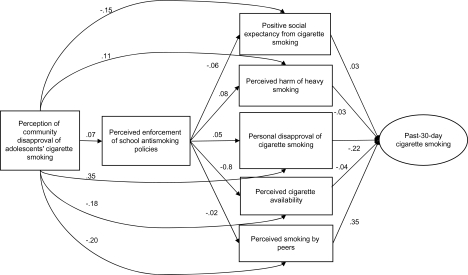
Results: Structural equation modeling indicated that perceived enforcement of school policy was directly and positively related to perceived community norms. In addition, adolescents' personal beliefs appeared to mediate the relationship between perceived enforcement of school antismoking policies and past-30-day cigarette smoking. School policies, in turn, partially mediated the relationship between community norms and smoking beliefs.
Discussion: The results of this study provide a better understanding of how community norms and school antismoking policies may affect adolescents' cigarette smoking.
Figures
References
-
- Altman DG, Wheelis AY, McFarlane M, Lee H, Fortmann SP. The relationship between tobacco access and use among adolescents: A four community study. Social Science and Medicine. 1999;48:759–775. - PubMed
-
- Andrews JA, Duncan SC. The effect of attitude on the development of adolescent cigarette use. Journal of Substance Abuse. 1998;10:1–7. - PubMed
-
- Arday DR, Giovino GA, Schulman J. Cigarette smoking and self-reported health problems among U.S high school seniors, 1982–1989. American Journal of Health Promotion. 1995;10:111–116. - PubMed
-
- Bandura A. Social foundations of thought and action: A social cognitive perspective. Englewood Cliffs, NJ: Princeton-Hall; 1986.
-
- Bentler PM. EQS for Windows, 6.1. Encino, CA: Multivariate Software; 1985–2004.
Publication types
MeSH terms
Grants and funding
LinkOut - more resources
Full Text Sources
Medical
Miscellaneous
