


An in vivo model of melanoma: treatment with ATP
- PMID: 19347609
- PMCID: PMC2717314
- DOI: 10.1007/s11302-009-9156-0
An in vivo model of melanoma: treatment with ATP
Abstract
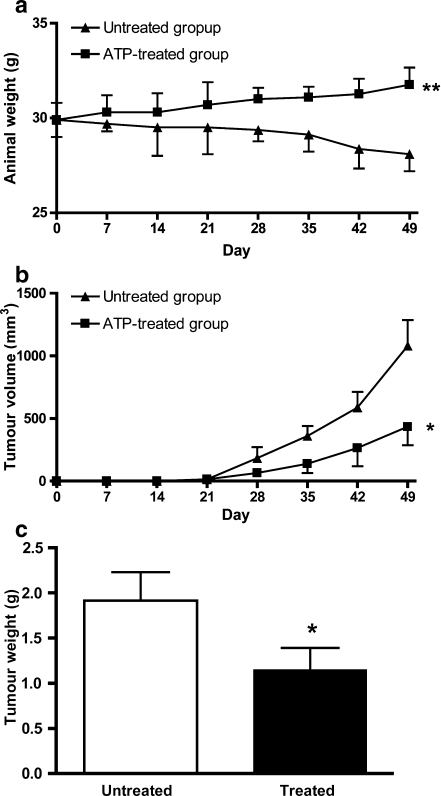
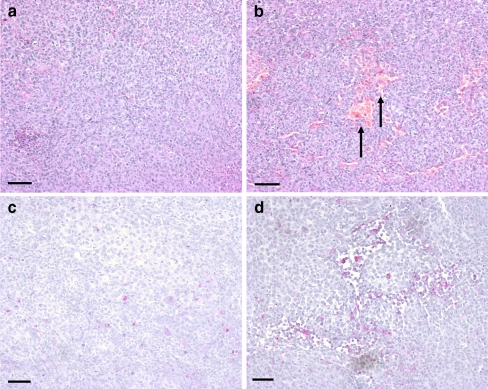
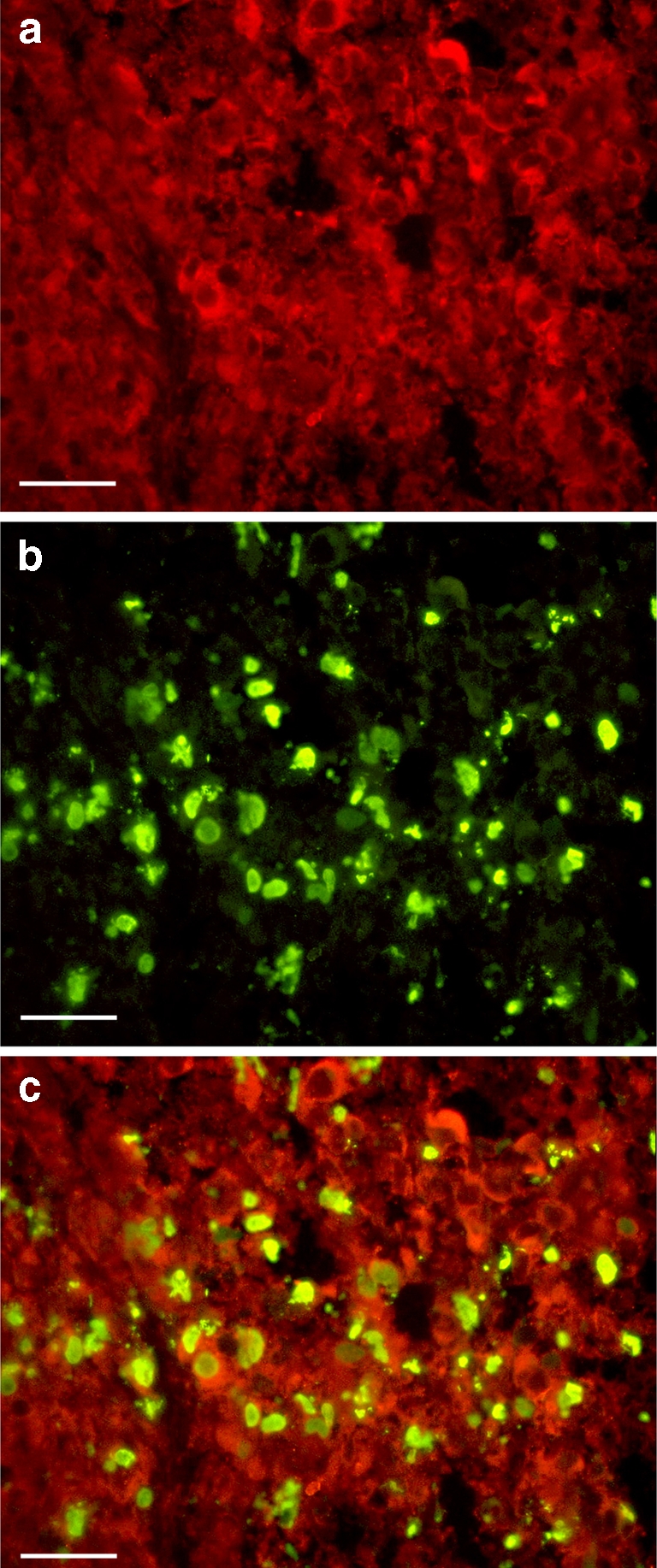
Athymic mice, injected with A375 human melanoma cells, were treated daily with intraperitoneal injections of adenosine 5'-triphosphate (ATP). The tumour volume and animal weight were measured over the course of the experiment and the final tumour nodule weight was measured at the end of the experiment. Tumour volume decreased by nearly 50% by 7 weeks in treated mice. Weight loss in untreated animals was prevented by ATP. Histological examination of the excised tumour nodules showed necrosis in the ATP-treated tumours only. The presence of P2Y(1) and P2X(7) receptors, previously proposed as extracellular targets for melanoma treatment with ATP, were demonstrated in the excised specimens by immunohistochemistry. This paper provides further support for the use of ATP as a treatment for melanoma.
Figures
Similar articles
-
Osteoblast responses to nucleotides increase during differentiation.Bone. 2006 Aug;39(2):300-9. doi: 10.1016/j.bone.2006.02.063. Epub 2006 Apr 17. Bone. 2006. PMID: 16616882
-
Involvement of peripheral adenosine 5'-triphosphate and P2X purinoceptor in pain-related behavior produced by orthotopic melanoma inoculation in mice.Eur J Neurosci. 2010 May;31(9):1629-36. doi: 10.1111/j.1460-9568.2010.07185.x. Eur J Neurosci. 2010. PMID: 20525075
-
Extracellular adenosine 5'-triphosphate modulates insulin secretion via functionally active purinergic receptors of X and Y subtype.Endocrinology. 2009 Jun;150(6):2596-602. doi: 10.1210/en.2008-1486. Epub 2009 Feb 5. Endocrinology. 2009. PMID: 19196799
-
P2Y and P2X purinoceptor mediated Ca2+ signalling in glial cell pathology in the central nervous system.Eur J Pharmacol. 2002 Jul 5;447(2-3):247-60. doi: 10.1016/s0014-2999(02)01756-9. Eur J Pharmacol. 2002. PMID: 12151016 Review.
-
Molecular physiology of P2 receptors in the central nervous system.Eur J Pharmacol. 2004 Jan 1;483(1):5-17. doi: 10.1016/j.ejphar.2003.10.030. Eur J Pharmacol. 2004. PMID: 14709321 Review.
Cited by
-
Shikonin inhibits proliferation of melanoma cells by MAPK pathway-mediated induction of apoptosis.Biosci Rep. 2021 Jan 29;41(1):BSR20203834. doi: 10.1042/BSR20203834. Biosci Rep. 2021. PMID: 33403388 Free PMC article.
-
Activation of hypermethylated P2RY1 mitigates gastric cancer by promoting apoptosis and inhibiting proliferation.Open Life Sci. 2023 Mar 3;18(1):20220078. doi: 10.1515/biol-2022-0078. eCollection 2023. Open Life Sci. 2023. PMID: 36879646 Free PMC article.
-
UTP increases wound healing in the self assembled skin substitute (SASS).J Cell Commun Signal. 2023 Sep;17(3):827-844. doi: 10.1007/s12079-023-00725-2. Epub 2023 Feb 1. J Cell Commun Signal. 2023. PMID: 36723784 Free PMC article.
-
Biological properties of acidic cosmetic water from seawater.Int J Mol Sci. 2012;13(5):5952-5971. doi: 10.3390/ijms13055952. Epub 2012 May 16. Int J Mol Sci. 2012. PMID: 22754342 Free PMC article.
-
Purine and purinergic receptors.Brain Neurosci Adv. 2018 Dec 6;2:2398212818817494. doi: 10.1177/2398212818817494. eCollection 2018 Jan-Dec. Brain Neurosci Adv. 2018. PMID: 32166165 Free PMC article. Review.
References
-
- None
- Grin-Jorgensen CM, Rigel DS, Friedman RJ (1992) The world-wide incidence of malignant melanoma. In: Balch CM (ed) Cutaneous melanoma. Lippincott Williams & Wilkins, Philadelphia, pp 27–39
-
- {'text': '', 'ref_index': 1, 'ids': [{'type': 'DOI', 'value': '10.1084/jem.184.4.1385', 'is_inner': False, 'url': 'https://doi.org/10.1084/jem.184.4.1385'}, {'type': 'PMC', 'value': 'PMC2192845', 'is_inner': False, 'url': 'https://pmc.ncbi.nlm.nih.gov/articles/PMC2192845/'}, {'type': 'PubMed', 'value': '8879211', 'is_inner': True, 'url': 'https://pubmed.ncbi.nlm.nih.gov/8879211/'}]}
- Hara M, Toyoda M, Yaar M, Bhawan J, Avila EM, Penner IR, Gilchrest BA (1996) Innervation of melanocytes in human skin. J Exp Med 184:1385–1395. doi:10.1084/jem.184.4.1385 - PMC - PubMed
-
- {'text': '', 'ref_index': 1, 'ids': [{'type': 'DOI', 'value': '10.1006/exer.2000.0869', 'is_inner': False, 'url': 'https://doi.org/10.1006/exer.2000.0869'}, {'type': 'PubMed', 'value': '10973730', 'is_inner': True, 'url': 'https://pubmed.ncbi.nlm.nih.gov/10973730/'}]}
- Hu DN, Woodward DF, McCormick SA (2000) Influence of autonomic neurotransmitters on human uveal melanocytes in vitro. Exp Eye Res 71:217–224. doi:10.1006/exer.2000.0869 - PubMed
-
- {'text': '', 'ref_index': 1, 'ids': [{'type': 'DOI', 'value': '10.1111/1523-1747.ep12470585', 'is_inner': False, 'url': 'https://doi.org/10.1111/1523-1747.ep12470585'}, {'type': 'PubMed', 'value': '1850772', 'is_inner': True, 'url': 'https://pubmed.ncbi.nlm.nih.gov/1850772/'}]}
- Brocker EB, Magiera H, Herlyn M (1991) Nerve growth and expression of receptors for nerve growth factor in tumors of melanocyte origin. J Invest Dermatol 96:662–665. doi:10.1111/1523-1747.ep12470585 - PubMed
-
- {'text': '', 'ref_index': 1, 'ids': [{'type': 'DOI', 'value': '10.1007/s00018-007-6497-0', 'is_inner': False, 'url': 'https://doi.org/10.1007/s00018-007-6497-0'}, {'type': 'PMC', 'value': 'PMC11149472', 'is_inner': False, 'url': 'https://pmc.ncbi.nlm.nih.gov/articles/PMC11149472/'}, {'type': 'PubMed', 'value': '17375261', 'is_inner': True, 'url': 'https://pubmed.ncbi.nlm.nih.gov/17375261/'}]}
- Burnstock G (2007) Purine and pyrimidine receptors. Cell Mol Life Sci 64:1471–1483. doi:10.1007/s00018-007-6497-0 - PMC - PubMed
LinkOut - more resources
Full Text Sources
Other Literature Sources
