Comment
. 2009 Apr;119(4):755-8.
doi: 10.1172/jci38831.

Preventing and exploiting the oncogenic potential of integrating gene vectors

Affiliations
Comment

Preventing and exploiting the oncogenic potential of integrating gene vectors

Ute Modlich et al. J Clin Invest. 2009 Apr.

Abstract

Gene therapy requires efficient gene delivery to cure or prevent disease by modifying the genome of somatic cells. However, gene vectors, which insert themselves into the host genome in order to achieve persistent protein expression, can trigger oncogenesis by upregulating cellular protooncogenes. This adverse event, known as insertional mutagenesis, has become a major hurdle in the field. Vectors developed on the basis of lentiviruses are considered to be less genotoxic than the hitherto used gamma-retroviral vectors. For their report in this issue of the JCI, Montini et al. utilized a tumor-prone mouse model to identify the genetic determinants of insertional mutagenesis (see the related article beginning on page 964). They report that the lentiviral integration pattern and additional improvements in vector design reduce the genotoxic risk. These findings will inform future vector design with the goal of limiting genotoxicity for gene therapy or increasing genotoxicity for protooncogene discovery.


Figures
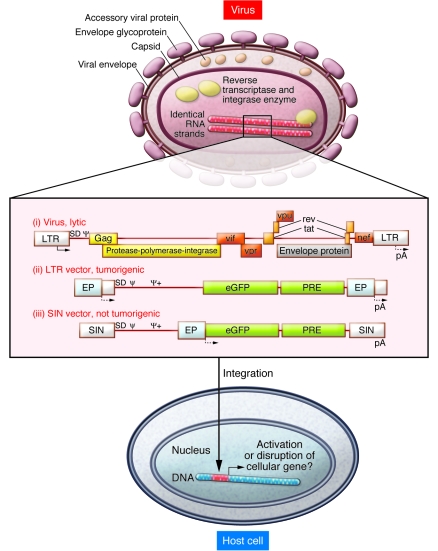
Figure 1
Figure 1. Oncogenic potential of integrating gene vectors.
Schema of a lentiviral particle with its mRNA genome embedded in the capsid is shown. Upon cell infection, viral mRNA is reverse transcribed into double-stranded DNA and transported into the nucleus. Chromosomal integration is mediated by the viral integrase and associated cellular proteins. Integration site selection is semirandom, with a preference for active transcription units. Adjacent cellular genes can be activated or disrupted, depending on interaction with the cis-regulatory sequences of the integrated virally transmitted DNA. Wild-type HIV-1 expresses several structural and regulatory proteins that kill cells by various cytopathic effects (i). The study by Montini et al. (15) in this issue of JCI shows that lentiviral vectors engineered to express a gene cassette of interest (shown here as enhanced GFP [eGFP] followed by a posttranscriptional regulatory element [PRE]) can be tumorigenic if a strong enhancer-promoter (EP) is introduced into the LTR (ii). Gene activation may involve a splice event through the splice donor (SD) present in the vector backbone and insufficient termination at the polyadenylation signal (pA). Vectors with a SIN LTR carry the EP in an internal position and were not tumorigenic in the Cdkn2a knockout mouse model (iii). Potential oncogenic consequences of gene disruption or internal EP sequences interacting with adjacent cellular promoters remain to be determined. Arrows denote transcriptional start sites; Ψ, packaging signal; Ψ+, extended Ψ; Gag, group-specific antigen; vif, virulence factor; vpr, viral protein R; vpu, viral protein U; rev, regulator of expression of viral proteins; tat, transactivator; nef, negative factor.

Comment on

References

    1. Wu X., Li Y., Crise B., Burgess S.M. Transcription start regions in the human genome are favored targets for MLV integration. Science. 2003;300:1749–1751. doi: 10.1126/science.1083413. - DOI - PubMed
    1. Cattoglio C., et al. Hot spots of retroviral integration in human CD34+ hematopoietic cells. Blood. 2007;110:1770–1778. doi: 10.1182/blood-2007-01-068759. - DOI - PubMed
    1. Uren A.G., Kool J., Berns A., van Lohuizen M. Retroviral insertional mutagenesis: past, present and future. Oncogene. 2005;24:7656–7672. doi: 10.1038/sj.onc.1209043. - DOI - PubMed
    1. Williams D.A., Lemischka I.R., Nathan D.G., Mulligan R.C. Introduction of new genetic material into pluripotent haematopoietic stem cells of the mouse. Nature. 1984;310:476–480. doi: 10.1038/310476a0. - DOI - PubMed
    1. Li Z., et al. Murine leukemia induced by retroviral gene marking. Science. 2002;296:497. - PubMed

Publication types