


Preventing and exploiting the oncogenic potential of integrating gene vectors
- PMID: 19348042
- PMCID: PMC2662574
- DOI: 10.1172/jci38831
Preventing and exploiting the oncogenic potential of integrating gene vectors
Abstract
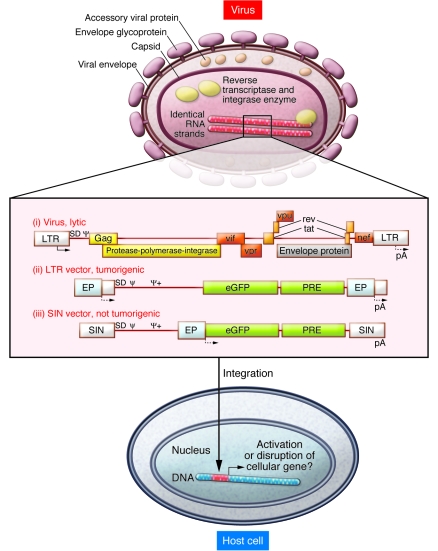
Gene therapy requires efficient gene delivery to cure or prevent disease by modifying the genome of somatic cells. However, gene vectors, which insert themselves into the host genome in order to achieve persistent protein expression, can trigger oncogenesis by upregulating cellular protooncogenes. This adverse event, known as insertional mutagenesis, has become a major hurdle in the field. Vectors developed on the basis of lentiviruses are considered to be less genotoxic than the hitherto used gamma-retroviral vectors. For their report in this issue of the JCI, Montini et al. utilized a tumor-prone mouse model to identify the genetic determinants of insertional mutagenesis (see the related article beginning on page 964). They report that the lentiviral integration pattern and additional improvements in vector design reduce the genotoxic risk. These findings will inform future vector design with the goal of limiting genotoxicity for gene therapy or increasing genotoxicity for protooncogene discovery.
Figures
Comment on
-
The genotoxic potential of retroviral vectors is strongly modulated by vector design and integration site selection in a mouse model of HSC gene therapy.J Clin Invest. 2009 Apr;119(4):964-75. doi: 10.1172/JCI37630. Epub 2009 Mar 23. J Clin Invest. 2009. PMID: 19307726 Free PMC article.
References
-
- Li Z., et al. Murine leukemia induced by retroviral gene marking. Science. 2002;296:497. - PubMed
