. 2009 Apr 2;458(7238):655-9.
doi: 10.1038/nature07763.

Clustering of InsP3 receptors by InsP3 retunes their regulation by InsP3 and Ca2+

Affiliations

Clustering of InsP3 receptors by InsP3 retunes their regulation by InsP3 and Ca2+

Taufiq-Ur-Rahman et al. Nature. .

Abstract

The versatility of Ca2+ signals derives from their spatio-temporal organization. For Ca2+ signals initiated by inositol-1,4,5-trisphosphate (InsP3), this requires local interactions between InsP3 receptors (InsP3Rs) mediated by their rapid stimulation and slower inhibition\ by cytosolic Ca2+. This allows hierarchical recruitment of Ca2+ release events as the InsP3 concentration increases. Single InsP3Rs respond first, then clustered InsP3Rs open together giving a local 'Ca2+ puff', and as puffs become more frequent they ignite regenerative Ca2+ waves. Using nuclear patch-clamp recording, here we demonstrate that InsP3Rs are initially randomly distributed with an estimated separation of 1 m. Low concentrations of InsP3 cause InsP3Rs to aggregate rapidly and reversibly into small clusters of about four closely associated InsP3Rs. At resting cytosolic [Ca2+], clustered InsP3Rs open independently, but with lower open probability, shorter open time, and less InsP3 sensitivity than lone InsP3Rs. Increasing cytosolic [Ca2+] reverses the inhibition caused by clustering, InsP3R gating becomes coupled, and the duration of multiple openings is prolonged. Clustering both exposes InsP3Rs to local Ca2+ rises and increases the effects of Ca2+. Dynamic regulation of clustering by InsP3 retunes InsP3R sensitivity to InsP3 and Ca2+, facilitating hierarchical recruitment of the elementary events that underlie all InsP3-evoked Ca2+ signals.


Figures
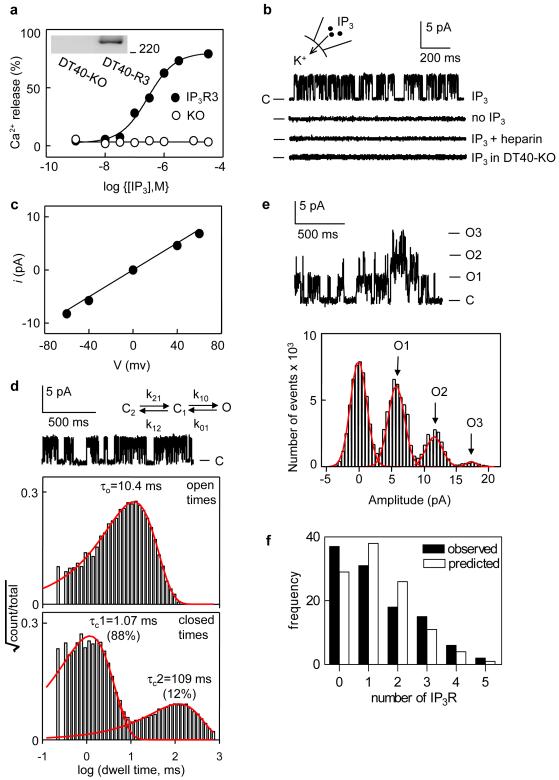
Figure 1
Figure 1. IP3R are randomly distributed
a, IP3-evoked Ca2+ release from permeabilized DT40-IP3R3 (EC50 = 281 ± 46 nM) and DT40-KO cells (means ± SEM, n ≥ 3). Immunoblot with IP3R3-specific antiserum (10 μg membrane protein/lane, 220-kDa marker shown). b, Currents recorded from excised patches with 10 μM IP3 in PS. No currents were detected without IP3 (n = 20), with heparin (100 μg/ml) and IP3 (n = 15), or with IP3 in DT40-KO cells (n > 30). C denotes closed state. c, i-V relationship for IP3-evoked current (γK = 121 ± 2.8 pS, n = 7). d, Dwell time distribution of single IP3R3 stimulated with 10 μM IP3. Open time distribution of this typical recording is fitted with a single probability density function (pdf) with τo = 10.4 ms (mean = 11.9 ± 1.6 ms, n = 6). The pdf for the τc distribution has two components (1.07 ms, 88% and 109 ms, 12%). Dwell time distributions are consistent with the gating scheme (Supplementary Methods, Supplementary Figs 5, 6). e, Typical all-points current amplitude histogram of an excised patch containing 3 IP3R stimulated with 10 μM IP3; C and O denote closed and open states. f, Observed and predicted numbers of IP3R/patch from 109 patches (mean = 1.34) stimulated with 10-100 μM IP3.
Figure 2
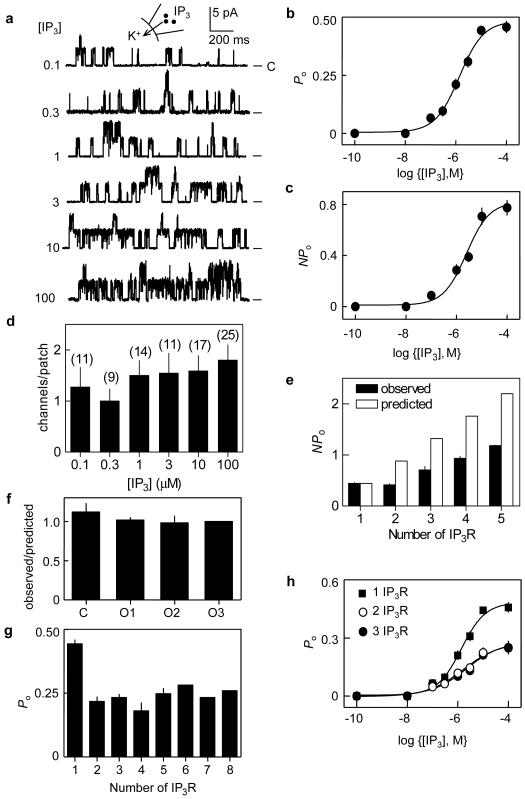
Figure 2. Lone IP3R are more active than clustered IP3R at resting cytosolic Ca2+
a, Typical records from patches (2 IP3R/patch) stimulated with IP3 (μM). b, c, Effect of IP3 on Po of patches containing a single IP3R (b) or on NPo of patches with 3 IP3R (c) (n ≥ 4). d, Numbers of IP3R detected in each patch for each IP3 concentration (n = 9-25). e, Predicted (ie NPlone) and observed NPo for patches containing 1-5 IP3R (n ≥ 3; n = 2 for 5-IP3R patch). f, For patches with 3 IP3R, observed/predicted values are shown for the indicated numbers of simultaneous openings (Supplementary equation 4). g, Po as a function of the number of IP3R within a patch after stimulation with 10 μM IP3 (Supplementary equation 5). h, Effect of IP3 on Po for lone IP3R and IP3R within multi-IP3R patches (n ≥ 4).
Figure 3
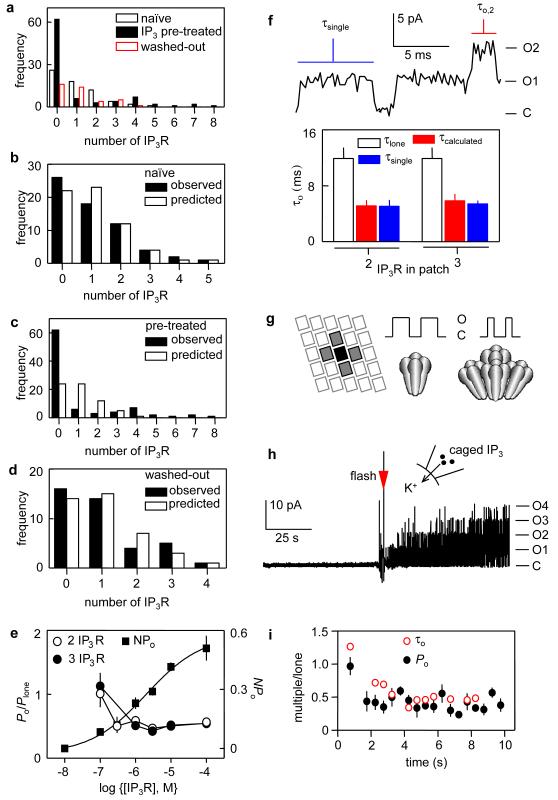
Figure 3. Reversible clustering of IP3R by IP3
a, Numbers of IP3R detected in patches from naive nuclei (n = 63), after pre-treatment with bath-applied IP3 (10 μM, ~2 min; n = 88), or the latter after recovery for 8-10 min without IP3 (n = 40). b-d, Observed and predicted numbers of IP3R/patch. e, Effects of IP3 on IP3R clustering and gating. Clustering is reported by Po/Plone for patches with 2 or 3 IP3R, and gating by NPo for patches with 2 IP3R (EC50 = 2.02 ± 0.20 μM). f, τo for patches with 2 or 3 IP3R measured from the duration of single channel openings (blue line, τsingle) or calculated from the duration of openings to the Nth level (red line, τcalculated = No,N). These are compared with τo for lone IP3R (τlone). Typical trace is from a patch with 2 IP3R. g, IP3 drives IP3R into small clusters consistent with arrays (grey) formed by IP3R at high density. Within a cluster, each IP3R opens independently, but closes more rapidly than a lone IP3R. h, Typical recording from a patch containing 4 IP3R with IP3 released from caged IP3 in PS by flash photolysis (electrical noise caused by the flash is shown). i, From records similar to h (Supplementary Fig. 8), Po (from NPo/N) and τo were measured during each 0.5 s interval after the flash (1.5 s for first interval). The ratio (multi-IP3R patch/lone IP3R) is shown for both τo and Po. Results (means ± SEM) are from 4 (single) and 7 (multiple, with 2-4 IP3R/patch) patches.
Figure 4
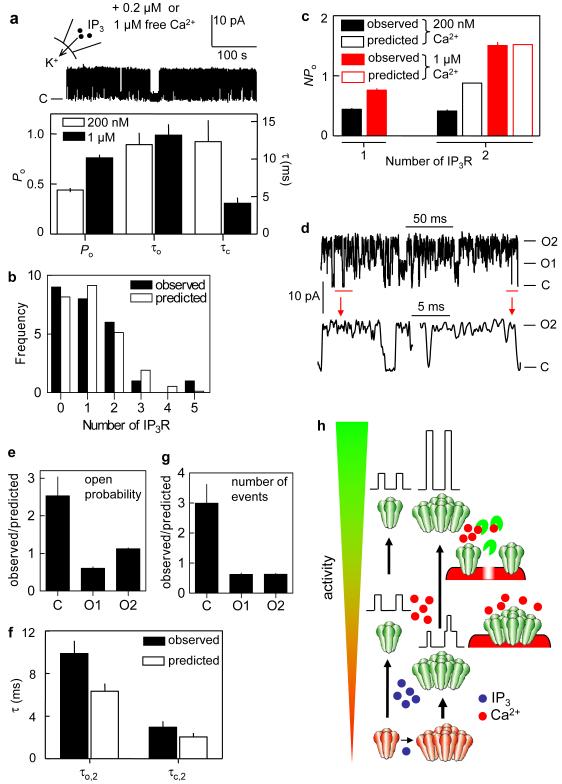
Figure 4. Clustering retunes Ca2+ regulation of IP3R
a-e, Patches were stimulated with PS containing 10 μM IP3 and (unless otherwise stated) 1 μM Ca2+. a, Typical recording and summary data (n = 5-6) from lone IP3R show that increasing Ca2+ increases Po by reducing τc. b, Observed and expected numbers of IP3R/patch. c, Observed and predicted NPo for patches containing 1 or 2 IP3R and stimulated with 10 μM IP3 in PS containing 200 nM or 1 μM Ca2+ (n = 5-6). d, Typical recording from a patch with 2 IP3R, enlarged (red) to highlight transitions directly between closed (C) and double open (O2) states. e, Observed and predicted Po for closed (C) and single (O1) or double openings (O2) for patches with 2 IP3R (n = 6, Supplementary equations 4, 5). f, Observed and expected durations of events when both IP3R are simultaneously open (τo,2) or closed (τc,2) for patches with 2 IP3R (n = 6, Supplementary equations 6, 7). g, Observed and predicted numbers of transitions to each of the 3 states in a patch with 2 IP3R (n = 6). h, At resting [Ca2+], IP3 drives IP3R into small clusters wherein IP3R gate independently, but with reduced Po and IP3 sensitivity. Ca2+ reverses the inhibition imposed by clustering, openings within a cluster are more synchronized, and simultaneous openings are prolonged. Clustering primes IP3R to respond by repressing their activity, and then allowing Ca2+ to unleash the coordinated gating of clustered IP3R (Supplementary Fig. 7).

Comment in

  • InsP3R channel gating altered by clustering?
    Vais H, Foskett JK, Mak DO. Vais H, et al. Nature. 2011 Oct 12;478(7368):E1-2; discussion E2-3. doi: 10.1038/nature10493. Nature. 2011. PMID: 21993761 Free PMC article. No abstract available.

References

    1. Berridge MJ, Lipp P, Bootman MD. The versatility and universality of calcium signalling. Nature Rev. Mol. Cell Biol. 2000;1:11–21. - PubMed
    1. Rizzuto R, Pozzan T. Microdomains of intracellular Ca2+: molecular determinants and functional consequences. Physiol. Rev. 2006;86:369–408. - PubMed
    1. Marchant J, Callamaras N, Parker I. Initiation of IP3-mediated Ca2+ waves in Xenopus oocytes. EMBO J. 1999;18:5285–5299. - PMC - PubMed
    1. Foskett JK, White C, Cheung KH, Mak DO. Inositol trisphosphate receptor Ca2+ release channels. Physiol. Rev. 2007;87:593–658. - PMC - PubMed
    1. Bootman MD, Berridge MJ, Lipp P. Cooking with calcium: the recipes for composing global signals from elementary events. Cell. 1997;91:367–373. - PubMed

Publication types

Substances