. 2009 May 19;25(10):5725-30.
doi: 10.1021/la803963r.

Dynamic seeding of perfusing human umbilical vein endothelial cells (HUVECs) onto dual-function cell adhesion ligands: Arg-Gly-Asp (RGD)-streptavidin and biotinylated fibronectin

Affiliations

Dynamic seeding of perfusing human umbilical vein endothelial cells (HUVECs) onto dual-function cell adhesion ligands: Arg-Gly-Asp (RGD)-streptavidin and biotinylated fibronectin

Charles C Anamelechi et al. Langmuir. .

Abstract

Surfaces decorated with high affinity ligands can be used to facilitate rapid attachment of endothelial cells; however, standard equilibrium cell detachment studies are poorly suited for assessing these initial adhesion events. Here, a dynamic seeding and cell retention method was used to examine the initial attachment of perfusing human umbilical vein endothelial cells (HUVECs) to bare Teflon-AF substrates, substrates pre-adsorbed with fibronectin alone, or substrates co-pre-adsorbed with two dual-function cell-adhesion ligands: biotinylated fibronectin (bFN) and RGD-streptavidin mutant (RGD-SA). Cell attachment was evaluated as a function of cell trypsinization (integrin digestion), surface protein formulation, and cell perfusion rate. Surfaces co-pre-adsorbed with bFN and RGD-SA showed the highest density of attached cells after 8 min of perfusion and the highest percent retention when subjected to shear flow at 60 dynes/cm2 for 2 min. Surfaces with no ligand treatment showed the lowest cell attachment and retention under flow in all cases. HUVECs trypsinized with mild 0.025% trypsin/ethylenediaminetetraacetic acid (EDTA) showed greater cell adhesion after perfusion and higher percent retention after shear flow than those trypsinized using harsher 0.05% trypsin/EDTA. The preferential affinities of the two dual-function ligands for alpha5beta1 and alphavbeta3 integrins were also examined by surface plasmon resonance (SPR) spectroscopy. The dynamic cell seeding studies confirmed that the dual-function ligand system promotes HUVEC adhesion and retention at short time points when tested using a perfusion assay. SPR studies showed that the two ligands exhibited equal affinity for both alpha5beta1 and alphavbeta3 integrins but that the combined ligands bound more total integrins than the two ligands tested separately.


Figures
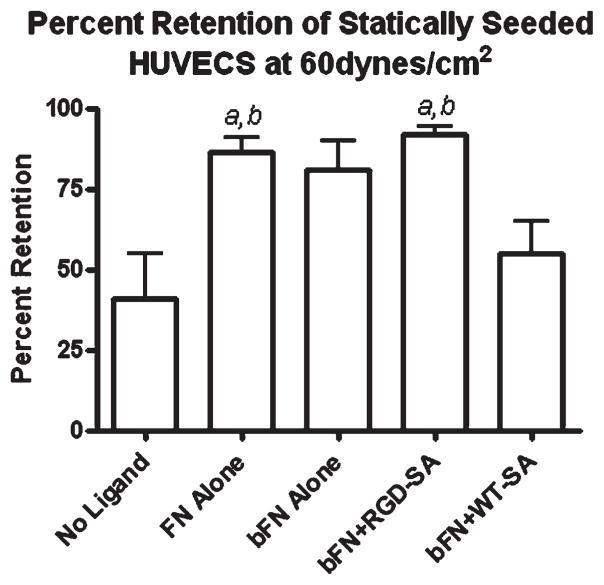
Figure 1
Figure 1
Percent retention of HUVEC statically seeded onto Teflon-AF with different ligand treatments at 60 dynes/cm2. The cells were seeded statically for 15 min prior to flow perturbation: (a) larger than no ligand and (b) larger than bFN + WT-SA. There were no statistical differences observed between FN alone, bFN alone, and bFN + RGD-SA treatment groups (n = 4). Statistical differences (p < 0.05).
Figure 2
Figure 2
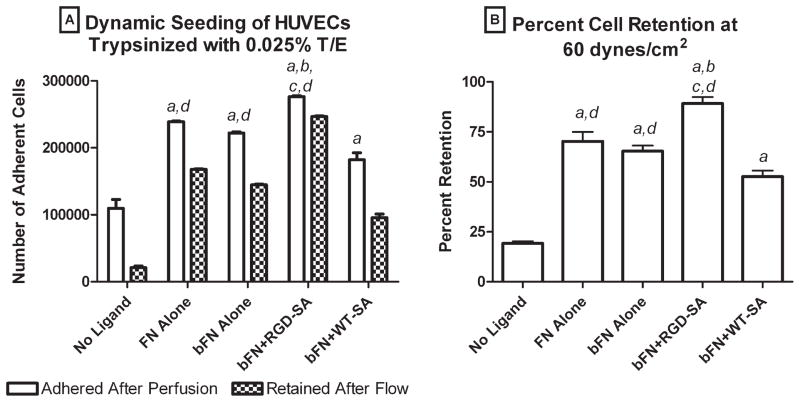
(A) Number of adherent cells and (B) cell retention for mildly trypsinized HUVECs on surfaces with no ligand, FN alone, bFN alone, bFN + RGD-SA, and bFN + WT-SA: (a) larger than no ligand, (b) larger than FN alone, (c) larger than bFN, and (d) larger than bFN + WT-SA. Error bars represent standard error of the mean (n = 4). Statistical differences (p < 0.05).
Figure 3
Figure 3
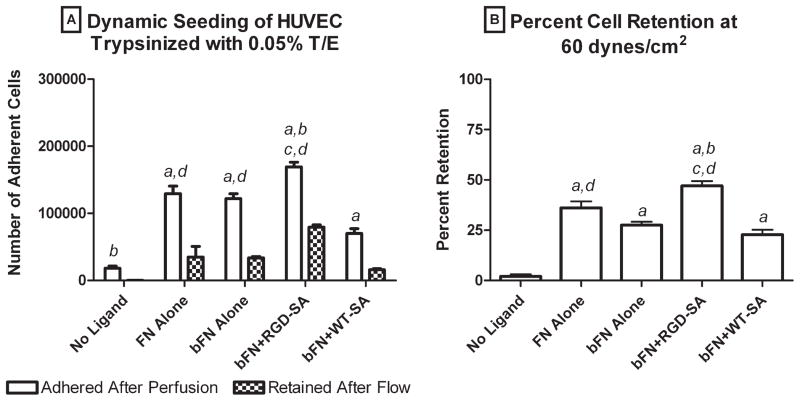
(A) Number of adherent cells and (B) cell retention for harsher trypsinized HUVECs on surfaces with no ligand, FN alone, bFN alone, bFN + RGD-SA, and bFN + WT-SA: (a) larger than no ligand, (b) larger than FN alone, (c) larger than bFN alone, and (d) larger than bFN + WT-SA. Error bars represent standard error of the mean (n = 4). Statistical differences (p < 0.05).
Figure 4
Figure 4
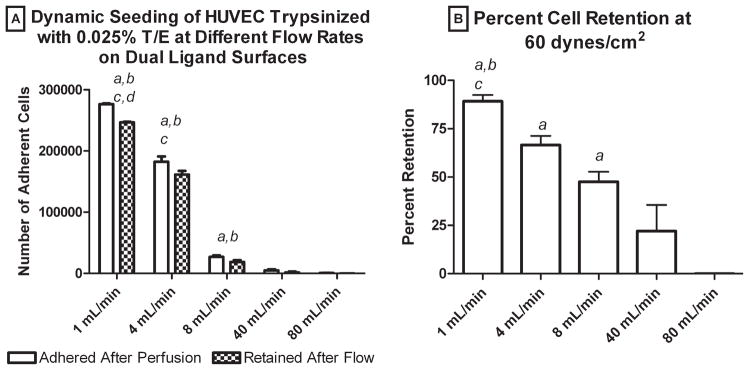
(A) Number of adherent cells and (B) cell retention for cells perfused at different flow rates on surfaces with bFN + RGD-SA: (a) larger than 80 mL/min, (b) larger than 40 mL/min, (c) larger than 8 mL/min, and (d) larger than 4 mL/min. Error bars represent standard error of the mean (n = 4). Statistical differences (p < 0.05).
Figure 5
Figure 5
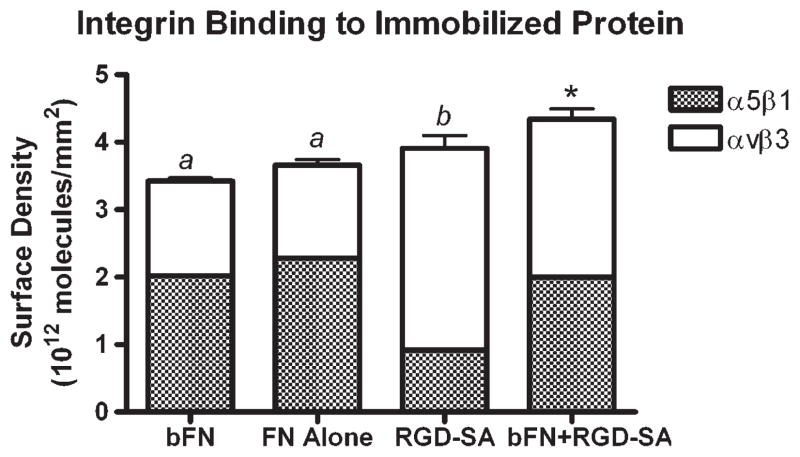
α5β1 and αvβ3 integrin bound to immobilized bFN, RGD-SA, and bFN + RGD-SA: (a) larger than αvβ3 integrin binding and (b) larger than α5β1 integrin binding. (*) Statistically different from bFN and RGD-SA. Error bars represent standard error of the mean (n = 4). Statistical differences (p < 0.05).

References

    1. Cavalcanti-Adam EA, Volberg T, Micoulet A, Kessler H, Geiger B, Spatz JP. Biophys J. 2007;92(8):2964–2974. - PMC - PubMed
    1. Hynd MR, Frampton JP, Dowell-Mesfin N, Turner JN, Shain W. J Neurosci Methods. 2007;162(1–2):255–263. - PMC - PubMed
    1. Howe A, Aplin AE, Alahari SK, Juliano RL. Curr Opin Cell Biol. 1998;10(2):220–231. - PubMed
    1. Garcia AJ, Vega MD, Boettiger D. Mol Biol Cell. 1999;10(3):785–798. - PMC - PubMed
    1. Prendiville EJ, Coleman JE, Callow AD, Gould KE, Laliberte-Verdon S, Ramberg K, Connolly RJ. Eur J Vasc Surg. 1991;5(3):311–319. - PubMed