


Cholangiociliopathies: genetics, molecular mechanisms and potential therapies
- PMID: 19349863
- PMCID: PMC3831343
- DOI: 10.1097/MOG.0b013e328328f4ff
Cholangiociliopathies: genetics, molecular mechanisms and potential therapies
Abstract
Purpose of review: The present review summarizes recent knowledge on polycystic liver diseases (PCLDs), mechanisms of hepatic cystogenesis and potential therapies for these conditions.
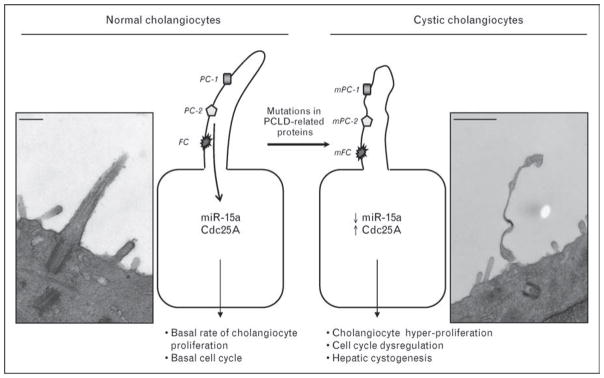
Recent findings: PCLD may be classified as cholangiociliopathies. In PCLD associated with polycystic kidney disease, cell proliferation is one of the major mechanisms of cystogenesis, whereas in isolated PCLD (autosomal dominant polycystic liver disease), disrupted cell adhesion may be more important in cyst progression. In cystic cholangiocytes, overexpression of ion transporters and water channels facilitates fluid secretion into the cystic lumen, and growth factors, estrogens and cytokines promote cholangiocyte proliferation. With age, cholangiocytes lining liver cysts acquire features of mesenchymal cells contributing to hepatic fibrocystogenesis. A novel mechanism of liver cyst expansion in PCLD involves microRNA regulatory pathways. Hyperproliferation of cystic cholangiocytes is linked to abnormalities in cell cycle progression and microRNA expression. Decreased levels of miR-15a are coupled to upregulation of its target--the cell cycle regulator, Cdc25A. Cholangiocyte cilia in liver cysts are structurally abnormal. Somatostatin analogues and sirolimus reduce liver cyst volume in PCLD patients.
Summary: Clarification of molecular mechanisms of hepatic cystogenesis provides an opportunity for the development of targeted therapeutic options in PCLD.
Figures
References
-
- Adams M, Smith UM, Logan CV, Johnson CA. Recent advances in the molecular pathology, cell biology and genetics of ciliopathies. J Med Genet. 2008;45:257–267. Role of cilia in development of ciliopathies. - PubMed
-
- Pan J. Cilia and ciliopathies: from Chlamydomonas and beyond. Sci China C Life Sci. 2008;51:479–486. Overview of various cilia-related disorders. - PubMed
-
- Hoevenaren IA, Wester R, Schrier RW, et al. Polycystic liver: clinical characteristics of patients with isolated polycystic liver disease compared with patients with polycystic liver and autosomal dominant polycystic kidney disease. Liver Int. 2008;28:264–270. Clinical features in ARPKD and ADPLD. - PubMed
-
- Everson GT, Taylor MR, Doctor RB. Polycystic disease of the liver. Hepatology. 2004;40:774–782. - PubMed
Publication types
MeSH terms
Substances
Grants and funding
LinkOut - more resources
Full Text Sources
Other Literature Sources
Medical
Research Materials
