. 2009 Jun 1;51(2):125-9.
doi: 10.1097/QAI.0b013e31819f9e31.

The differential binding and activity of PRO 2000 against diverse HIV-1 envelopes

Affiliations

The differential binding and activity of PRO 2000 against diverse HIV-1 envelopes

Darpun D Sachdev et al. J Acquir Immune Defic Syndr. .

Abstract

Objective: PRO 2000 is a polyanionic microbicide that binds directly to the glycoprotein 120 (gp120) envelope protein to inhibit HIV-1 entry. We studied the breadth of PRO 2000 activity against HIV-1 derived from recently transmitted R5 viruses. We also investigated the interaction of this compound with X4 and R5 HIV-1 envelope glycoproteins using an epitope-mapping strategy.

Methods: The anti-HIV activity of PRO 2000 against subtype B and C Env-pseudotyped viruses was assessed in saline and cervicovaginal lavage fluid. Competitive binding assays were performed with X4 and R5 monomeric and virus-associated gp120.

Results: PRO 2000 was found to be active against recently transmitted subtype B and C viruses tested in vitro, however, at 1 microg/mL in saline, activity against subtype C was decreased compared with subtype B. Epitope mapping using anti-V3 region antibodies showed that PRO 2000 binds to the V3 region of monomeric and virus-associated X4 gp120 with a higher affinity than to V3 of R5 gp120. In contrast, the interaction of PRO 2000 with the CD4-binding site was similar for both X4 and R5 monomeric and virus-associated gp120.

Conclusions: PRO 2000 has significant activity against recently transmitted viruses, although some activity is lost at low concentrations. Epitope binding studies suggest that this broad activity is due to direct and indirect interactions with multiple gp120 sites rather than V3 binding alone.


Figures
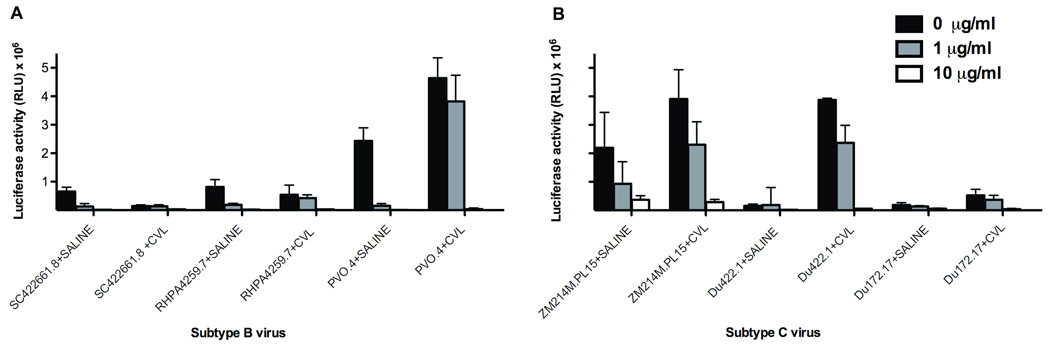
Fig. 1
Fig. 1. Activity of PRO 2000 in saline and in the presence of cervicovaginal lavage fluid (CVL)
Saline or CVL from healthy donors was mixed with 1, 10, or 100 µg/ml of PRO 2000 for 5 min then incubated with U87-CD4-CCR5 cells for 1 h at 37°C, followed by 2 h infection with a HIV-1 pseudotyped subtype B or subtype C from recently infected patients. The cells were washed with DMEM and cultured in fresh medium for 48 h. Single-cycle HIV-1 infection was determined by lysing cells to measure luciferase production. The concentration of 100 µg/ml of PRO 2000 inhibited infection of U87-CD4-CCR5 cells mediated by envelopes derived from recently transmitted B and C viruses in saline and CVL. Data represent the mean +/− SD for virus tested. Each condition was tested in triplicate. RLU, relative light units.
Fig. 2
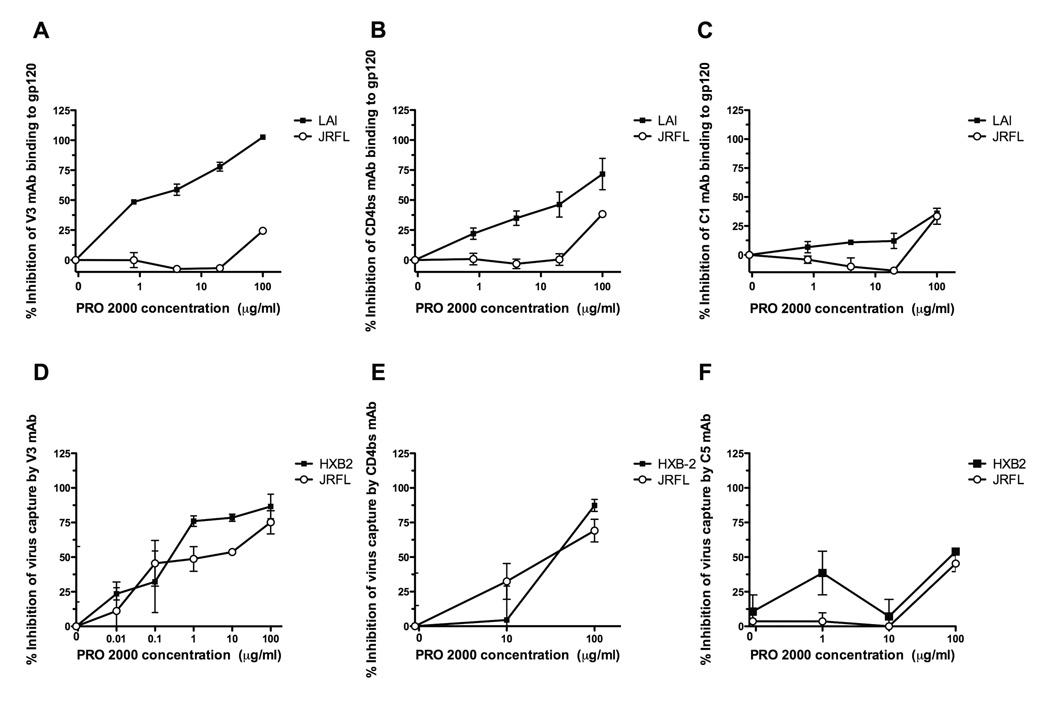
Fig. 2. PRO 2000 competitively inhibits gp120 mAb binding to X4 and R5 viruses
In Figure 2A–2C, PRO 2000 inhibited the binding of mAbs to the V3 loop and the CD4-binding site, but had little effect on the mAb binding to the N-terminus of gp120. The capacity of PRO 2000 to inhibit mAb binding to soluble gp120 was tested in a blocking sandwich ELISA. Soluble gp120LAI or gp120JRFL (1 µg/ml) was treated with the designated concentrations of PRO 2000 and captured onto ELISA plate with sheep anti-C terminus of gp120. The binding of mAbs to the V3 (2A), CD4-binding site (2B), and N-terminal C1 region (2C) of PRO 2000-treated gp120 was detected by alkaline phosphatase-conjugated secondary anti-human IgG antibody. MAb binding to gp120 in the absence of PRO 2000 was considered to be 100%; the OD405 values ranged from 1.0 to 2.9, depending on the combinations of gp120 and mAbs tested. Background levels (0% binding) were determined from wells reacted with an irrelevant mAb control. Data from one of two experiments are shown. In Figure 2D and 2E, PRO 2000 inhibited the binding of mAbs to V3 and the CD4-binding site of gp120 expressed on HIV-1 virions. Virus capture assay was performed to assess the inhibitory effect of PRO 2000 on mAb binding to intact HIV pseudovirions. Pseudovirions bearing envelope of HXB2 (50 ng p24/ml) or JRFL (100 ng p24/ml) isolates were treated with varying concentrations of PRO 2000 and captured by V3 mAb 447-52D (2D), CD4-binding site mAb b12 (2E), or mAb to the C-terminal C5 region (2F) coated on ELISA plates. The amount of p24 associated with the captured virions was determined by non-commercial p24 ELISA. The quantity of virions captured in the absence of PRO 2000 was considered as 100% (typically 40–100 pg p24/ml for HXB2 and 100–200 pg p24/ml for JRFL). Background levels were obtained from wells containing no p24 or virions or from wells in which virions were captured with an irrelevant mAb. The data shown are from one of 3 or 4 repeated experiments.

References

    1. Hemelaar J, Gouws E, Ghys PD, Osmanov S. Global and regional distribution of HIV-1 genetic subtypes and recombinants in 2004. Aids. 2006 Oct 24;20(16):W13–W23. - PubMed
    1. Taylor BS, Sobieszczyk ME, McCutchan FE, Hammer SM. The challenge of HIV-1 subtype diversity. N Engl J Med. 2008 Apr 10;358(15):1590–1602. - PMC - PubMed
    1. Li M, Salazar-Gonzalez JF, Derdeyn CA, et al. Genetic and neutralization properties of subtype C human immunodeficiency virus type 1 molecular env clones from acute and early heterosexually acquired infections in Southern Africa. J Virol. 2006 Dec;80(23):11776–11790. - PMC - PubMed
    1. Derdeyn CA, Decker JM, Bibollet-Ruche F, et al. Envelope-constrained neutralization-sensitive HIV-1 after heterosexual transmission. Science. 2004 Mar 26;303(5666):2019–2022. - PubMed
    1. Overbaugh J, Kreiss J, Poss M, et al. Studies of human immunodeficiency virus type 1 mucosal viral shedding and transmission in Kenya. J Infect Dis. 1999 May;179 Suppl 3:S401–S404. - PubMed

Publication types