


doi: 10.1021/ja900591t.
Photoregulated release of caged anticancer drugs from gold nanoparticles
Affiliations
- PMID: 19351115
- PMCID: PMC2673701
- DOI: 10.1021/ja900591t
Item in Clipboard
Photoregulated release of caged anticancer drugs from gold nanoparticles
J Am Chem Soc.
.
Abstract
An anticancer drug (5-fluorouracil) was conjugated to the surface of gold nanoparticles through a photocleavable o-nitrobenzyl linkage. In this system, the particle serves as both cage and carrier for the therapeutic, providing a nontoxic conjugate that effectively releases the payload upon long wavelength UV irradiation.
Figures
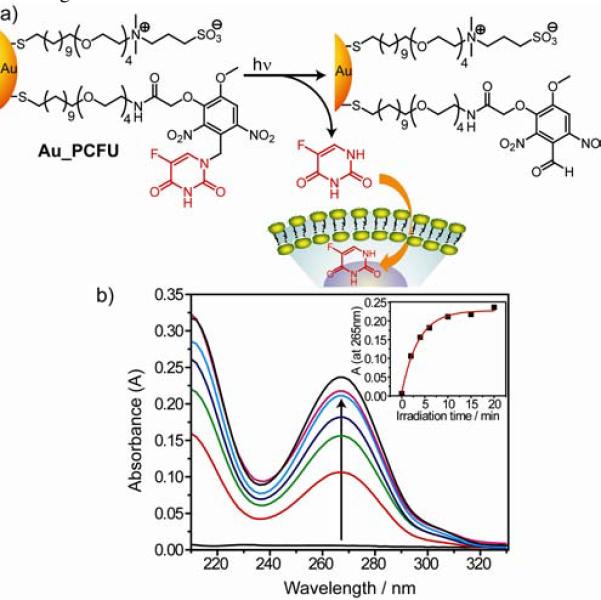
a) Photochemical reaction of Au_PCFU and delivery of payload to cell. b) Overlaid UV-Vis spectral changes showing light dose dependent increase of 5-FU concentration. Inset: The plot of absorbance at 265 nm against irradiation time.
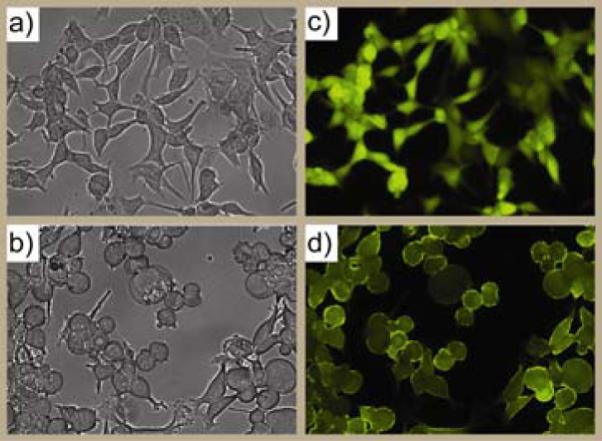
The bright-field and fluorescence-microscopy images of the cells irradiating before treated with Au_PCFU (a and c) and irradiating after treated with Au_PCFU (b and d) with light.
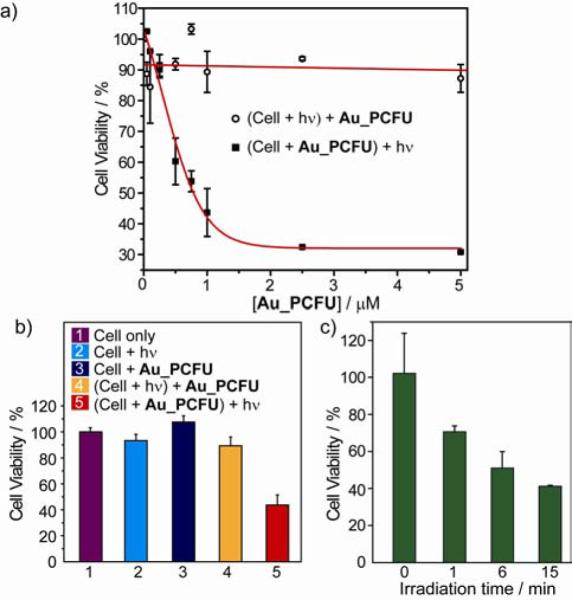
a) The cytotoxicity of different concentration of Au_PCFU under caging and control condition. The IC50 value was 0.7 μM per particle, 11.9 μM per drug. b) The effect of different condition on the cell viability of MCF-7 cell line. The concentration of Au_PCFU used is 1 μM and the light exposure time is 20 min. c) Cell viability with different durations of light exposure.
References
-
- Peer D, Karp JM, Hong S, FaroKhzad OC, Margalit R, Langer R. Nat. Nanotechnol. 2007;2:751–760. - PubMed
-
- Rooseboom M, Commandeur JNM, Vermeulen NPE. Pharmacol. Rev. 2004;56:53–102. - PubMed
- Ulbrich K, Subr V. Adv. Drug Delivery Rev. 2004;56:1023–1050. - PubMed
- Giri S, Trewyn BG, Stellmaker MP, Lin VSY. Angew. Chem., Int. Ed. 2005;44:5038–5044. - PubMed
- Kam NWS, Liu Z, Dai H. J. Am. Chem. Soc. 2005;127:12492–12493. - PubMed
-
- Kim HJ, Matsuda H, Zhou HS, Honma I. Adv. Mater. 2006;18:3083–3088.
- Kwon IC, Bae YH, Kim SW. Nature. 1991;354:291–293. - PubMed
- Babincova M, Sourivong P, Chorvat D, Babinec P. J. Magn. Magn. Mater. 1999;194:163–6.
- Wu CL, Chen C, Lai JP, Chen JB, Mu X, Zheng JS, Zhao YB. Chem. Commun. 2008:2662–2664. - PubMed
- Park H, Yang J, Seo S, Kim K, Suh J, Kim D, Haam S, Yoo KH. Small. 2008;4:192–196. - PubMed
- Skirtach AG, Javier AM, Kreft O, Kohler K, Alberola AP, Mohwald H, Parak WJ, Sukhorukov GB. Angew. Chem., Int. Ed. 2006;45:4612–4617. - PubMed
- Park C, Lee K, Kim C. Angew. Chem., Int. Ed. 2009;48:1275–1278. - PubMed
-
- Mal NK, Fujiwara M, Tanaka Y. Nature. 2003;421:350–353. - PubMed
- Zhu YC, Fujiwara M. Angew. Chem., Int. Ed. 2007;46:2241–2244. - PubMed
- Liu NG, Dunphy DR, Atanassov P, Bunge SD, Chen Z, Lopez GP, Boyle TJ, Brinker CJ. Nano Lett. 2004;4:551–554.
- Park C, Lim J, Yun M, Kim C. Angew. Chem., Int. Ed. 2008;47:2959–2963. - PubMed
Publication types
MeSH terms
Substances
Grants and funding
LinkOut - more resources
Full Text Sources
Other Literature Sources
