


Theories of impaired consciousness in epilepsy
- PMID: 19351355
- PMCID: PMC4681578
- DOI: 10.1111/j.1749-6632.2009.04472.x
Theories of impaired consciousness in epilepsy
Abstract
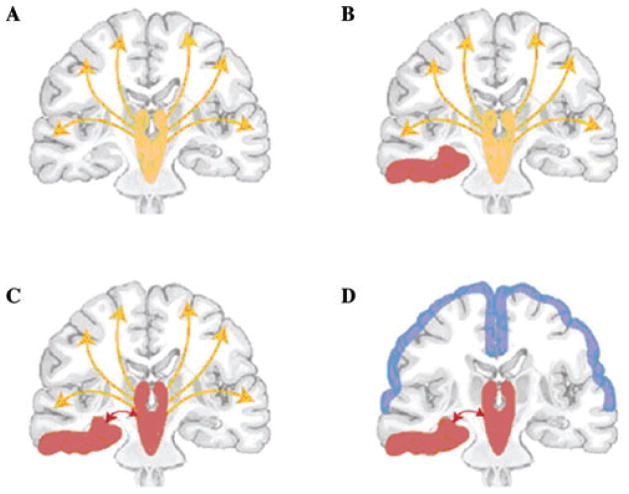
Although the precise mechanisms for control of consciousness are not fully understood, emerging data show that conscious information processing depends on the activation of certain networks in the brain and that the impairment of consciousness is related to abnormal activity in these systems. Epilepsy can lead to transient impairment of consciousness, providing a window into the mechanisms necessary for normal consciousness. Thus, despite differences in behavioral manifestations, cause, and electrophysiology, generalized tonic-clonic, absence, and partial seizures engage similar anatomical structures and pathways. We review prior concepts of impaired consciousness in epilepsy, focusing especially on temporal lobe complex partial seizures, which are a common and debilitating form of epileptic unconsciousness. We discuss a "network inhibition hypothesis" in which focal temporal lobe seizure activity disrupts normal cortical-subcortical interactions, leading to depressed neocortical function and impaired consciousness. This review of the major prior theories of impaired consciousness in epilepsy allows us to put more recent data into context and to reach a better understanding of the mechanisms important for normal consciousness.
Conflict of interest statement
The authors declare no conflicts of interest.
Figures
References
-
- Dennett DC. Kinds of Minds: Toward an Understanding of Consciousness. Basic Books; New York, NY: 1996.
-
- Chalmers DJ. The Conscious Mind: In Search of a Fundamental Theory. Oxford University Press; Oxford, UK: 1996.
-
- Searle JR. Reductionism and the irreducibility of consciousness. In: Block N, Flanagan OJ, Guzeldere G, editors. The Nature of Consciousness. MIT Press; Cambridge, MA: 1997.
-
- Gray J. Consciousness on the scientific agenda. Nature. 1992;358:277. - PubMed
-
- Singer W. Consciousness from a neurobiological perspective. In: Gazzaniga M, Altman J, editors. Brain and Mind: Evolutionary Perspectives. HFSP; Strasbourg, Germany: 1998. pp. 72–88.
