


Specific exercises performed in the period of brace weaning can avoid loss of correction in Adolescent Idiopathic Scoliosis (AIS) patients: Winner of SOSORT's 2008 Award for Best Clinical Paper
- PMID: 19351395
- PMCID: PMC2672077
- DOI: 10.1186/1748-7161-4-8
Specific exercises performed in the period of brace weaning can avoid loss of correction in Adolescent Idiopathic Scoliosis (AIS) patients: Winner of SOSORT's 2008 Award for Best Clinical Paper
Abstract
Background: Exercises are frequently performed in order to improve the efficacy of bracing and avoid its collateral effects. Very frequently there is a loss of correction during brace weaning in AIS treatment.
Aim: To verify the efficacy of exercises in reducing correction loss during brace weaning.
Study design: Retrospective controlled study.
Population: Sixty-eight consecutive patients (eight males), age 15 +/- 1 and Cobb angle 22 +/- 8 degrees at start of brace weaning.
Methods: The start of brace weaning was defined as the first visit in which the wearing of brace for less than 18/24 hours was prescribed (according to our protocol, at Risser 3). Patients were divided into two groups according to whether or not exercises were performed: (1) EX (exercises), included 39 patients and was further divided into two sub-groups: SEAS (who performed exercises according to our institute's protocol, 14 patients) and OTH (other exercises, 25 patients) and (2) CON (controls, 29 patients) that was divided into two other sub-groups: DIS (discontinuous exercises, 19 patients) and NO (no exercises, 10 patients). Complete brace weaning was defined as the first visit in which the brace was no longer prescribed (ringapophysis closure or Risser 5, according to our protocol). ANOVA and Chi Square tests were performed.
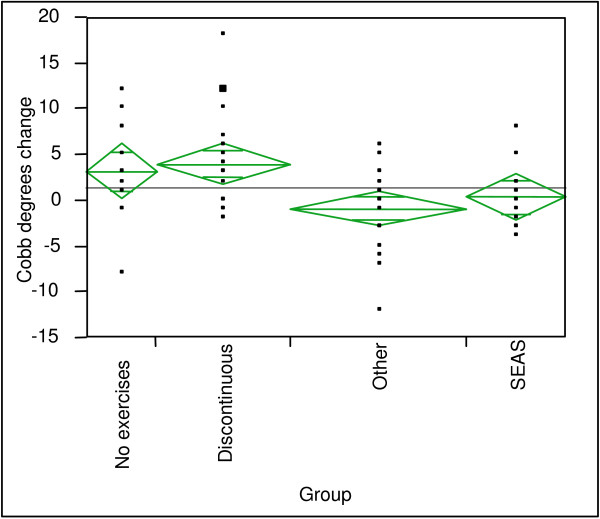
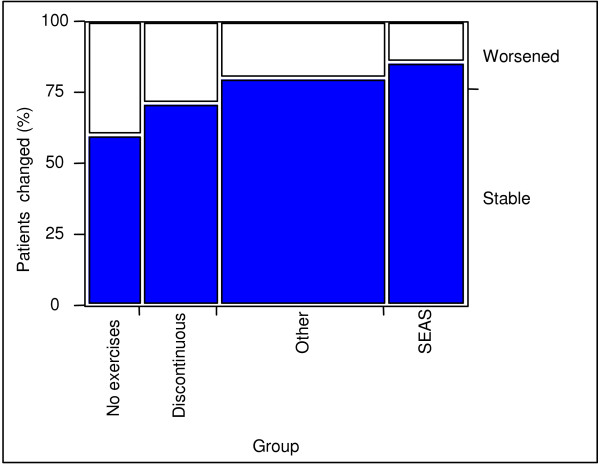
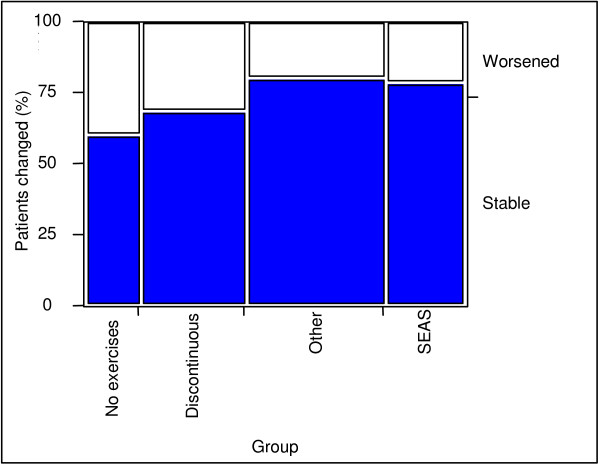
Results: There was no difference between groups at baseline. However, at the end of treatment, 2.7 years after the start of the weaning process, Cobb angle increased significantly in both the DIS and NO groups (3.9 degrees and 3.1 degrees Cobb, respectively). The SEAS and OTH groups did not change. Comparing single groups, OTH (with respect to DIS) had a significant difference (P < 0.05).
Conclusion: Exercises can help reduce the correction loss in brace weaning for AIS.
Figures
References
-
- Negrini A, Verzini N, Parzini S, Negrini A, Negrini S. Role of physical exercise in the treatment of mild idiopathic adolescent scoliosis. Eur Med Phys. 2001. pp. 181–190.
-
- Negrini S. The Evidence-Based ISICO Approach to Spinal Deformities. 1. Milan, Boston: ISICO; 2007.
-
- Rigo M, Quera-Salva G, Villagrasa M, Ferrer M, Casas A, Corbella C, Urrutia A, Martinez S, Puigdevall N. Scoliosis intensive out-patient rehabilitation based on Schroth method. Stud Health Technol Inform. 2008;135:208–227. - PubMed
-
- Dobosiewicz K, Durmala J, Kotwicki T. Dobosiewicz method physiotherapy for idiopathic scoliosis. Stud Health Technol Inform. 2008;135:228–236. - PubMed
-
- Bialek M, M'Hango A. "FITS" concept Functional Individual Therapy of Scoliosis. Stud Health Technol Inform. 2008;135:250–261. - PubMed
