


Response inhibition among early adolescents prenatally exposed to tobacco: an fMRI study
- PMID: 19351556
- PMCID: PMC2771740
- DOI: 10.1016/j.ntt.2009.03.003
Response inhibition among early adolescents prenatally exposed to tobacco: an fMRI study
Abstract
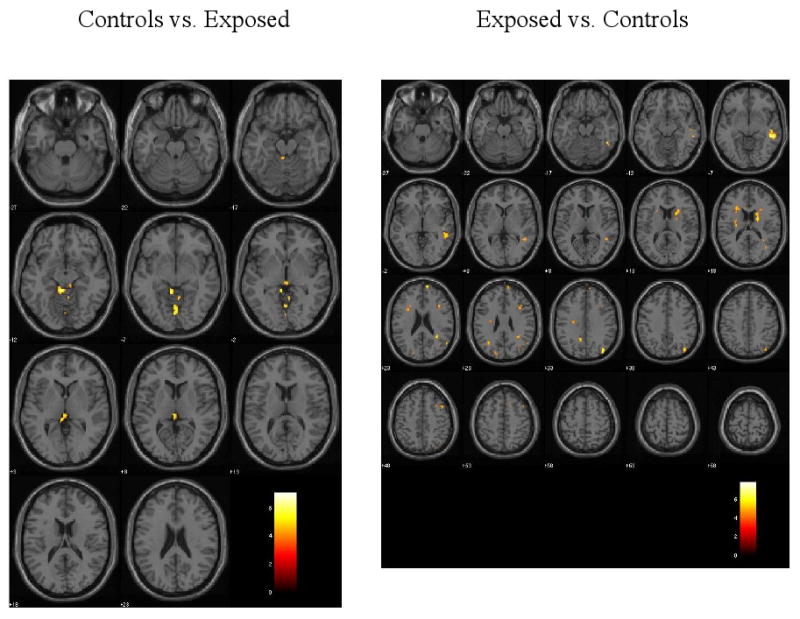
Children prenatally exposed to tobacco have been found to exhibit increased rates of behavior problems related to response inhibition deficits. The present study compared the brain function of tobacco-exposed (n=7) and unexposed (n=11) 12-year-olds during a Go/No-Go response inhibition task using an event-related functional MRI (fMRI) design. Prenatal alcohol exposure, neonatal medical problems, environmental risk, IQ, current environmental smoke exposure, and handedness were statistically controlled. Tobacco-exposed children showed greater activation in a relatively large and diverse set of regions, including left frontal, right occipital, and bilateral temporal and parietal regions. In contrast, unexposed but not exposed children showed activation in the cerebellum, which prior research has indicated is important for attention and motor preparation. The diversity of regions showing greater activation among tobacco-exposed children suggests that their brain function is characterized by an inefficient recruitment of regions required for response inhibition.
Figures
References
-
- National pregnancy and health survey. Drug use among women delivering live births, 1992. NIDA; Rockville, MD: 1996.
-
- Altman NR, Bernal B. Pediatric Applications of fMRI. In: Faro SH, Mohamed FB, editors. Functional MRI: Basic principles and clinical applications. Springer; New York: 2006. pp. 394–428.
-
- Barkley RA. Behavioral inhibitions, sustained attention, and executive functions: Constructing a unifying theory of ADHD. Psychological Bulletin. 1997;121:65–94. - PubMed
Publication types
MeSH terms
Grants and funding
LinkOut - more resources
Full Text Sources
Medical
