


Evidence for association between polycystic ovary syndrome (PCOS) and TCF7L2 and glucose intolerance in women with PCOS and TCF7L2
- PMID: 19351735
- PMCID: PMC2708958
- DOI: 10.1210/jc.2008-1664
Evidence for association between polycystic ovary syndrome (PCOS) and TCF7L2 and glucose intolerance in women with PCOS and TCF7L2
Abstract
Context and objective: Of the recently identified type 2 diabetes mellitus (T2D) susceptibility loci, transcription factor 7-like 2 (TCF7L2) confers the greatest relative risk for T2D and significantly predicts conversion to T2D in persons with impaired glucose tolerance. TCF7L2 is, therefore, also a strong candidate gene for polycystic ovary syndrome (PCOS), a common endocrine disorder characterized by androgen excess and menstrual irregularities and associated with insulin resistance and a 7-fold increased risk for T2D.
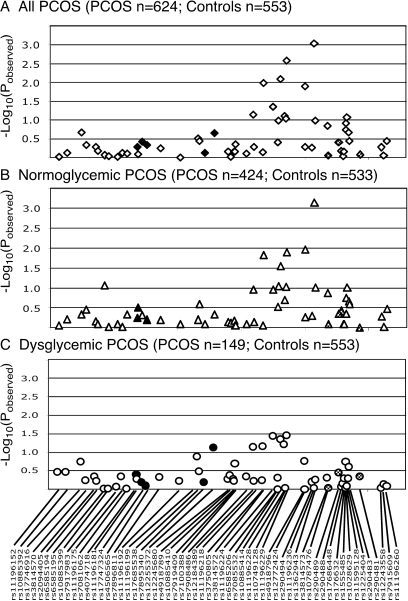
Research design and methods: We tested for association between 58 single nucleotide polymorphisms mapping to TCF7L2 and PCOS in 624 index (PCOS) cases and 553 control women of European ancestry. Furthermore, in the women with PCOS, we tested for association with seven reproductive and metabolic quantitative traits.
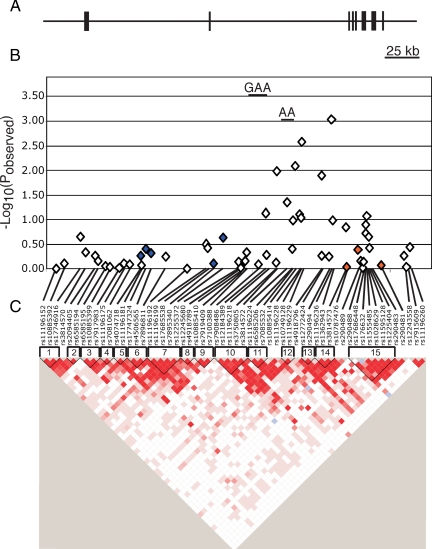
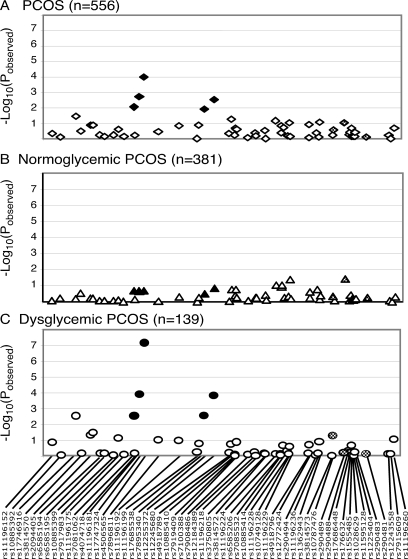
Results: Although we did not detect evidence for association between the previously described TCF7L2 T2D locus, the proinsulin:insulin molar ratio, a marker of pancreatic beta-cell dysfunction, was strongly associated with this locus (P = 2.1 x 10(-4)). We also observed evidence for association between PCOS and two single nucleotide polymorphisms, rs11196236 (P = 9.0 x 10(-4)) and rs11196229 (P = 0.0027) mapping more than 100 kb centromeric to the previously published T2D susceptibility loci.
Conclusions: We have observed evidence of association with two independent TCF7L2 loci in a PCOS cohort: 1) association between the proinsulin:insulin molar ratio and the T2D locus; and 2) association with reproductive PCOS phenotype and a novel locus. This study suggests that variation in different regions of a susceptibility gene contributes to distinct phenotypes.
Figures
References
-
- Kahsar-Miller MD, Nixon C, Boots LR, Go RC, Azziz R 2001 Prevalence of polycystic ovary syndrome (PCOS) in first degree relatives of patients with PCOS. Fertil Steril 75:53–58 - PubMed
-
- Cooper HE, Spellacy WN, Prem KA, Cohen WD 1968 Hereditary factors in Stein-Leventhal syndrome. Am J Obstet Gynecol 100:371–387 - PubMed
-
- Yildiz BO, Yarali H, Oguz H, Bayraktar M 2003 Glucose intolerance, insulin resistance, and hyperandrogenemia in first degree relatives of women with polycystic ovary syndrome. J Clin Endocrinol Metab 88:2031–2036 - PubMed
-
- Yilmaz M, Bukan N, Ersoy R, Karakoça, Yetkin I, Ayvaz G, Cakir N, Arslan M 2005 Glucose intolerance, insulin resistance and cardiovascular risk factors in first degree relatives of women with polycystic ovary syndrome. Hum Reprod 20:2414–2420 - PubMed
Publication types
MeSH terms
Substances
Grants and funding
- M01 RR010732/RR/NCRR NIH HHS/United States
- C06 RR016499/RR/NCRR NIH HHS/United States
- UL1 RR025741/RR/NCRR NIH HHS/United States
- M01 RR10732/RR/NCRR NIH HHS/United States
- M01 RR000048/RR/NCRR NIH HHS/United States
- P50 HD44405/HD/NICHD NIH HHS/United States
- M01 RR00048/RR/NCRR NIH HHS/United States
- U54 HD34449/HD/NICHD NIH HHS/United States
- U54 HD034449/HD/NICHD NIH HHS/United States
- R01 HD057450/HD/NICHD NIH HHS/United States
- M01 RR002635/RR/NCRR NIH HHS/United States
- M01 RR02635/RR/NCRR NIH HHS/United States
- P50 HD044405/HD/NICHD NIH HHS/United States
LinkOut - more resources
Full Text Sources
Medical
Molecular Biology Databases
