


Antivascular actions of microtubule-binding drugs
- PMID: 19351751
- PMCID: PMC2745203
- DOI: 10.1158/1078-0432.CCR-08-2710
Antivascular actions of microtubule-binding drugs
Abstract
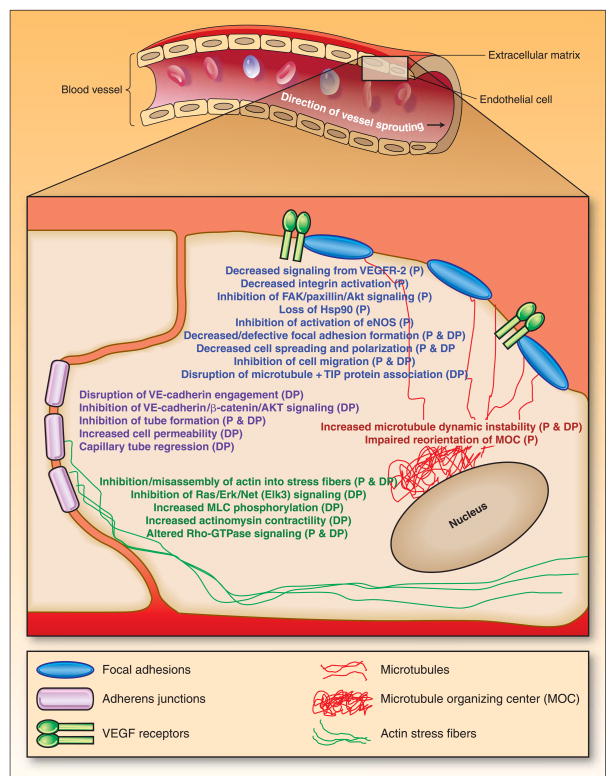
Microtubule-binding drugs (MBD) are widely used in cancer chemotherapy and also have clinically relevant antiangiogenic and vascular-disrupting properties. These antivascular actions are due in part to direct effects on endothelial cells, and all MBDs (both microtubule-stabilizing and microtubule-destabilizing) inhibit endothelial cell proliferation, migration, and tube formation in vitro, actions that are thought to correspond to therapeutic antiangiogenic actions. In addition, the microtubule-destabilizing agents cause prominent changes in endothelial cell morphology, an action associated with rapid vascular collapse in vivo. The effects on endothelial cells occur in vitro at low drug concentrations, which do not affect microtubule gross morphology, do not cause microtubule bundling or microtubule loss and do not induce cell cycle arrest, apoptosis, or cell death. Rather, it has been hypothesized that, at low concentrations, MBDs produce more subtle effects on microtubule dynamics, block critical cell signaling pathways, and prevent the microtubules from properly interacting with transient subcellular assemblies (focal adhesions and adherens junctions) whose subsequent stabilization and/or maturation are required for cell motility and cell-cell interactions. This review will focus on recent studies to define the molecular mechanisms for the antivascular actions of the MBDs, information that could be useful in the identification or design of agents whose actions more selectively target the tumor vasculature.
Figures
References
-
- Jordan MA, Wilson L. Microtubules as a target for anticancer drugs. Nat Reviews Cancer. 2004;4:253–65. - PubMed
-
- Rowinsky EK, Calvo E. Novel agents that target tubulin and related elements. Semin Oncol. 2006;33:421–35. - PubMed
-
- Belotti D, Vergani V, Drudis T, et al. The microtubule-affecting drug paclitaxel has antiangiogenic activity. Clin Cancer Res. 1996;2:1843–9. - PubMed
-
- Klauber N, Parangi S, Flynn E, Hamel E, D’Amato RJ. Inhibition of angiogenesis and breast cancer in mice by the microtubule inhibitors 2-methoxyestradiol and taxol. Cancer Res. 1997;57:81–6. - PubMed
-
- Grant DS, Williams TL, Zahaczewsky M, Dicker AP. Comparison of the antiangiogenic activities using paclitaxel (taxol) and docetaxel (taxotere) Int J Cancer. 2003;104:121–9. - PubMed
Publication types
MeSH terms
Substances
Grants and funding
LinkOut - more resources
Full Text Sources
