. 2009 Jul 9;114(2):452-8.
doi: 10.1182/blood-2009-02-203604. Epub 2009 Apr 7.

Factor XI contributes to thrombin generation in the absence of factor XII

Affiliations

Factor XI contributes to thrombin generation in the absence of factor XII

Dmitri V Kravtsov et al. Blood. .

Abstract

During surface-initiated blood coagulation in vitro, activated factor XII (fXIIa) converts factor XI (fXI) to fXIa. Whereas fXI deficiency is associated with a hemorrhagic disorder, factor XII deficiency is not, suggesting that fXI can be activated by other mechanisms in vivo. Thrombin activates fXI, and several studies suggest that fXI promotes coagulation independent of fXII. However, a recent study failed to find evidence for fXII-independent activation of fXI in plasma. Using plasma in which fXII is either inhibited or absent, we show that fXI contributes to plasma thrombin generation when coagulation is initiated with low concentrations of tissue factor, factor Xa, or alpha-thrombin. The results could not be accounted for by fXIa contamination of the plasma systems. Replacing fXI with recombinant fXI that activates factor IX poorly, or fXI that is activated poorly by thrombin, reduced thrombin generation. An antibody that blocks fXIa activation of factor IX reduced thrombin generation; however, an antibody that specifically interferes with fXI activation by fXIIa did not. The results support a model in which fXI is activated by thrombin or another protease generated early in coagulation, with the resulting fXIa contributing to sustained thrombin generation through activation of factor IX.


Figures

Figure 1
Figure 1
Effect of fXI on thrombin generation in fXI-deficient plasma. Thrombin generation in plasma is shown as areas under the curve for panels A and B or thrombin generation over time for panels C through E. Coagulation was initiated with (A) TF and Ca2+ in the presence (□) or absence (■) of fXI; (B) TF (0.23 pM) and Ca2+ (□) or Ca2+ alone (■) at various fXI concentrations; (C) Ca2+ and 1.6 pM (1 and 2) or 0.23 pM (3 and 4) TF in the presence (1 and 3) or absence (2 and 4) of fXI; (D) Ca2+ and 30 pM (1 and 2) or 6 pM (3 and 4) fXa, in the presence (1 and 3) or absence (2 and 4) of fXI; and (E) 5 nM α-thrombin in the presence (1) or absence (2) of fXI. Error bars for panels A and B represent one SD.
Figure 2
Figure 2
Effect of fXIa on thrombin generation in fXI-deficient plasma. Thrombin generation in plasma supplemented with (A) vehicle or (B) 30 nM fXI. Coagulation was initiated with (1) 300, (2) 30, (3) 3.0, (4) 0.3, or (5) 0.0 pM fXIa. Note that curves 4 and 5 in panel A, and curve 5 in panel B, are essentially flat lines (ie, no thrombin generated).
Figure 3
Figure 3
Effect of recombinant fXI on thrombin generation in fXI-deficient plasma. Thrombin generation with (A-B) recombinant (1) fXIWT, (2) vehicle, (3) fXI-Ala557, or (4) fXI-Ala195-197; or (D) (1) fXIWT, (2) vehicle, or (3) fXI-Ala.83-84 Assays contain phospholipid (A,D) or gel-filtered platelets (B). (C) Activation of 25 nM fXIWT (□, ○) or fXI-Ala83-84 (■, ●) by 5 nM fXIIa (□, ■) or 15 nM α-thrombin (○, ●). fXIa generation was followed by cleavage of S2366, as described in “Characterization of recombinant fXI.”
Figure 4
Figure 4
Anti-fXI monoclonal antibodies. Western blots of fXI and PK using (A) anti–human fXI IgG O1A6 or (B) anti–murine fXI IgG 14E11 as primary antibody. H indicates human fXI; M, murine fXI; A1, A2, A3, and A4, human fXI with PK domains A1, A2, A3, or A4, respectively; and PK, human PK. Positions of molecular mass standards are shown on the left. The uppercase D and M to the right of each panel indicate positions of fXI dimer and monomer (no interchain disulfide bond), respectively. Note that fXI/PKA4 is half the molecular mass of other fXI species because the fXI A4 domain mediates dimer formation. (C) Activation of 25 nM fXI with 5 nM fXIIa (○, ●) or 15 nM α-thrombin (□, ▵) in the presence (●, ▵) or absence (○, □) of 100 nM IgG 14E11.
Figure 5
Figure 5
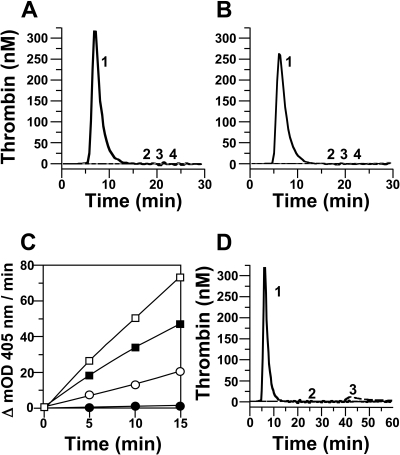
Thrombin generation in fXII-deficient plasma. Thrombin generation was initiated by addition of Ca2+ and (A) 0.23 pM TF or (B) 5 nM (1 and 2) or 50 nM (3 and 4) α-thrombin. Reactions were run in the absence (1 and 3) or presence (2 and 4) of 50 nM O1A6. (C) Thrombin generation initiated with Ca2+ and 1 nM fXIIa in the presence of (1) vehicle, (2) 50 μg/mL CTI, or (3) 50 nM 14E11. (D) Thrombin generation initiated with Ca2+ and 5 nM α-thrombin (1-3) or no initiator (4). Reactions were run with (1) vehicle, (2) 50 nM O1A6, or (3) 50 nM 14E11.

Comment in

  • Feedback controversy stops here.
    Meijers JC. Meijers JC. Blood. 2009 Jul 9;114(2):235. doi: 10.1182/blood-2009-04-217117. Blood. 2009. PMID: 19589932 No abstract available.

References

    1. Ponczek MB, Gailani D, Doolittle RF. Evolution of the contact phase of vertebrate blood coagulation. J Thromb Haemost. 2008;6:1876–1883. - PMC - PubMed
    1. Furie B, Furie BC. Molecular basis of blood coagulation. In: Hoffman H, Benze EJ, Shattil SJ, Furie B, Silberstein LE, McGlave P, Heslop H, editors. Hematology, Basic Principles and Practice. 5th Ed. New York, NY: Churchill Livingstone-Elsevier; 2009. pp. 1819–1836.
    1. Davie EW, Fujikawa K, Kisiel W. The coagulation cascade: initiation, maintenance, and regulation. Biochemistry. 1991;30:10363–10370. - PubMed
    1. Gailani D, Broze G. Factor XI and the contact system. In: Scriver C, Beaudet A, Sly W, Valle D, Childs B, Kinzler K, Vogelstein B, editors. Metabolic and Molecular Basis of Inherited Disease. New York, NY: McGraw-Hill; 2001. pp. 4433–4453.
    1. Seligsohn U. Factor XI in haemostasis and thrombosis: past, present and future. Thromb Haemost. 2007;98:84–89. - PubMed

Publication types