


Increasing uptake of HIV testing and counseling among the poorest in sub-Saharan countries through home-based service provision
- PMID: 19352202
- PMCID: PMC3068048
- DOI: 10.1097/QAI.0b013e31819c1726
Increasing uptake of HIV testing and counseling among the poorest in sub-Saharan countries through home-based service provision
Abstract
Background: Uptake of HIV testing and counseling (HTC) is lower among members of the poorest households in sub-Saharan countries, thereby creating significant inequalities in access to HTC and possibly antiretroviral treatment.
Objectives: To measure uptake of home-based HTC and estimate HIV prevalence among members of the poorest households in a sub-Saharan population.
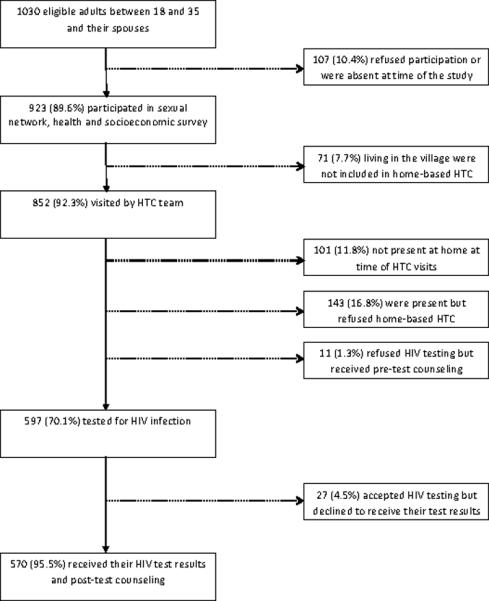
Methods: Residents of 6 villages of Likoma Island (Malawi) aged 18-35 and their spouses were offered home-based HTC services. Socioeconomic status, HIV testing history, and HIV risk factors were assessed. Differences in HTC uptake and HIV infection rates between members of households in the lowest income quartile and the rest of the population were estimated using logistic regression.
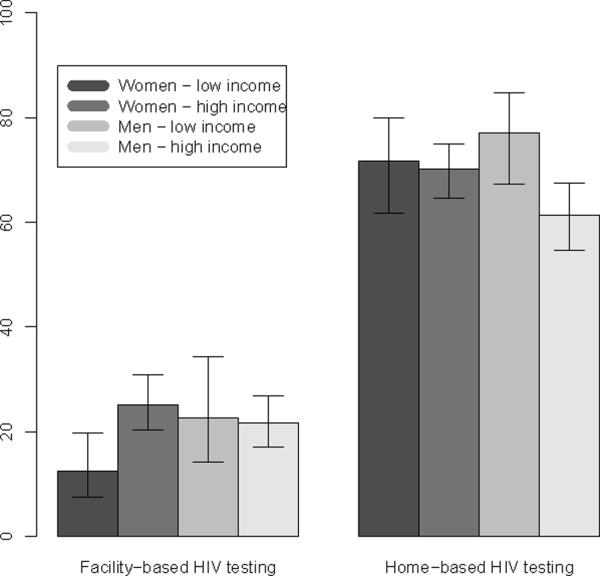
Results: Members of households in the lowest income quartile were significantly less likely to have ever used facility-based HTC services than the rest of the population (odds ratio = 0.60, 95% confidence interval (CI): 0.36 to 0.97). In contrast, they were significantly more likely to use home-based HTC services provided during the study (adjusted odds ratio = 1.70, 95% CI: 1.04 to 2.79). Socioeconomic differences in uptake of home-based HTC were not due to underlying differences in socioeconomic characteristics or HIV risk factors. The prevalence of HIV was significantly lower among members of the poorest households tested during home-based HTC than among the rest of the population (adjusted odds ratio = 0.37, 95% CI: 0.14 to 0.96).
Conclusions: HTC uptake was high during a home-based HTC campaign on Likoma Island, particularly among the poorest. Home-based HTC has the potential to significantly reduce existing socioeconomic gradients in HTC uptake and help mitigate the impact of AIDS on the most vulnerable households.
Figures
References
-
- Malawi National Statistical Office . Malawi demographic and health survey 2004 — preliminary report. Malawi National Statistical Office; Zomba, Malawi and Measure DHS, Claverton, MD: 2004. Available online at http://www.nso.malawi.net/data_on_line/demography/dhs2004/dhs2004.html.
-
- Uganda Bureau of Statistics (UBOS) Macro International Inc . Uganda Demographic and Health Survey 2006. UBOS and Macro International Inc.; Calverton, Maryland, USA: 2007.
-
- Central Statistical Office (Zimbabwe) Macro International Inc . Zimbabwe Demographic and Health Survey 2005–06. UBOS and Macro International Inc.; Calverton, Maryland, USA: 2007.
-
- Central Bureau of Statistics (Kenya) Macro International Inc . Kenya Demographic and Health Survey 2003. UBOS and Macro International Inc.; Calverton, Maryland, USA: 2004.
-
- Bunnell R, Ekwaru J, Solberg P, Wamai N, Bikaako-Kajura W, Were W, et al. Changes in sexual behavior and risk of HIV transmission after antiretroviral therapy and prevention interventions in rural Uganda. AIDS. 2006;20(1):85–92. - PubMed
Publication types
MeSH terms
Grants and funding
LinkOut - more resources
Full Text Sources
Medical
