


Review
doi: 10.1038/sj.bjc.6605007.
Epub 2009 Apr 7.
De novo fatty-acid synthesis and related pathways as molecular targets for cancer therapy
Affiliations
- PMID: 19352381
- PMCID: PMC2694429
- DOI: 10.1038/sj.bjc.6605007
Item in Clipboard
Review
De novo fatty-acid synthesis and related pathways as molecular targets for cancer therapy
Br J Cancer.
.
Abstract
Enhanced lipid biosynthesis is a characteristic feature of cancer. Deregulated lipogenesis plays an important role in tumour cell survival. These observations suggest that enzymes in the lipid synthesis pathway would be rational therapeutic targets for cancer. To this end, we review the enzymes in de novo fatty-acid synthesis and related pathways.
Figures
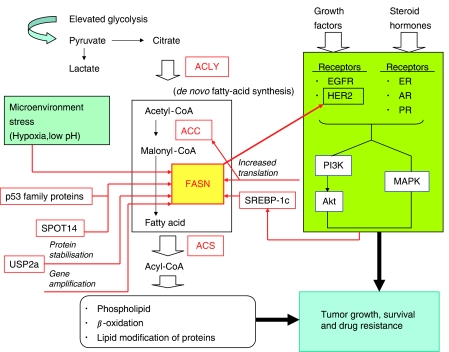
Coupling of elevated fatty-acid metabolism with growth factor signalling in cancer. Growth factors and hormone receptors play essential roles in tumour-related FASN overexpression. FASN and growth factor-dependent signalling are mutually regulated in cancer cells. Tumour microenvironment stress, as well as multiple other factors are involved in FASN overexpression and elevated lipogenesis in cancer. ACLY, ATP citrate lyase; ACC, acetyl-CoA carboxylase; FASN, fatty-acid synthase; ACS, acyl-CoA synthetase; EGFR, epidermal growth factor receptor; ER, oestrogen receptor; AR, androgen receptor; PR, progesterone receptor; PI3K, phosphatidylinositol-3-kinase; MAPK, mitogen-activated protein kinase; SREBP-1c, sterol regulatory element-binding protein 1c; USP2a, ubiquitin-specific protease-2a.
References
-
- Bauer DE, Hatzivassiliou G, Zhao F, Andreadis C, Thompson CB (2005) ATP citrate lyase is an important component of cell growth and transformation. Oncogene 24: 6314–6322 - PubMed
-
- Browne CD, Hindmarsh EJ, Smith JW (2006) Inhibition of endothelial cell proliferation and angiogenesis by orlistat, a fatty acid synthase inhibitor. FASEB J 20: 2027–2035 - PubMed
-
- Brusselmans K, De Schrijver E, Verhoeven G, Swinnen JV (2005) RNA interference-mediated silencing of the acetyl-CoA-carboxylase-alpha gene induces growth inhibition and apoptosis of prostate cancer cells. Cancer Res 65: 6719–6725 - PubMed
-
- Chajes V, Cambot M, Moreau K, Lenoir GM, Joulin V (2006) Acetyl-CoA carboxylase alpha is essential to breast cancer cell survival. Cancer Res 66: 5287–5294 - PubMed
Publication types
MeSH terms
Substances
LinkOut - more resources
Full Text Sources
Other Literature Sources
Miscellaneous
