. 2009 Aug;35(8):1368-76.
doi: 10.1007/s00134-009-1467-7. Epub 2009 Apr 8.

A bench study of intensive-care-unit ventilators: new versus old and turbine-based versus compressed gas-based ventilators

Affiliations

A bench study of intensive-care-unit ventilators: new versus old and turbine-based versus compressed gas-based ventilators

Arnaud W Thille et al. Intensive Care Med. 2009 Aug.

Abstract

Objective: To compare 13 commercially available, new-generation, intensive-care-unit (ICU) ventilators in terms of trigger function, pressurization capacity during pressure-support ventilation (PSV), accuracy of pressure measurements, and expiratory resistance.

Design and setting: Bench study at a research laboratory in a university hospital.

Methods: Four turbine-based ventilators and nine conventional servo-valve compressed-gas ventilators were tested using a two-compartment lung model. Three levels of effort were simulated. Each ventilator was evaluated at four PSV levels (5, 10, 15, and 20 cm H2O), with and without positive end-expiratory pressure (5 cm H2O). Trigger function was assessed as the time from effort onset to detectable pressurization. Pressurization capacity was evaluated using the airway pressure-time product computed as the net area under the pressure-time curve over the first 0.3 s after inspiratory effort onset. Expiratory resistance was evaluated by measuring trapped volume in controlled ventilation.

Results: Significant differences were found across the ventilators, with a range of triggering delays from 42 to 88 ms for all conditions averaged (P < 0.001). Under difficult conditions, the triggering delay was longer than 100 ms and the pressurization was poor for five ventilators at PSV5 and three at PSV10, suggesting an inability to unload patient's effort. On average, turbine-based ventilators performed better than conventional ventilators, which showed no improvement compared to a bench comparison in 2000.

Conclusion: Technical performance of trigger function, pressurization capacity, and expiratory resistance differs considerably across new-generation ICU ventilators. ICU ventilators seem to have reached a technical ceiling in recent years, and some ventilators still perform inadequately.


Figures
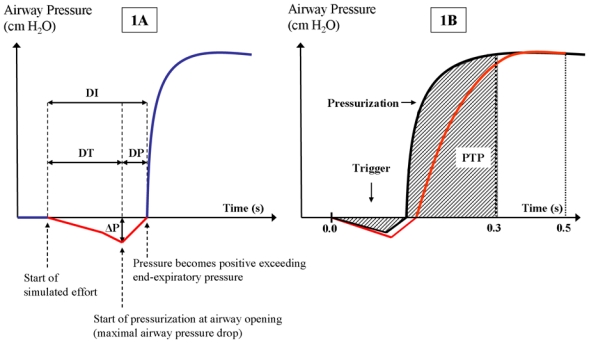
Figure 1
Figure 1
Figure 1A: Evaluation of trigger performance Pressure signal showing the inspiratory delay (DI), which is the sum of the triggering delay (DT) from the beginning of the simulated patient effort to the beginning of ventilator pressurization and of the pressurization delay (DP) from the maximal airway pressure drop (ΔP) to the return to baseline pressure. Figure 1B: Evaluation of pressurization capacity Pressure signal showing the pressurization capacity represented by the positive area over the first 0.3 s of the simulated patient effort (black hatched area). The red signal illustrates poor pressurization capacity: the time needed to reach the set pressure is longer and the positive area is smaller.
Figure 2
Figure 2
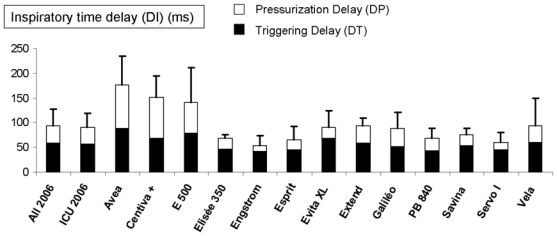
Inspiratory delay (DI) is displayed with its two components, triggering delay (DT) and pressurization delay (DP), for each ventilator. A shorter DI value indicates better trigger performance. Values are mean ± standard deviation for each of 24 conditions (four levels of pressure-support [5, 10, 15, and 20 cm H2O], three effort intensities [weak, strong, and very strong], and two levels of positive end-expiratory pressure [0 and 5 cm H2O]). The mean value for the 13 ventilators tested in 2006 (including 6 mid-level ICU ventilators) and the 7 ICU ventilators are shown at the far left.
Figure 3
Figure 3
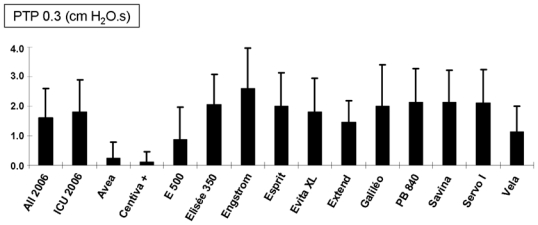
Pressure-time product (PTP) for each ventilator. PTP was assessed as the positive area over the first 0.3 s of the inspiratory effort. Higher PTP values indicate better pressurization. Values are mean±standard deviation for each of 24 conditions (four levels of pressure-support [5, 10, 15, and 20 cm H2O], three effort intensities [weak, strong, and very strong], and two levels of positive end-expiratory pressure [0 and 5 cm H2O]). The mean value for the 13 ventilators tested in 2006 (including 6 mid-level ICU ventilators) and the 7 ICU ventilators are shown at the far left.
Figure 4
Figure 4
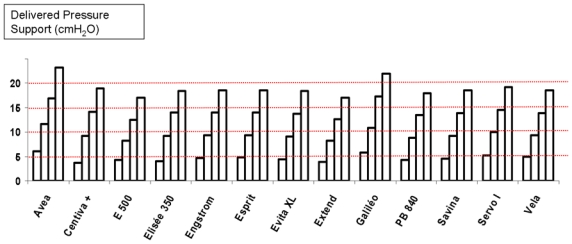
Figure showing the true delivered pressure support at different levels of pressure support. Each ventilator was tested for a preset pressure support of 5, 10, 15 and 20 cm H2O.
Figure 5
Figure 5
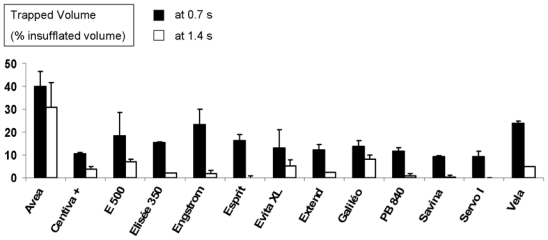
Expiratory resistance for each ventilator evaluated by the trapped volume at 0.7 s and 1.4 s of expiratory time (expressed in percentage of insufflated volume). Lower trapped volumes indicate lower expiratory resistance and better performance.
Figure 6
Figure 6
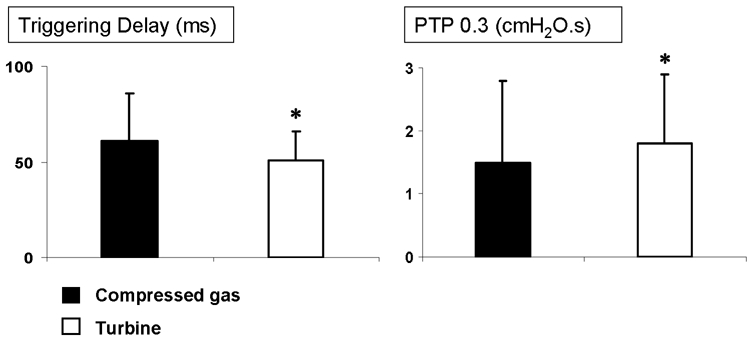
Comparison of the nine compressed-gas ventilators (black squares) and the four turbine-based ventilators (white squares) regarding trigger performance assessed on triggering delay (DT) and pressurization capacity assessed as the pressure-time product (PTP) over the first 0.3 s after the start of the simulated effort. Trigger performance and pressurization capacity were significantly better with the turbine-based ventilators.
Figure 7
Figure 7
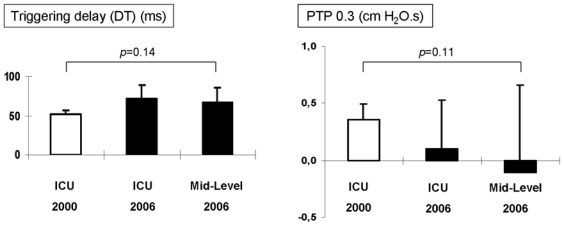
Comparison of the seven ICU ventilators in 2000 (white squares) with the seven ICU ventilators and the six mid-level ICU ventilators in 2006 (black squares) regarding trigger performance assessed on triggering delay (DT) and pressurization capacity assessed as the pressure-time product (PTP) over the first 0.3 s after the start of the simulated effort. A shorter DI value indicates better trigger performance and a higher PTP values indicate better pressurization. We found no significant differences and performances tended to be poorer in 2006.

References

    1. Tobin MJ, Jubran A, Laghi F. Patient-ventilator interaction. Am J Respir Crit Care Med. 2001;163:1059–1063. - PubMed
    1. Esteban A, Ferguson ND, Meade MO, Frutos-Vivar F, Apezteguia C, Brochard L, Raymondos K, Nin N, Hurtado J, Tomicic V, Gonzalez M, Elizalde J, Nightingale P, Abroug F, Pelosi P, Arabi Y, Moreno R, Jibaja M, Empaire DG, Sandi F, Matamis D, Montanez AM, Anzueto A. Evolution of mechanical ventilation in response to clinical research. Am J Respir Crit Care Med. 2008;177:170–177. - PubMed
    1. Carlucci A, Richard JC, Wysocki M, Lepage E, Brochard L. Noninvasive versus conventional mechanical ventilation. An epidemiologic survey. Am J Respir Crit Care Med. 2001;163:874–880. - PubMed
    1. Demoule A, Girou E, Richard JC, Taille S, Brochard L. Increased use of noninvasive ventilation in French intensive care units. Intensive Care Med. 2006;32:1747–1755. - PubMed
    1. Thille AW, Rodriguez P, Cabello B, Lellouche F, Brochard L. Patient-ventilator asynchrony during assisted mechanical ventilation. Intensive Care Med. 2006;32:1515–1522. - PubMed

Publication types