


Distinct patterns of brain activity in young carriers of the APOE-epsilon4 allele
- PMID: 19357304
- PMCID: PMC2678478
- DOI: 10.1073/pnas.0811879106
Distinct patterns of brain activity in young carriers of the APOE-epsilon4 allele
Abstract
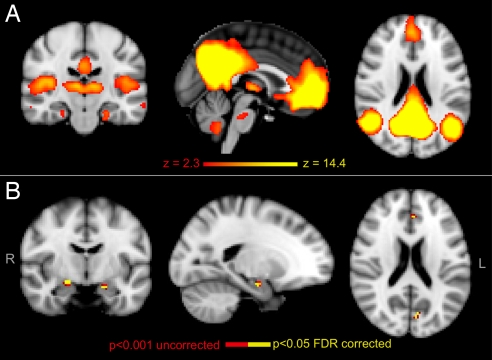
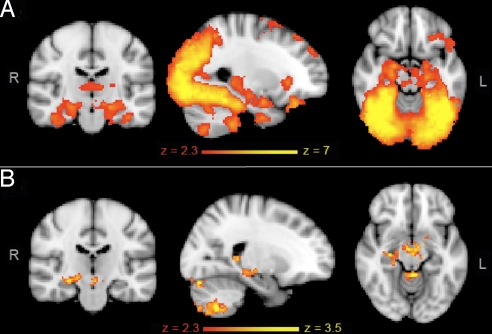
The APOE epsilon4 allele is a risk factor for late-life pathological changes that is also associated with anatomical and functional brain changes in middle-aged and elderly healthy subjects. We investigated structural and functional effects of the APOE polymorphism in 18 young healthy APOE epsilon4-carriers and 18 matched noncarriers (age range: 20-35 years). Brain activity was studied both at rest and during an encoding memory paradigm using blood oxygen level-dependent fMRI. Resting fMRI revealed increased "default mode network" (involving retrosplenial, medial temporal, and medial-prefrontal cortical areas) coactivation in epsilon4-carriers relative to noncarriers. The encoding task produced greater hippocampal activation in epsilon4-carriers relative to noncarriers. Neither result could be explained by differences in memory performance, brain morphology, or resting cerebral blood flow. The APOE epsilon4 allele modulates brain function decades before any clinical or neurophysiological expression of neurodegenerative processes.
Conflict of interest statement
The authors declare no conflict of interest.
Figures
References
-
- Mahley RW, Rall SC., Jr Apolipoprotein E: Far more than a lipid transport protein. Annu Rev Genomics Hum Genet. 2000;1:507–537. - PubMed
-
- Mahley RW. Apolipoprotein E: Cholesterol transport protein with expanding role in cell biology. Science. 1988;240:622–630. - PubMed
-
- Lenzen HJ, Assmann G, Buchwalsky R, Schulte H. Association of apolipoprotein E polymorphism, low-density lipoprotein cholesterol, and coronary artery disease. Clin Chem. 1986;32:778–781. - PubMed
-
- Okuizumi K, et al. ApoE-epsilon 4 and early-onset Alzheimer's. Nat Genet. 1994;7:10–11. - PubMed
Publication types
MeSH terms
Substances
Grants and funding
LinkOut - more resources
Full Text Sources
Other Literature Sources
Medical
Miscellaneous
