


A population-based study of Australian twins with melanoma suggests a strong genetic contribution to liability
- PMID: 19357710
- PMCID: PMC3672052
- DOI: 10.1038/jid.2009.48
A population-based study of Australian twins with melanoma suggests a strong genetic contribution to liability
Abstract
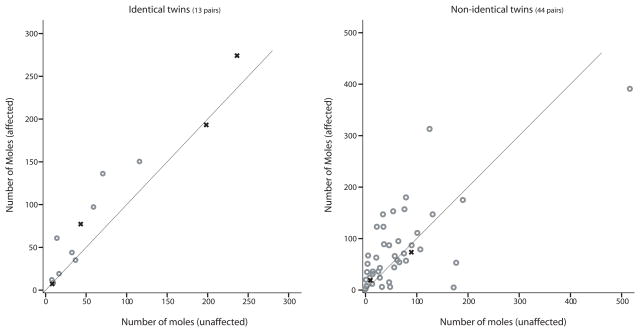
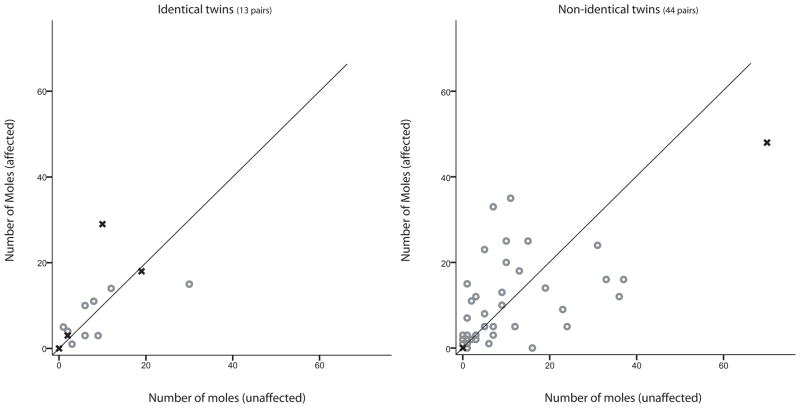
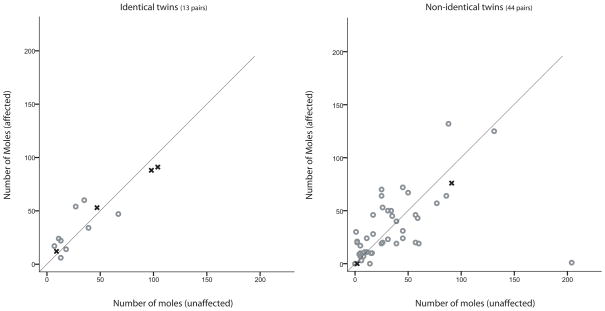
Melanoma runs within families, but this may be due to either shared genetic or shared environmental influences within those families. The concordance between pairs of non-identical twins compared to that between identical twins can be used to determine whether familial aggregation is due to genetic or environmental factors. Mandatory reporting of melanoma cases in the state of Queensland yielded approximately 12,000 cases between 1982 and 1990. Twins in this study and from the adjacent state of New South Wales (125 pairs in total) were used to partition variation in liability to melanoma into genetic and environmental factors. Identical twins were more concordant for melanoma (4 of 27 pairs) than non-identical twins (3 of 98 pairs; P-value approximately 0.04). Identical co-twins of affected individuals were 9.8 times more likely to be affected than by chance. However, non-identical co-twins of affected individuals were only 1.8 times more likely to be affected than by chance. An MZ:DZ recurrence risk ratio of 5.6 suggests that some of the genetic influences on melanoma are due to epistatic (gene-gene) interactions. Using these data and population prevalences, it was estimated that 55% of the variation in liability to melanoma is due to genetic influences.
Figures
References
-
- Aitken JF, Duffy DL, Green A, Youl P, MacLennan R, Martin NG. Heterogeneity of melanoma risk in families of melanoma patients. Am J Epidemiol. 1994;140:961–973. - PubMed
-
- Aitken JF, Green AC, MacLennan R, Youl P, Martin NG. The Queensland Familial Melanoma Project: study design and characteristics of participants. Melanoma Res. 1996;6:155–165. - PubMed
-
- Bastuji-Garin S, Grob JJ, Grognard C, Grosjean F, Guillaume JC. Melanoma prevention: evaluation of a health education campaign for primary schools. Arch Dermatol. 1999;135:936–940. - PubMed
-
- Baxter AJ, Hughes MC, Kvaskoff M, Siskind V, Shekar S, Aitken JF, et al. The Queensland Study of Melanoma: Environmental and Genetic Associations (Q-MEGA); Study Design, Baseline Characteristics, and Repeatability of Phenotype and Sun Exposure Measures. Twin Res Hum Genet. 2008;11:183–196. - PMC - PubMed
-
- Bonnelykke B, Hauge M, Holm N, Kristoffersen K, Gurtler H. Evaluation of zygosity diagnosis in twin pairs below age seven by means of a mailed questionnaire. Acta Genet Med Gemellol (Roma) 1989;38:305–313. - PubMed
Publication types
MeSH terms
Grants and funding
LinkOut - more resources
Full Text Sources
Medical
