. 2009 Apr;5(4):e1000380.
doi: 10.1371/journal.ppat.1000380. Epub 2009 Apr 10.

Haemonchus contortus acetylcholine receptors of the DEG-3 subfamily and their role in sensitivity to monepantel

Affiliations

Haemonchus contortus acetylcholine receptors of the DEG-3 subfamily and their role in sensitivity to monepantel

Lucien Rufener et al. PLoS Pathog. 2009 Apr.

Abstract

Gastro-intestinal nematodes in ruminants, especially Haemonchus contortus, are a global threat to sheep and cattle farming. The emergence of drug resistance, and even multi-drug resistance to the currently available classes of broad spectrum anthelmintics, further stresses the need for new drugs active against gastro-intestinal nematodes. A novel chemical class of synthetic anthelmintics, the Amino-Acetonitrile Derivatives (AADs), was recently discovered and the drug candidate AAD-1566 (monepantel) was chosen for further development. Studies with Caenorhabditis elegans suggested that the AADs act via nicotinic acetylcholine receptors (nAChR) of the nematode-specific DEG-3 subfamily. Here we identify nAChR genes of the DEG-3 subfamily from H. contortus and investigate their role in AAD sensitivity. Using a novel in vitro selection procedure, mutant H. contortus populations of reduced sensitivity to AAD-1566 were obtained. Sequencing of full-length nAChR coding sequences from AAD-susceptible H. contortus and their AAD-1566-mutant progeny revealed 2 genes to be affected. In the gene monepantel-1 (Hco-mptl-1, formerly named Hc-acr-23H), a panel of mutations was observed exclusively in the AAD-mutant nematodes, including deletions at intron-exon boundaries that result in mis-spliced transcripts and premature stop codons. In the gene Hco-des-2H, the same 135 bp insertion in the 5' UTR created additional, out of frame start codons in 2 independent H. contortus AAD-mutants. Furthermore, the AAD mutants exhibited altered expression levels of the DEG-3 subfamily nAChR genes Hco-mptl-1, Hco-des-2H and Hco-deg-3H as quantified by real-time PCR. These results indicate that Hco-MPTL-1 and other nAChR subunits of the DEG-3 subfamily constitute a target for AAD action against H. contortus and that loss-of-function mutations in the corresponding genes may reduce the sensitivity to AADs.


Conflict of interest statement

The use of AADs for veterinary purposes is patented (WO2002049641).

Figures
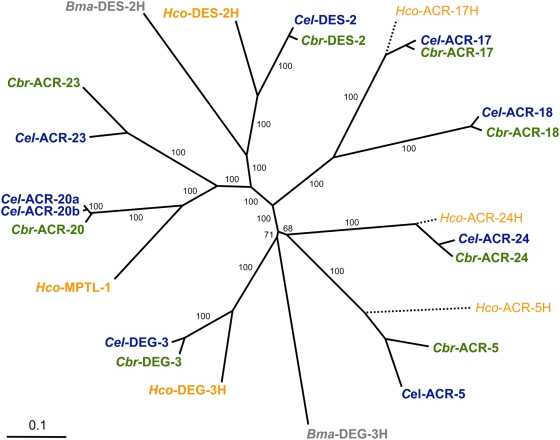
Figure 1
Figure 1. Phylogenetic analysis of the DEG-3 subfamily of nAChR.
ClustalW dendrogram of nAChRs subunits of the DEG-3 subfamily (amino acid sequences) from B. malayi (Bma; grey), C. briggsae (Cbr; green), C. elegans (Cel; blue), and H. contortus (Hco; orange). Two isoforms (a and b) of Cel-ACR-20 are shown. The scale bar indicates the number of amino acid substitutions per site, bootstrapping values are shown in percent positives of 1000 rounds. Tree construction and bootstrapping was initially performed on full-length sequences only; the partial sequences (dashed lines, thin characters) were added subsequently based on a second ClustalW guide tree.
Figure 2
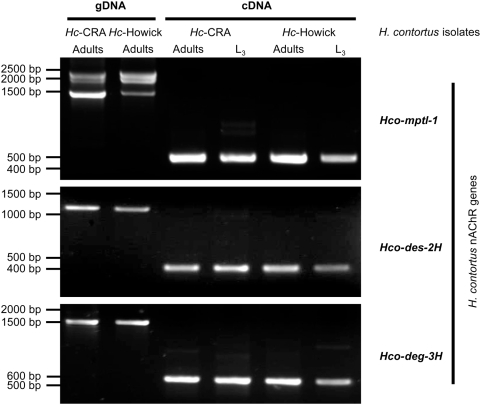
Figure 2. Expression of DEG-3 subfamily members in Haemonchus contortus.
Hco-mptl-1, Hco-des-2H and Hco-deg-3H are expressed in adult as well as L3-larvae stages of both the Hc-CRA and Hc-Howick parental reference isolates (AAD naïve) as determined by reverse transcriptase PCR. Genomic DNA (gDNA) was included as a control.
Figure 3
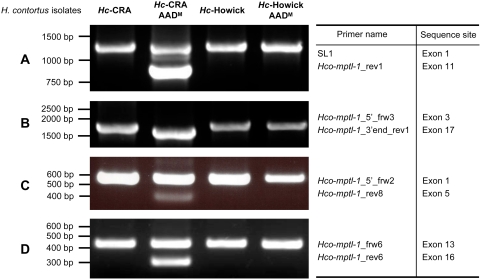
Figure 3. Deletions in the Hco-mptl-1 coding sequence.
PCR products were amplified from cDNA of the mutant (AADM) and sensitive parental isolates. Different pairs of primers were tested in order to map the region where the deletions occurred. No apparent deletions were observed in Hc-Howick AADM mutants. Note the apparent absence of a full-length product for Hc-CRA AADM in panel B, where the primers encompass both critical exons 4 and 15 (Figure 4), indicating the absence of wild-type Hco-mptl-1 transcripts in this mutant.
Figure 4
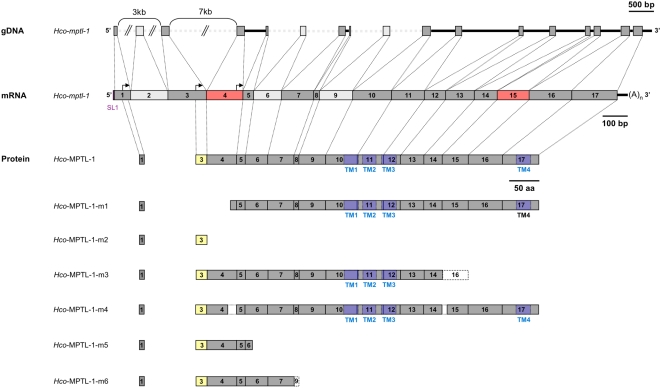
Figure 4. The Hco-mptl-1 locus, mRNA and protein (top) and mis-splicing mutations in the AAD mutants (bottom).
Exons are represented by boxes, start codons by arrows. The 5′ region of the genomic DNA is not drawn to scale (double parallel bars). No hits were found in the H. contortus genome project for the exons and introns shown in clear grey. The spliced leader is shown in violet and mis-spliced exons in red. The signal peptide is shown in yellow and the predicted transmembrane domains (TM) in blue.
Figure 5
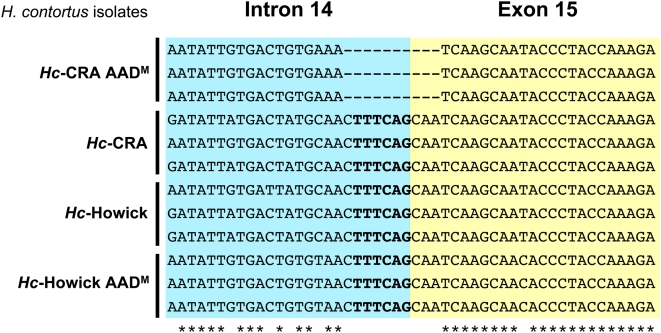
Figure 5. Hc-CRA AADM mutants lack the splice acceptor site of intron 14.
Sequencing of PCR products amplified from genomic DNA revealed a 10 bp deletion in the Hc-CRA AADM mutant that encompasses the predicted splice acceptor site (bold). The blue box corresponds to the end of intron 14 and the yellow box to the start of exon 15. Asterisks denote bases identical throughout all 12 sequenced clones.
Figure 6
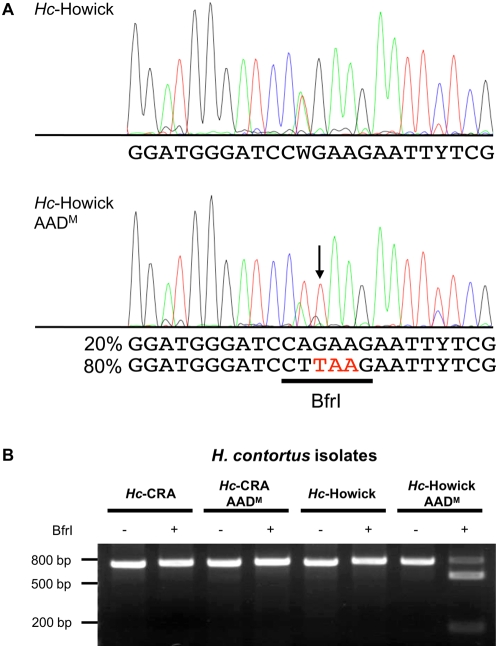
Figure 6. Detection of a nonsense mutation in Hc-Howick AADM worms.
(A) Direct sequencing of RT-PCR products revealed a transversion in exon 6 from G to T (arrow) in the Hco-mptl-1 gene that leads to a premature stop at codon 93 (TAA; shown in red) in about 80% of Hc-Howick AADM mutants as estimated from the electropherogram. (B) The point mutation creates a restriction site for the endonuclease BfrI (CTTAAG; underlined). Only the product amplified from cDNA of the Hc-Howick AADM mutant could be digested.
Figure 7
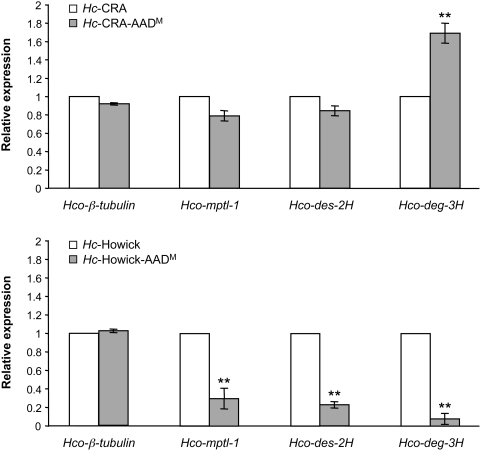
Figure 7. Relative mRNA levels of DEG-3 subfamily genes in AAD mutant H. contortus.
Relative expression levels of the DEG-3 subfamily nAChR genes Hco-mptl-1, Hco-des-2H, and Hco-deg-3H quantified by RT-qPCR for Hc-CRA and Hc-CRA AADM (top), or Hc-Howick and Hc-Howick AADM isolates (bottom). Relative expression values were normalized to those of glucose-phosphate isomerase (GPI); ß-tubulin served as a non-affected control. P-values (<0.01 are indicated by **) were calculated with repeated measures Anova, followed by Dunnett's test against the parental control (which had been set to 1). Average mRNA levels and SD were derived from 3 independent experiments, each in duplicate with 1 qPCR run each.

References

    1. McLeod RS. Costs of major parasites to the Australian livestock industries. Int J Parasitol. 1995;25:1363–1367. - PubMed
    1. Atanasio A, Boomker J, Sitoe C. A survey on the occurrence of resistance to anthelmintics of gastrointestinal nematodes of goats in Mozambique. Onderstepoort J Vet Res. 2002;69:215–220. - PubMed
    1. Conder GA, Campbell WC. Chemotherapy of nematode infections of veterinary importance, with special reference to drug resistance. Adv Parasitol. 1995;35:1–84. - PubMed
    1. Jackson F, Coop RL. The development of anthelmintic resistance in sheep nematodes. Parasitology. 2000;120(Suppl):S95–107. - PubMed
    1. Prichard R. Anthelmintic resistance. Vet Parasitol. 1994;54:259–268. - PubMed

Publication types