. 2009 Apr;84(4):459-67.
doi: 10.1016/j.ajhg.2009.03.014.

IFAP syndrome is caused by deficiency in MBTPS2, an intramembrane zinc metalloprotease essential for cholesterol homeostasis and ER stress response

Affiliations

IFAP syndrome is caused by deficiency in MBTPS2, an intramembrane zinc metalloprotease essential for cholesterol homeostasis and ER stress response

Frank Oeffner et al. Am J Hum Genet. 2009 Apr.

Abstract

Ichthyosis follicularis with atrichia and photophobia (IFAP syndrome) is a rare X-linked, oculocutaneous human disorder. Here, we assign the IFAP locus to the 5.4 Mb region between DXS989 and DXS8019 on Xp22.11-p22.13 and provide evidence that missense mutations exchanging highly conserved amino acids of membrane-bound transcription factor protease, site 2 (MBTPS2) are associated with this phenotype. MBTPS2, a membrane-embedded zinc metalloprotease, activates signaling proteins involved in sterol control of transcription and ER stress response. Wild-type MBTPS2 was able to complement the protease deficiency in Chinese hamster M19 cells as shown by induction of an SRE-regulated reporter gene in transient transfection experiments and by growth of stably transfected cells in media devoid of cholesterol and lipids. These functions were impaired in five mutations as detected in unrelated patients. The degree of diminished activity correlated with clinical severity as noted in male patients. Our findings indicate that the phenotypic expression of IFAP syndrome is quantitatively related to a reduced function of a key cellular regulatory system affecting cholesterol homeostasis and ability to cope with ER stress.


Figures

Figure 1
Figure 1
Clinical Features of IFAP Syndrome Male patient showing typical filiform follicular hyperkeratoses (“ichthyosis follicularis”) (A), atrichia of the scalp (B), half-closed eyelids reflecting severe photophobia, and absence of eyebrows and lashes (C).
Figure 2
Figure 2
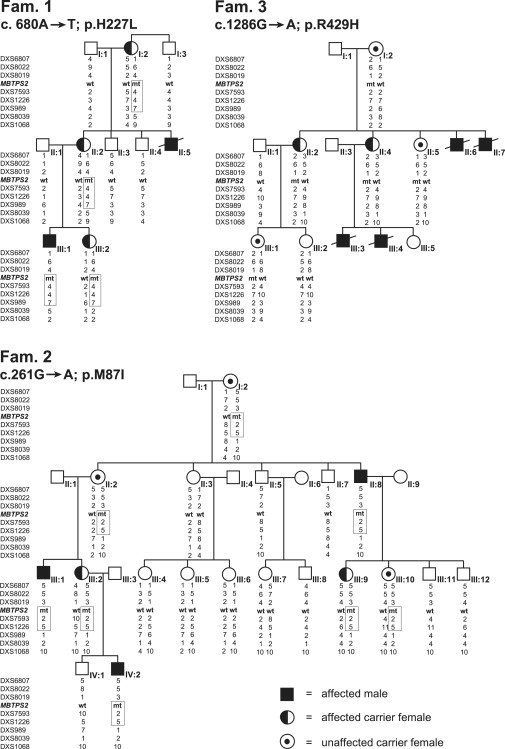
Pedigrees of Three Families of European Descent with IFAP Syndrome Partial pedigrees of families 1–3 show genotypes of X-chromosomal markers from Xpter to Xcen. Disease-associated haplotypes in families 1 and 2 are encased in a box. For clarity, not all analyzed markers listed in Table S1 are given. MBTPS2 mutations and the derived amino acid changes are indicated below the family identifier and are included as allele “mt” in the list of genotypes; “wt” represents wild-type MBTPS2. The status of females as unaffected carriers in families 2 and 3 is defined a posteriori according to the presence of a mutated MBTPS2 allele.
Figure 3
Figure 3
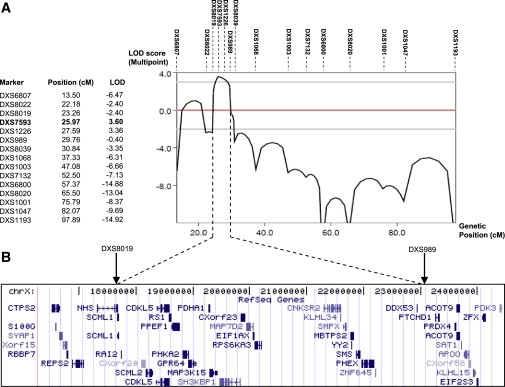
Multipoint Linkage Analysis of the IFAP Locus Combined parametric multipoint linkage analysis with the MINX program of MERLIN confirms the two-point linkage results placing the IFAP locus between DXS8019 and DXS989 (Table S1). (A) Table and graphical representation of multipoint LOD scores calculated with X-chromosomal marker genotypes of pedigrees 1 and 2 (Figure 2). The highest LOD score of 3.60 at DXS7593 is marked in bold. (B) NCBI RefSeq genes (adopted from the UCSC genome browser) from the critical interval on the X chromosome between markers DXS8019 (telomeric) and DXS989 (centromeric).
Figure 4
Figure 4
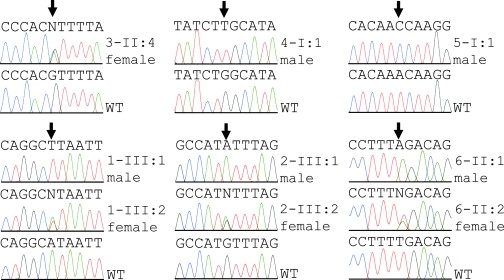
MBTPS2 Mutation Analysis DNA sequence electropherograms of WT MBTPS2 and mutations observed in male or female IFAP patients from six unrelated families. The positions of the mutant bases are indicated by arrows. Phenotypes of the individuals analyzed are listed in Table 1.
Figure 5
Figure 5
Cellular Localization and Complementation Analysis of MBTPS2 Mutant Proteins (A) In cultured cells transiently transfected with clones expressing YFP alone (vector), with clone IOH46558-pdEYFP-C1amp expressing a YFP-MBTPS2-wild-type protein (WT), or with five clones expressing mutated YFP-MBTPS2 proteins as indicated at the bottom of (C), the YFP-MBTPS2 fusion proteins localize preferentially in the cytoplasm but not in the nucleus, whereas YFP is found both in nucleus and cytoplasm (green fluorescence, upper panel). For clarity, nuclei are stained in blue with DAPI; the Golgi shows red color and is orange in superposition with green fluorescence (lower panel). (B) Stable transfection of CHO-K1-M19 cells lacking hamster Mbtps2 with WT human MBTPS2 complements the enzyme defect, thereby allowing growth in cholesterol-deficient media. Complementation analysis with either of five mutants exchanging highly conserved amino acids indicated at the bottom of (C) supports growth in cholesterol-deficient media to various degrees correlated with the severity of the phenotype (Table 1). The proportion of cells capable of growth in spite of cholesterol deprivation is documented as photographs of the cultures in absence or presence of sterols and, graphically, by counts of growing stably transfected cells under the same conditions. Data are represented as mean ± SEM. Absence of sterols in the culture media is indicated by a red frame encasing the photographs of culture dishes and red columns in the diagrams; growth in media with sterols is indicated by blue frame or columns. (C) Transient cotransfection of a construct expressing wild-type MBTPS2 (WT) with a luciferase reporter gene under transcriptional control of sterol responsive elements (SRE) into M19 cells restores sterol responsiveness of the cells in sterol-deficient media (red columns) but not in sterol-containing media (blue columns). Replacement of the wild-type with mutant MBTPS2 expression constructs results in reduced induction by sterols to different extent. Transfection efficiency is normalized to cotransfected Renilla luciferase. The results shown are representative of three independent transfection experiments. Data are represented as mean ± SEM. In (A)–(C), ”Vector” represents different empty vectors used to clone WT and mutant MBTPS2 as described in Material and Methods.

References

    1. Macleod J.M.H. Three cases of “ichthyosis follicularis” associated with baldness. Br. J. Dermatol. 1909;21:165–189.
    1. Boente M.C., Bibas-Bonet H., Coronel A.M., Asial R.A. Atrichia, ichthyosis, follicular hyperkeratosis, chronic candidiasis, keratitis, seizures, mental retardation and inguinal hernia: A severe manifestation of IFAP syndrome? Eur. J. Dermatol. 2000;10:98–102. - PubMed
    1. Sato-Matsumura K.C., Matsumura T., Kumakiri M., Hosokawa K., Nakamura H., Kobayashi H., Ohkawara A. Ichthyosis follicularis with alopecia and photophobia in a mother and daughter. Br. J. Dermatol. 2000;142:157–162. - PubMed
    1. Cambiaghi S., Barbareschi M., Tadini G. Ichthyosis follicularis with atrichia and photophobia (IFAP) syndrome in two unrelated female patients. J. Am. Acad. Dermatol. 2002;46:S156–S158. - PubMed
    1. Khandpur S., Bhat R., Ramam M. Ichthyosis follicularis, alopecia and photophobia (IFAP) syndrome treated with acitretin. J. Eur. Acad. Dermatol. Venereol. 2005;19:759–762. - PubMed

Publication types

MeSH terms