


Case Reports
doi: 10.1016/j.ajhg.2009.03.016.
Epub 2009 Apr 9.
Ovaries and female phenotype in a girl with 46,XY karyotype and mutations in the CBX2 gene
Affiliations
- PMID: 19361780
- PMCID: PMC2680992
- DOI: 10.1016/j.ajhg.2009.03.016
Item in Clipboard
Case Reports
Ovaries and female phenotype in a girl with 46,XY karyotype and mutations in the CBX2 gene
Am J Hum Genet.
2009 May.
Abstract
A girl with a prenatal 46,XY karyotype was born with a completely normal female phenotype, including uterus and histologically normal ovaries. In mice with a similar phenotype, the ablation of M33, an ortholog of Drosophila Polycomb, causes male-to-female sex reversal. The analysis of the human homolog of M33, Chromobox homolog 2 (CBX2), in this girl revealed loss-of-function mutations that allowed us, by placing CBX2 upstream of SRY, to add an additional component to the still incomplete cascade of human sex development.
Figures
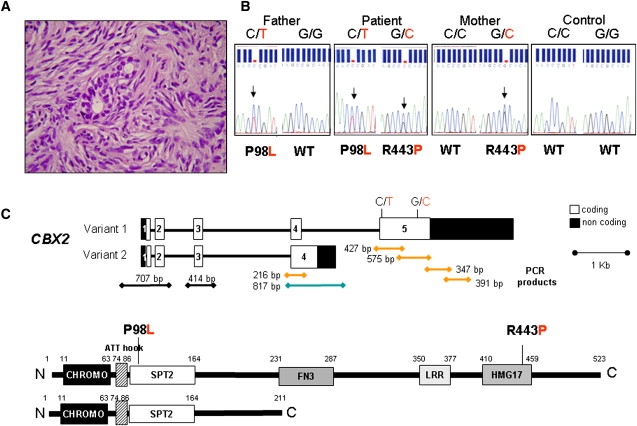
Ovarian Phenotype, Genotype, and Genotyping Strategy (A) Hystology of bioptic ovarian fragment (0.3 × 0.2 × 0.15 cm) showing ovarian cortex stromal tissue and two primordial follicles. (B) DNA sequence chromatograms obtained by direct sequencing of PCR products showing the presence of the heterozygote c.C293T and c.G1370C substitution in exon 5, not present in normal individuals (control, representative example out of 320 alleles). (C) General structure of the CBX2 gene and protein variants and location of the P98L and R443P mutations. Exons are represented by boxes. The PCR products and their lengths are also depicted: black lines, products common to both variants; blue line, product of variant 2 only; yellow lines, products of variant 1 only. The protein domains were identified with the SMART server. Abbreviations: CHROMO, CHRomatin Organization mOdifier; ATT-hook, small DNA binding motif originally described in the high-mobility group (HMG) nonhistone chromosomal protein HMG-I; SPT2, S. cerevisiae chromatin protein involved in transcriptional regulation; FN3, fibronectin 3-repeat region; LRR_R1, leucin-repeat region involved in protein-protein interaction; HMG17, high mobility group nonhistone chromatin component.
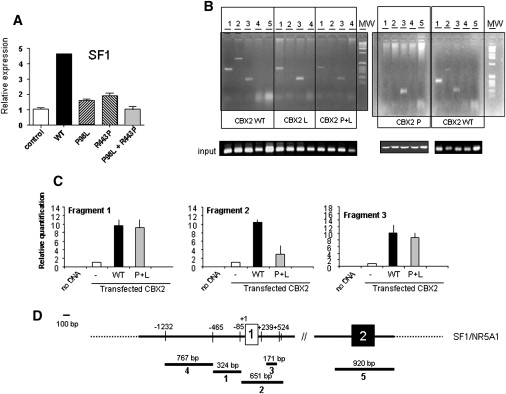
Binding of CBX2 to SF1/NR5A1 Promoter and Influence on Expression (A) Role of CBX2 variants on the expression of the putative target gene SF1/NR5A1 and proof of a direct influence of CBX2 by its direct binding to promoter target sequences. Expression of SF1 in H295R cells nontransfected (control) or transfected with WT or mutant CBX2. (B–D) Qualitative (B) and quantitative (C) chromatine immunoprecipitation (ChIP) assay. Crosslinked extracts from H295R cells with or without transfection with WT or mutated CBX2 were sonicated and immunoprecipitated with anti-myc (tag) antibody. After reverse cross-linking, PCR was performed with primers specific for the regions depicted in (D). The numbers on top of the gel in (B) correspond to fragment numbers . Quantitative RT-PCR was performed with SYBR Green incorporation. The data are expressed as mean ± SD.
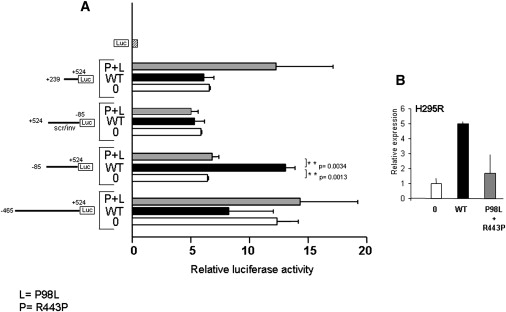
Effect of CBX2 Variants on Gene Target Promoters (A) Transactivation of luciferase reporter driven by deletion construct of SF1 promoter in absence (0) or presence of overexpression of WT or both CBX2 mutants (P+L). Luciferase activity is expressed as relative to empty vector (luc). Construct +524/85 scr/inv contains the same sequence as in −85/+524 that was scrambled and inserted in the opposite direction. For reference to the ChIP experiments, construct −465/+524 contains ChIP fragments 1, 2, and 3; −85/+524 is fragment 2 and contains fragment 3; +239/+524 contains fragment 3. (B) Real-time PCR of endogenous SF1 in H295R without (0) or with transfection of wild-type (WT) or mutant CBX2. The image represents the results of mean ± SD of three independent experiments. The comparison between (A) and (B) suggests that the stimulatory effect of WT CBX2 on the −85/+524 sequence is dominant over the inhibitory effect of the bigger construct (−465/+524).
References
-
- Polanco J.C., Koopman P. Sry and the hesitant beginnings of male development. Dev. Biol. 2007;302:13–24. - PubMed
-
- Kent J., Wheatley S.C., Andrews J.E., Sinclair A.H., Koopman P. A male-specific role for SOX9 in vertebrate sex determination. Development. 1996;122:2813–2822. - PubMed
-
- Colvin J.S., Green R.P., Schmahl J., Capel B., Ornitz D.M. Male-to-female sex reversal in mice lacking fibroblast growth factor 9. Cell. 2001;104:875–889. - PubMed
Publication types
MeSH terms
Substances
LinkOut - more resources
Full Text Sources
Other Literature Sources
Molecular Biology Databases
