


Effect of early skin-to-skin contact on mother-preterm infant interaction through 18 months: randomized controlled trial
- PMID: 19361802
- PMCID: PMC2818078
- DOI: 10.1016/j.ijnurstu.2009.03.005
Effect of early skin-to-skin contact on mother-preterm infant interaction through 18 months: randomized controlled trial
Abstract
Background: Preterm birth often negatively influences mother-infant interaction. Skin-to-skin contact postbirth has positive effects on maternal feelings toward their preterm infants and on infant development and family interaction. However, little is known about the long-term effects of skin-to-skin contact on mother-late preterm infant interaction when skin-to-skin contact was experienced early postbirth and intermittently throughout the next five days.
Objective: The purpose of this report was to examine the effect of skin-to-skin contact on mother-late preterm infant interaction through 18 months.
Design: Randomized controlled trial with follow-up.
Setting: Two hospitals in the United States of America.
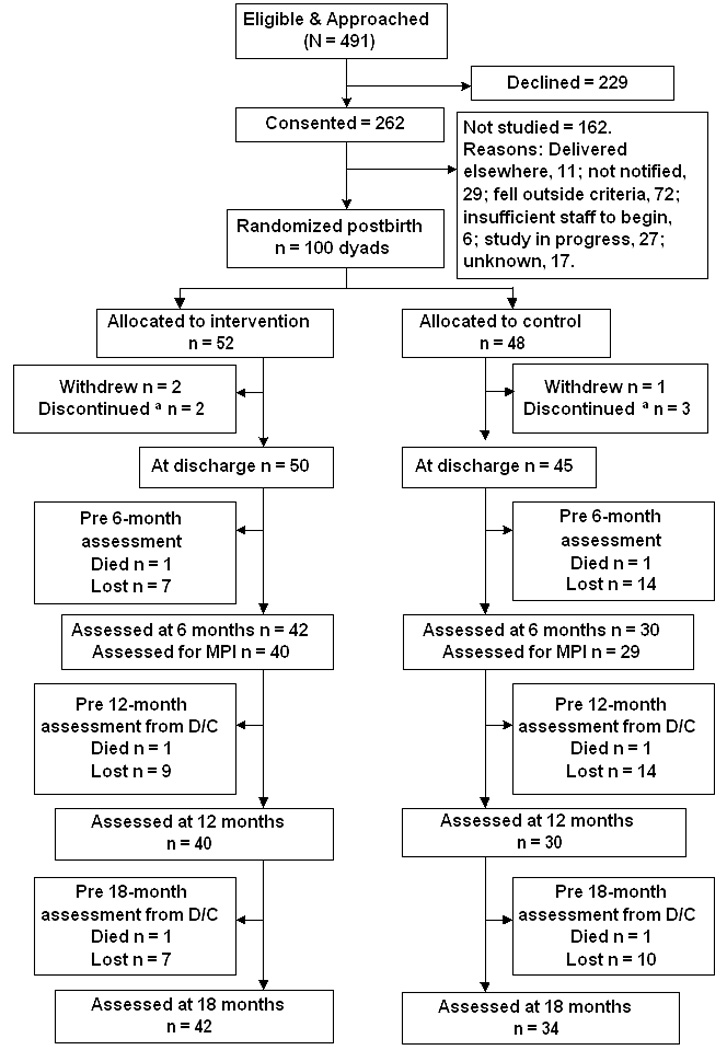
Participants: 100 mothers and their late preterm infants, 32 to <37 weeks' gestation, were recruited. Mother-preterm infant interactions were assessed in 69, 70, and 76 dyads at 6, 12, and 18 months.
Methods: Mothers and their preterm infants were videotaped during a feeding session at 6 and 12 months, and a teaching session at 6, 12, and 18 months. Their interactions were then scored using the Nursing Child Assessment Satellite Feeding Scale and Teaching Scale.
Results: Skin-to-skin contact and control dyads had comparable feeding scores at 6 and 12 months. Skin-to-skin contact infants had lower infant teaching scores at six months, a difference that disappeared thereafter.
Conclusions: These inconclusive results call for additional studies with larger doses of skin-to-skin contact, larger sample sizes, and other outcome measures of mother-late preterm infant interactions. Such measures include the Parent-Child Early Relational Assessment and behavioral coding during play.
Figures
References
-
- Affonso DD, Bosque E, Wahlberg V, Brady JP. Reconciliation and healing for mothers through skin-to-skin contact provided in an American tertiary level intensive care nursery. Neonatal Network. 1993;12(3):25–32. - PubMed
-
- Affonso DD, Hurst L, Mayberry LJ, Haller L, Yost K, Lynch MI. Stressors reported by mothers of hospitalized premature infants. Neonatal Network. 1992;11(6):63–70. - PubMed
-
- Affonso DD, Wahlberg V, Persson B. Exploration of mothers’ reactions to the kangaroo method of prematurity care. Neonatal Network. 1989;7(6):43–51. - PubMed
-
- Anderson GC. Unpublished masters thesis. Madison: University of Wisconsin; 1972. Self-regulatory mother-infant interaction deprivation: A theoretical framework.
-
- Anderson GC. The mother and her newborn: Mutual caregivers. Journal of Obstetric, Gynecologic, & Neonatal Nursing. 1977;6(5):50–57. - PubMed
Publication types
MeSH terms
Grants and funding
LinkOut - more resources
Full Text Sources
Medical
Miscellaneous
