


Syphilis in drug users in low and middle income countries
- PMID: 19361976
- PMCID: PMC2790553
- DOI: 10.1016/j.drugpo.2009.02.008
Syphilis in drug users in low and middle income countries
Abstract
Background: Genital ulcer disease (GUD), including syphilis, is an important cause of morbidity in low and middle income (LMI) countries and syphilis transmission is associated with HIV transmission.
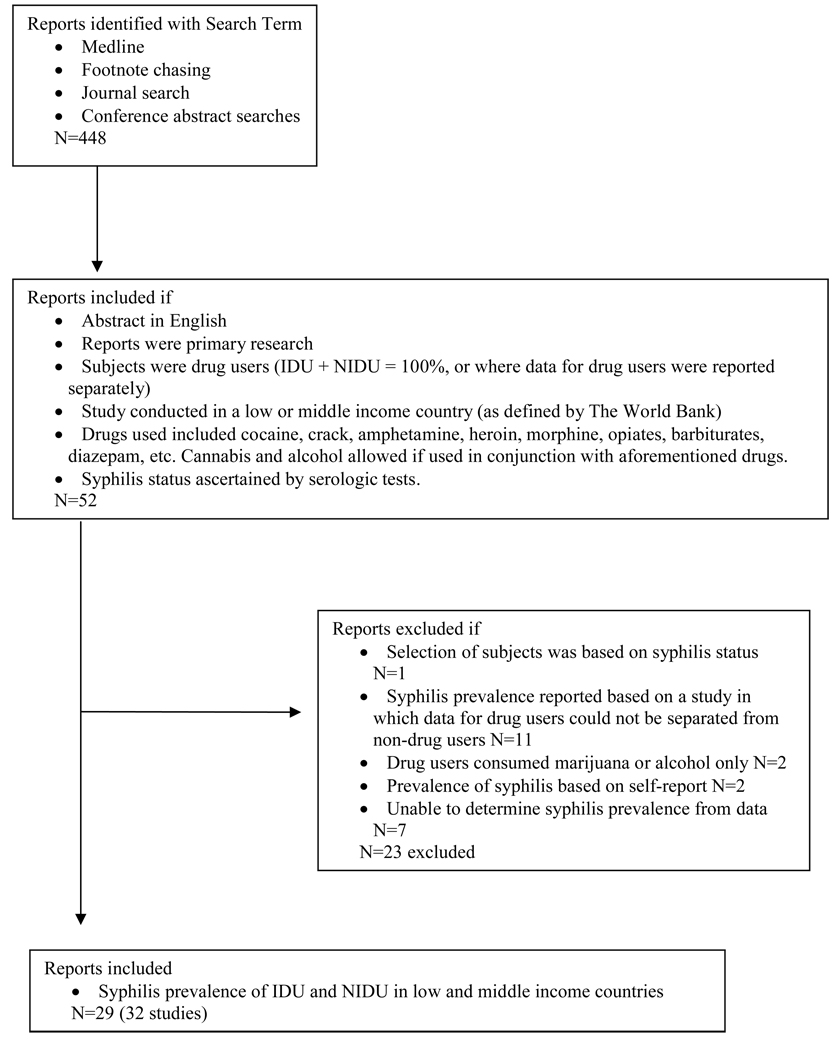
Methods: We conducted a literature review to evaluate syphilis infection among drug users in LMI countries for the period 1995-2007. Countries were categorized using the World Bank Atlas method [The World Bank. (2007). Data and statistics: Country groups. Retrieved online October 18, 2007 at http://go.worldbank.org/D7SN0B8YU0] according to 2006 gross national income per capita.
Results: Thirty-two studies were included (N=13,848 subjects), mostly from Southeast Asia with some from Latin America, Eastern Europe, Central and East Asia, North Africa and the Middle East but none from regions such as Sub-Saharan Africa. The median prevalence of overall lifetime syphilis (N=32 studies) was 11.1% (interquartile range: 6.3-15.3%) and of HIV (N=31 studies) was 1.1% (interquartile range: 0.22-5.50%). There was a modest relation (r=0.27) between HIV and syphilis prevalence. Median syphilis prevalence by gender was 4.0% (interquartile range: 3.4-6.6%) among males (N=11 studies) and 19.9% (interquartile range: 11.4-36.0%) among females (N=6 studies). There was a strong relation (r=0.68) between syphilis prevalence and female gender that may be related to female sex work.
Conclusion: Drug users in LMI countries have a high prevalence of syphilis but data are limited and, in some regions, entirely lacking. Further data are needed, including studies targeting the risks of women. Interventions to promote safer sex, testing, counselling and education, as well as health care worker awareness, should be integrated in harm reduction programs and health care settings to prevent new syphilis infections and reduce HIV transmission among drug users and their partners in LMI countries.
Figures
References
-
- Abdala N, Carney JM, Durante AJ, Klimov N, Ostrovski D, Somalí AM, Kozlov A, Heimer R. Estimating the prevalence of syringe-borne and sexually transmitted disease among injection drug users in St Petersburg, Russia. International Journal of STD & AIDS. 2003;14(10):697–703. - PubMed
-
- Azim T, Alam MS, Rahman M, Sarker MS, Ahmed G, Khan MR, Rahman S, Rahman ASMM, Sack DA. Impending concentrated HIV epidemic among injecting drug users in Central Bangladesh. International Journal of STD & AIDS. 2004;15(4):280–282. - PubMed
-
- Azim T, Bogarts J, Yirrell DL, Banerjea AC, Sarker MS, Ahmed G, Amin MMM, Rahman ASMM, Hussain AMZ. Injecting drug users in Bangladesh: Prevalence of syphilis. Hepatitis, HIV and HIV subtypes. AIDS. 2002;16(1):121–123. - PubMed
-
- Azim T, Chowdhury EI, Reza M, Ahmed M, Uddin MT, Khan R, Ahmed G, Rahman M, Khandakar I, Khan SI, Sack DA, Strathdee SA. Vulnerability to HIV infection among sex workers and non-sex worker female injecting drug users in Dhaka, Bangladesh: Evidence from the baseline survey of a cohort study. Harm Reduction Journal. 2006;3:33. - PMC - PubMed
