. 2009 Jun;29(12):3307-18.
doi: 10.1128/MCB.00240-09. Epub 2009 Apr 13.

Polyubiquitination by HECT E3s and the determinants of chain type specificity

Affiliations

Polyubiquitination by HECT E3s and the determinants of chain type specificity

Hyung Cheol Kim et al. Mol Cell Biol. 2009 Jun.

Abstract

Polyubiquitination can mediate several different biochemical functions, determined in part by which lysine of ubiquitin is used to link the polyubiquitin chain. Among the HECT domain ubiquitin ligases, some, such as human E6AP, preferentially catalyze the formation of K48-linked polyubiquitin chains, while others, including Saccharomyces cerevisiae Rsp5 and human Itch, preferentially catalyze the formation of K63-linked chains. The features of HECT E3s that determine their chain type specificities have not been identified. We show here that chain type specificity is a function solely of the Rsp5 HECT domain, that the identity of the cooperating E2 protein does not influence the chain type specificity, that single chains produced by Rsp5 contain between 12 and 30 ubiquitin moieties, and that the determinants of chain type specificity are located within the last 60 amino acids of the C lobe of the HECT domain. Our results are also consistent with a simple sequential-addition mechanism for polyubiquitination by Rsp5, rather than a mechanism involving the formation of either E2- or E3-linked polyubiquitin chain transfers.


Figures

FIG. 1.
FIG. 1.
Chain type specificities of E6AP and Rsp5. (A) In vitro ubiquitination of 32P-labeled p53 in the presence of human E1, UbcH7, E6AP, and HPV33 E6 proteins, with wild-type protein (WT) or the indicated ubiquitin (Ub) mutant proteins. Following a 10-min reaction, the products were resolved by SDS-PAGE and visualized by autoradiography. (B) Schematic diagram of (left) wild-type Wbp2 (WT), Wbp2-C, Wbp2 containing lysine K222 as its only lysine (Wbp2-C-K222), and lysineless Wbp2 [Wbp2-K(0)]. Sna3, a single-lysine derivative (Sna3-K125), and Sna3-K(0) are shown on the right. PPXY motifs are indicated with gray rectangles, and lysine residues are indicated with small black squares. (C and D) In vitro Rsp5 ubiquitination assays were performed with Wbp2-C-K222 (C) or Sna3-K125 (D) as the substrate in the presence of Uba1, Ubc4, and the indicated form of ubiquitin.
FIG. 2.
FIG. 2.
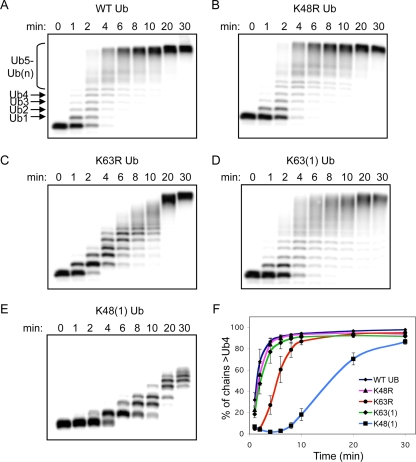
Time course of ubiquitination by Rsp5, with 32P-labeled Wbp2-C-K222 as a substrate, in the presence of wild-type (A), K48R (B), K63R (C), K63R(1) (D), and K48(1) (E) ubiquitin (Ub). Mono-, di-, tri-, and tetraubiquitinated substrates are designated Ub1, Ub2, Ub3, and Ub4 in panel A. (F) The results from the experiments shown in panels A to E were quantitated with a Bio-Rad phosphorimager. The graph shows the percentages of the ubiquitinated products that contained more than four ubiquitin molecules.
FIG. 3.
FIG. 3.
N-terminal substrate modification and the lengths of Rsp5-catalyzed chains. (A) In vitro ubiquitination of 32P-labeled Wbp2-C, Wbp2-C-K222, and Wbp2-C-K(0) with K(0) or wild-type (WT) ubiquitin (Ub). The reaction mixtures were incubated for 10 min at room temperature, and the products were resolved by SDS-PAGE and visualized by autoradiography. ub(1) to ub(4) indicate migration positions of substrate modified with one to four ubiquitin molecules, respectively. (B) 32P-labeled GST-Wbp2-C-K(0) or GST-Wbp2-C-K222, bound to glutathione-Sepharose, was incubated with Uba1, Ubc4, and Rsp5 for 30 min at room temperature. The reactions were terminated by washing the beads with phosphate-buffered saline. Half of the reaction mixture was analyzed directly by SDS-PAGE and autoradiography (left); the other half was treated with PreScission protease for 4 h at 4°C, and free Wbp2-C-K(0) or Wbp2-C-K222, retaining the 32P label, was analyzed by SDS-PAGE and autoradiography (right). The degradation products of GST-Wbp2-C present in the reaction mixture are indicated by the asterisk (left). (C) Time course of ubiquitination of 32P-labeled Wbp2-C-K(0) or Wbp2-C-K222 in the presence of Uba1, Ubc4, Rsp5, and K(0) ubiquitin. The reactions were initiated by the addition of ubiquitin and stopped by the addition of SDS-PAGE loading buffer. The total reaction products were resolved in SDS-PAGE and visualized by autoradiography. N-Ub indicates the Wbp2-C product ubiquitinated at the terminal amino group, and K-Ub indicates the product ubiquitinated at the internal lysine (K222). (D) To determine the lengths of K63-linked polyubiquitin chains formed by Rsp5, 32P-labeled Wbp2-C-K(0) was ubiquitinated with either K63(1) ubiquitin (second lane) or a mixture of K63(1) and K(0) ubiquitins at a ratio of 16:1 (third lane from left). Twelve ubiquitinated species could be resolved in the second lane (arrows).
FIG. 4.
FIG. 4.
The chain type specificity of Rsp5 is not influenced by the identity of E2. (A) 32P-labeled Wbp2-C-K222 was ubiquitinated in the presence of Uba1, Rsp5, ubiquitin, and the indicated yeast E2s. (B to E) The chain type specificity of Rsp5 was determined in the presence of Ubc1 (B), Ubc5 (C), Ubc1ΔUBA (D), or human UbcH7 (E). All reactions were incubated for 10 min at room temperature, and the products were resolved by SDS-PAGE and visualized by autoradiography. Ub, ubiquitin.
FIG. 5.
FIG. 5.
Rsp5 chain type specificity is a function of the HECT domain. (A) Schematic of Rsp5 truncation mutants used for in vitro ubiquitination assays. (B and C) ΔC2 Rsp5 was used in ubiquitination assays with 32P-labeled Wbp2-C-K222 in the presence of Uba1, Ubc4, and the indicated forms of ubiquitin (Ub) (B) and with ΔWW1,2 Rsp5 as the E3 (C). (D) Autoubiquitination of ΔWW1,2,3 Rsp5. 32P-labeled ΔWW1,2,3 was incubated with Uba1, Ubc4, and the indicated forms of ubiquitin and analyzed by SDS-PAGE and autoradiography.
FIG. 6.
FIG. 6.
Chain type specificities of chimeric Rsp5-E6AP proteins. (A) Structure of the E6AP HECT domain. The N lobe (blue), C lobe (green), hinge (red), and active-site cysteine (yellow) are indicated. (B) Schematic diagram of wild-type Rsp5 (top) and chimeras A to E, with E6AP regions indicated in yellow. Chimeras A and B were not biochemically active and could not be analyzed. (C to E) Chimera C (C), D (D), or E (E) was used in ubiquitination assays with 32P-labeled Wbp2-C-K222 in the presence of Uba1, Ubc4, and the indicated forms of ubiquitin (Ub). The reaction mixtures were analyzed by SDS-PAGE and autoradiography. WT, wild type.
FIG. 7.
FIG. 7.
Chain type specificities of chimeric Rsp5-Nedd4, -Itch, and -Huwe1 proteins. (A) Schematic diagram of the Rsp5-based chimeric E3s in which the C lobe of Rsp5 was replaced by the C lobe of NEDD4 (red), Itch (green), or Huwe1 (blue). The Huwe1 (a) chimera contained the complete C lobe and hinge regions from Huwe1, and the Huwe1 (b) chimera contained the region corresponding to the last 62 amino acids of Rsp5. (B to E) The Rsp5-Nedd4 (B), Rsp5-Itch (C), Rsp5-Huwe1 (a) (D), or Rsp5-Huwe1 (b) (E) chimera was used in ubiquitination assays with 32P-labeled Wbp2-C-K222 in the presence of Uba1, Ubc4, and the indicated forms of ubiquitin (Ub). The reaction mixtures were analyzed by SDS-PAGE and autoradiography. WT, wild type.
FIG. 8.
FIG. 8.
Chain type specificities of chimeric Itch-E6AP and Itch-Huwe1 proteins. (A) Schematic diagram of Itch-based chimeras, with the C lobe of Itch replaced by that of E6AP (yellow) or Huwe1 (blue). (B to D) Wild-type Itch (B) or the Itch-E6AP (C) or Itch-Huwe1 (D) chimera was used in ubiquitination assays with 32P-labeled Wbp2-C-K222 in the presence of Uba1, Ubc4, and the indicated forms of ubiquitin (Ub). The reaction mixtures were analyzed by SDS-PAGE and autoradiography. WT, wild type.
FIG. 9.
FIG. 9.
(A) Structures of the HECT domain C lobes of E6AP (19) and WWP1 (50). The structural elements of the last ∼60 amino acids of E6AP are colored, as are the corresponding regions of WWP1 (β-strands, blue; α-helix, red; active-site loop, yellow). The side chain of active-site cysteine shown, as is the extra loop in WWP1 (green). (B) Alignment of the last ∼60 amino acids of the HECT domain C lobes of several HECT E3s, with the structural elements indicated according to the colors in panel A. Identical residues among this group of E3s are shown in red, with highly conserved residues in green. (C) Model for how the C lobe might direct chain specificity. The N (blue) and C (green) lobes of the HECT domain are shown, with a ubiquitin (Ub) molecule tethered by a thioester bond (∼) to the active-site cysteine of the C lobe. Different HECT E3s might orient the thioester-linked ubiquitin molecule in different orientations, so that only K63 (left) or K48 (right) of the distal ubiquitin of a chain can approach the active site.

References

    1. Adhikary, S., F. Marinoni, A. Hock, E. Hulleman, N. Popov, R. Beier, S. Bernard, M. Quarto, M. Capra, S. Goettig, U. Kogel, M. Scheffner, K. Helin, and M. Eilers. 2005. The ubiquitin ligase HectH9 regulates transcriptional activation by Myc and is essential for tumor cell proliferation. Cell 123409-421. - PubMed
    1. Beaudenon, S., and J. M. Huibregtse. 2008. HPV E6, E6AP and cervical cancer. BMC Biochem. 9(Suppl. 1)S4. - PMC - PubMed
    1. Beaudenon, S. L., M. R. Huacani, G. Wang, D. P. McDonnell, and J. M. Huibregtse. 1999. Rsp5 ubiquitin-protein ligase mediates DNA damage-induced degradation of the large subunit of RNA polymerase II in Saccharomyces cerevisiae. Mol. Cell. Biol. 196972-6979. - PMC - PubMed
    1. Bernassola, F., M. Karin, A. Ciechanover, and G. Melino. 2008. The HECT family of E3 ubiquitin ligases: multiple players in cancer development. Cancer Cell 1410-21. - PubMed
    1. Bothos, J., M. K. Summers, M. Venere, D. M. Scolnick, and T. D. Halazonetis. 2003. The Chfr mitotic checkpoint protein functions with Ubc13-Mms2 to form Lys63-linked polyubiquitin chains. Oncogene 227101-7107. - PubMed

Publication types

MeSH terms

Substances