Optimization of control strategies for non-domiciliated Triatoma dimidiata, Chagas disease vector in the Yucatán Peninsula, Mexico
- PMID: 19365542
- PMCID: PMC2664331
- DOI: 10.1371/journal.pntd.0000416
Optimization of control strategies for non-domiciliated Triatoma dimidiata, Chagas disease vector in the Yucatán Peninsula, Mexico
Abstract
Background: Chagas disease is the most important vector-borne disease in Latin America. Regional initiatives based on residual insecticide spraying have successfully controlled domiciliated vectors in many regions. Non-domiciliated vectors remain responsible for a significant transmission risk, and their control is now a key challenge for disease control.
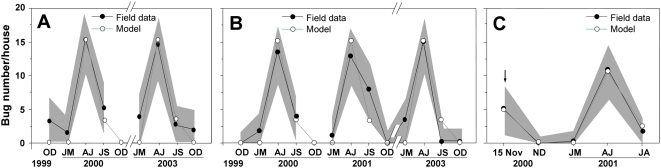
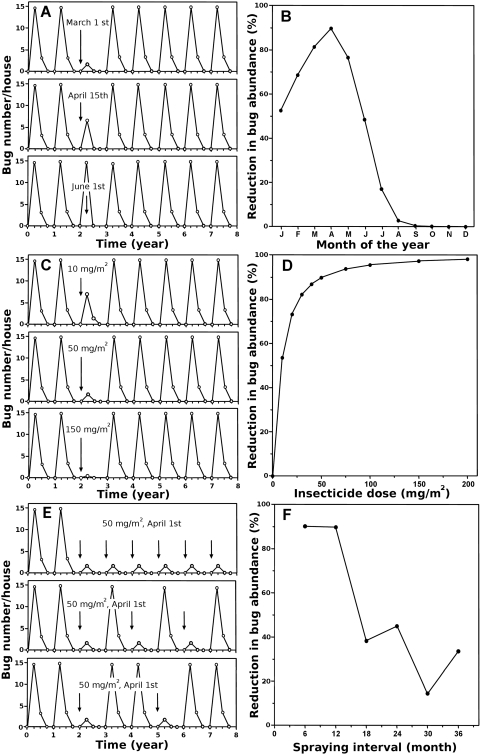
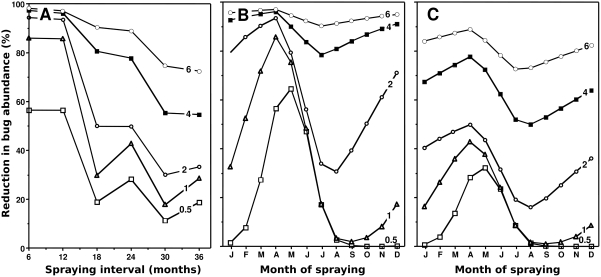
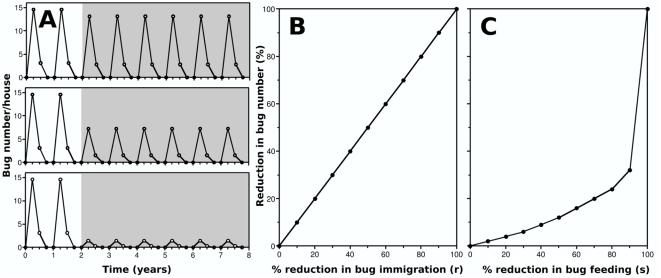
Methodology/principal findings: A mathematical model was developed to predict the temporal variations in abundance of non-domiciliated vectors inside houses. Demographic parameters were estimated by fitting the model to two years of field data from the Yucatan peninsula, Mexico. The predictive value of the model was tested on an independent data set before simulations examined the efficacy of control strategies based on residual insecticide spraying, insect screens, and bednets. The model accurately fitted and predicted field data in the absence and presence of insecticide spraying. Pyrethroid spraying was found effective when 50 mg/m(2) were applied yearly within a two-month period matching the immigration season. The >80% reduction in bug abundance was not improved by larger doses or more frequent interventions, and it decreased drastically for different timing and lower frequencies of intervention. Alternatively, the use of insect screens consistently reduced bug abundance proportionally to the reduction of the vector immigration rate.
Conclusion/significance: Control of non-domiciliated vectors can hardly be achieved by insecticide spraying, because it would require yearly application and an accurate understanding of the temporal pattern of immigration. Insect screens appear to offer an effective and sustainable alternative, which may be part of multi-disease interventions for the integrated control of neglected vector-borne diseases.
Conflict of interest statement
The authors have declared that no competing interests exist.
Figures
References
-
- Moncayo AC, Ortiz Yanine MI. An update on Chagas disease (human american trypansomomiasis). Ann Trop Med Parasitol. 2006;100:663–677. - PubMed
-
- Schofield CJ, Jannin J, Salvatella R. The future of Chagas disease control. Trends Parasitol. 2006;22:583–588. - PubMed
-
- Moncayo AC, Guhl F, Stein C. Global burden of disease 2000. Geneva, Switzerland: WHO; 2000. Global burden of Chagas' disease in the year 2000.
-
- Dorn PL, Buekens P, Hanford E. Wac-a-mole: future trends in Chagas disease transmission and the importance of a global perspective on disease control. Fut Microbiol. 2007;2:365–367. - PubMed
-
- Pinto Dias JC. Chagas disease: successes and challenges. Cad Saude Publica. 2006;22:2020–2021. - PubMed
Publication types
MeSH terms
Substances
LinkOut - more resources
Full Text Sources
Medical