


Lateralization of the arcuate fasciculus from childhood to adulthood and its relation to cognitive abilities in children
- PMID: 19365801
- PMCID: PMC6870654
- DOI: 10.1002/hbm.20779
Lateralization of the arcuate fasciculus from childhood to adulthood and its relation to cognitive abilities in children
Abstract
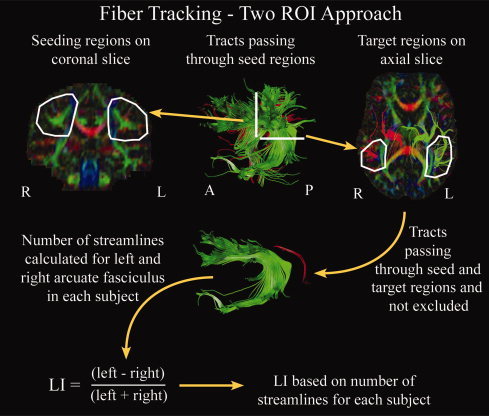
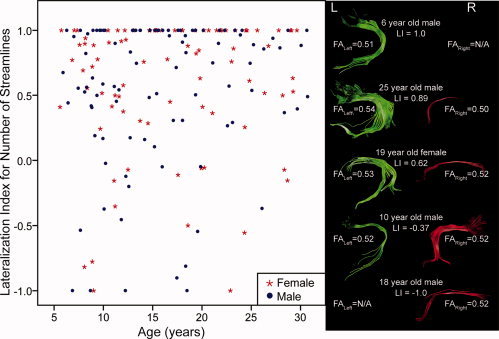
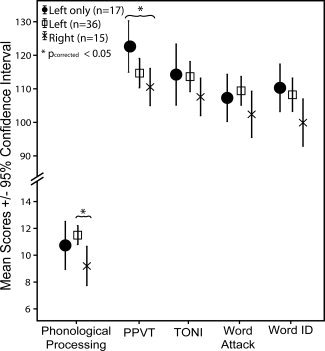
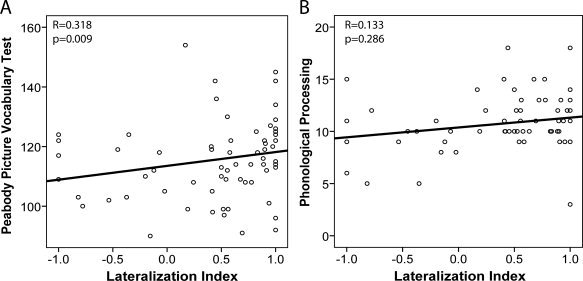
The arcuate fasciculus is a major white matter tract involved in language processing that has also been repeatedly implicated in intelligence and reasoning tasks. Language in the human brain is lateralized in terms of both function and structure, and while the arcuate fasciculus reflects this asymmetry, its pattern of lateralization is poorly understood in children and adolescents. We used diffusion tensor imaging (DTI) and tractography to examine arcuate fasciculus lateralization in a large (n = 183) group of healthy right-handed volunteers aged 5-30 years; a subset of 68 children aged 5-13 years also underwent cognitive assessments. Fractional anisotropy and number of streamlines of the arcuate fasciculus were both significantly higher in the left hemisphere than the right hemisphere in most subjects, although some subjects (10%) were right lateralized. Age and gender effects on lateralization were not significant. Children receiving cognitive assessments were divided into three groups: a "left-only" group in whom only the left side of the arcuate fasciculus could be tracked, a left-lateralized group, and a right-lateralized group. Scores on the Peabody Picture Vocabulary Test (PPVT) and NEPSY Phonological Processing task differed significantly among groups, with left-only subjects outperforming the right-lateralized group on the PPVT, and the left-lateralized children scoring significantly better than the right-lateralized group on phonological processing. In summary, DTI tractography demonstrates leftward arcuate fasciculus lateralization in children, adolescents, and young adults, and reveals a relationship between structural white matter lateralization and specific cognitive abilities in children.
Figures
References
-
- Ashtari M,Cervellione KL,Hasan KM,Wu J,McIlree C,Kester H,Ardekani BA,Roofeh D,Szeszko PR,Kumra S ( 2007): White matter development during late adolescence in healthy males: A cross‐sectional diffusion tensor imaging study. Neuroimage 35: 501–510. - PubMed
-
- Balsamo LM,Xu B,Grandin CB,Petrella JR,Braniecki SH,Elliott TK,Gaillard WD ( 2002): A functional magnetic resonance imaging study of left hemisphere language dominance in children. Arch Neurol 59: 1168–1174. - PubMed
-
- Barnea‐Goraly N,Menon V,Eckert M,Tamm L,Bammer R,Karchemskiy A,Dant CC,Reiss AL ( 2005): White matter development during childhood and adolescence: A cross‐sectional diffusion tensor imaging study. Cereb Cortex 15: 1848–1854. - PubMed
-
- Basser PJ,Pajevic S,Pierpaoli C,Duda J,Aldroubi A ( 2000): In vivo fiber tractography using DT‐MRI data. Magn Reson Med 44: 625–632. - PubMed
-
- Beaulieu C ( 2002): The basis of anisotropic water diffusion in the nervous system—A technical review. NMR Biomed 15: 435–455. - PubMed
Publication types
MeSH terms
LinkOut - more resources
Full Text Sources
