


Extracellularly activated nanocarriers: a new paradigm of tumor targeted drug delivery
- PMID: 19366234
- PMCID: PMC2743941
- DOI: 10.1021/mp900090z
Extracellularly activated nanocarriers: a new paradigm of tumor targeted drug delivery
Abstract
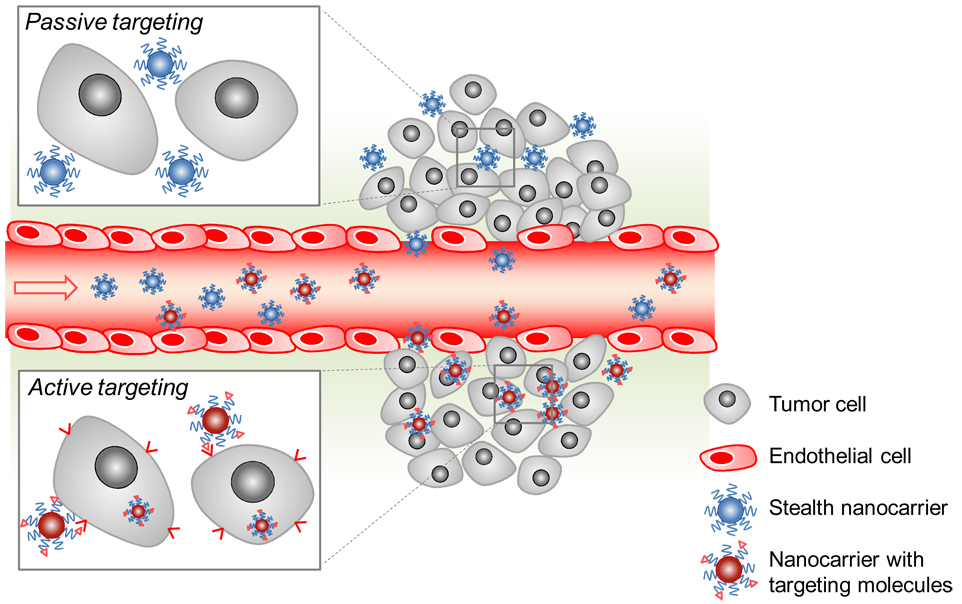
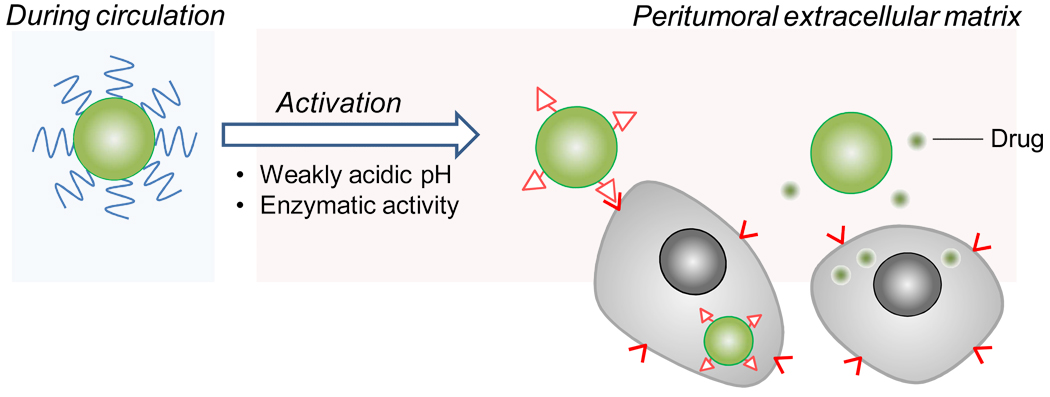
One of the main goals of nanomedicine is to develop a nanocarrier that can selectively deliver anticancer drugs to the targeted tumors. Extensive efforts have resulted in several tumor-targeted nanocarriers, some of which are approved for clinical use. Most nanocarriers achieve tumor-selective accumulation through the enhanced permeability and retention effect. Targeting molecules such as antibodies, peptides, ligands, or nucleic acids attached to the nanocarriers further enhance their recognition and internalization by the target tissues. While both the stealth and targeting features are important for effective and selective drug delivery to the tumors, achieving both features simultaneously is often found to be difficult. Some of the recent targeting strategies have the potential to overcome this challenge. These strategies utilize the unique extracellular environment of tumors to change the long-circulating nanocarriers to release the drug or interact with cells in a tumor-specific manner. This review discusses the new targeting strategies with recent examples, which utilize the environmental stimuli to activate the nanocarriers. Traditional strategies for tumor-targeted nanocarriers are briefly discussed with an emphasis on their achievements and challenges.
Figures
References
-
- Matsumura Y, Maeda H. A New Concept for Macromolecular Therapeutics in Cancer Chemotherapy: Mechanism of Tumoritropic Accumulation of Proteins and the Antitumor Agent Smancs. Cancer Res. 1986;46:6387–6392. - PubMed
-
- Maeda H, Wu J, Sawa T, Matsumura Y, Hori K. Tumor vascular permeability and the EPR effect in macromolecular therapeutics: a review. Journal of Controlled Release. 2000;65(1–2):271. - PubMed
-
- Yang T, Choi MK, Cui FD, Kim JS, Chung SJ, Shim CK, Kim DD. Preparation and evaluation of paclitaxel-loaded PEGylated immunoliposome. Journal of Controlled Release. 2007;120(3):169–177. - PubMed
-
- Kirpotin DB, Drummond DC, Shao Y, Shalaby MR, Hong KL, Nielsen UB, Marks JD, Benz CC, Park JW. Antibody targeting of long-circulating lipidic nanoparticles does not increase tumor localization but does increase internalization in animal models. Cancer Research. 2006;66(13):6732–6740. - PubMed
-
- Mamot C, Drummond DC, Noble CO, Kallab V, Guo ZX, Hong KL, Kirpotin DB, Park JW. Epidermal growth factor receptor-targeted immunoliposomes significantly enhance the efficacy of multiple anticancer drugs in vivo. Cancer Research. 2005;65(24):11631–11638. - PubMed
Publication types
MeSH terms
Substances
Grants and funding
LinkOut - more resources
Full Text Sources
Other Literature Sources
