


Post-conditioning restores pre-ischaemic receptor coupling in rat isolated hearts
- PMID: 19366352
- PMCID: PMC2697714
- DOI: 10.1111/j.1476-5381.2008.00053.x
Post-conditioning restores pre-ischaemic receptor coupling in rat isolated hearts
Abstract
Background and purpose: Ischaemic preconditioning (IPC) and ischaemic post-conditioning (IPoC) activate signal transduction pathways that are also involved in receptor de- and re-sensitization such as phosphatidylinositol (PI) 3-kinase. Therefore, IPC and IPoC may affect post-infarct receptor coupling.
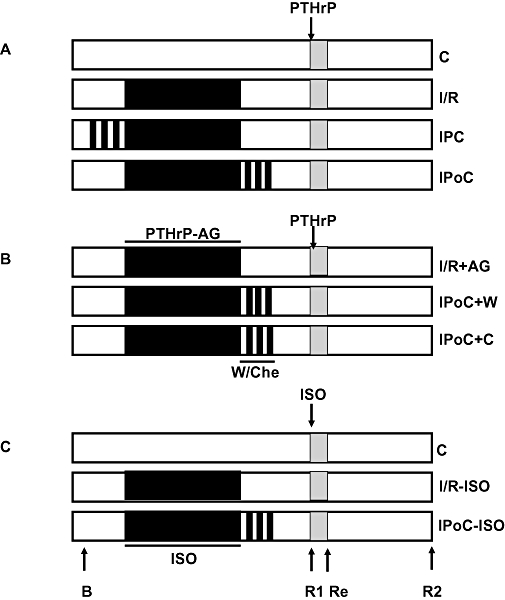
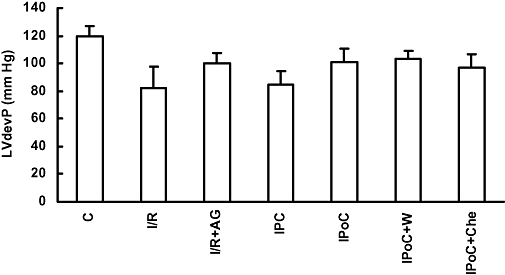
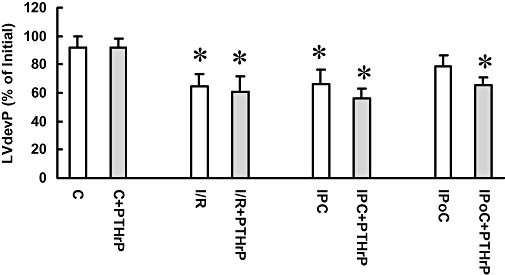
Experimental approach: Rat isolated hearts (Langendorff mode, constant flow) were exposed to 45 min flow arrest followed by 120 min reperfusion, including IPC or IPoC. Control hearts were perfused without a 45 min flow arrest. Left ventricular developed pressure (LVdevP) was determined. Thirty min after reperfusion, hearts were exposed to parathyroid hormone-related peptide (PTHrP) or isoprenaline for 10 min to monitor receptor responsiveness. Reperfusion injury was quantified by enzyme release.
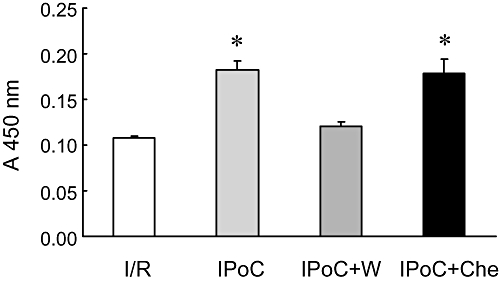
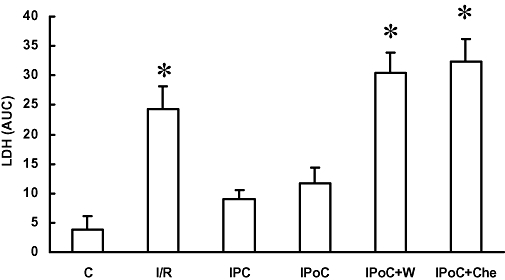
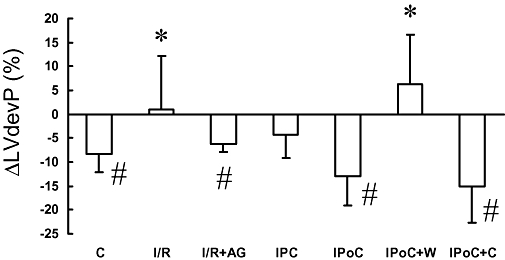
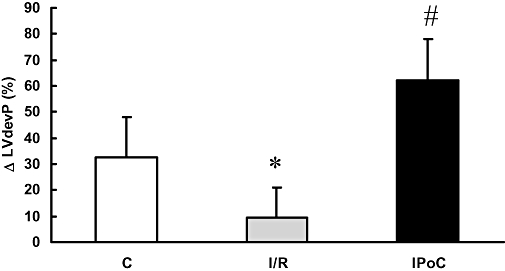
Key results: IPC and IPoC significantly reduced enzyme release compared with ischaemia and reperfusion alone by 75% and 62% respectively. Wortmannin or chelerythrine inhibiting either PI 3-kinase or protein kinase C, respectively, attenuated protection. Application of PTHrP 30 min after reperfusion did not change LVdevP in hearts exposed to ischaemia (+1 +/- 11%), but IPoC restored the normal and non-ischaemic response to PTHrP characterized by a negative inotropism (-8.3 +/- 3.9% and -12.9 +/- 6.1%). IPC restored a small negative inotropic effect (-4.4 +/- 4.7%). Application of a PTHrP receptor antagonist during the 45 min flow arrest attenuated receptor desensitization (DeltaLVdevP: -6.1 +/- 1.7%). Wortmannin but not chelerythrine attenuated the re-sensitizing effect of IPoC on post-ischaemic receptor coupling (DeltaLVdevP: +6.2 +/- 10.5 and -15.0 +/- 7.7%). As observed with PTHrP receptors, IPoC restored beta-adrenoceptors (DeltaLVdevP: +9.3 +/- 11.8% vs. 62.3 +/- 15.8%).
Conclusions and implications: IPoC restores PTHrP receptor coupling in a PI 3-kinase-dependent way. A similar mechanism may allow beta-adrenoceptor re-sensitization.
Figures
Comment in
-
Modulation of receptor sensitivity: possible therapeutic target?Br J Pharmacol. 2009 Mar;156(6):899-900. doi: 10.1111/j.1476-5381.2009.00115.x. Br J Pharmacol. 2009. PMID: 19366351 Free PMC article.
References
-
- Drake MT, Shenoy SK, Lefkowitz RJ. Trafficking of G protein-coupled receptors. Circ Res. 2006;99:570–582. - PubMed
-
- Garcia-Dorado D, Vinten-Johansen J, Piper HM. Bringing preconditioning and postconditioning into focus. Cardiovasc Res. 2006;70:167–169. - PubMed
-
- Grohé C, van Eickels M, Wenzel S, Meyer R, Degenhardt H, Doevendans PA, et al. Sex-specific differences in ventricular expression and function of parathyroid hormone-related peptide. Cardiovasc Res. 2004;61:307–316. - PubMed
-
- Hausenloy DJ, Yellon DM. Survival kinases in ischemic preconditioning and postconditioning. Cardiovasc Res. 2006;70:240–253. - PubMed
Publication types
MeSH terms
Substances
LinkOut - more resources
Full Text Sources
Research Materials
Miscellaneous
